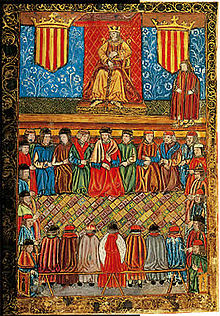
Cortes ( Spanish cortes - courtyards ) - in medieval Spain, regional estate-representative assemblies, since the XIX century - the parliament in Spain and Portugal . The first cortes were created in 1137 in Castile .
Initially, only nobles and clergy could participate in the Cortes. Only in 1188 did the townspeople get representations in Cortes.
They gained great importance again under the Cadiz Cortes, the movement of 1812 - the Spanish Revolution of 1811-1814 .
In 1814-1820 and from 1823 to 1834 they had to give way to absolutism ; in 1836 they edited the new constitution, in 1845 redone in a conservative spirit, and in 1856 again subjected to alteration by extraordinary Cortes.
After the Glorious Revolution of 1868, the constituent assembly of the Cortes constituted a commission to prepare the constitution, published on June 6, 1869. After the abdication of Amadeus, the Cortes proclaimed the republic, but did not have time to develop a project for its organization.
In modern Spain
In Portugal
In Portugal, the Cortes have long been involved in legislation. After gaining independence from Spain ( 1640 ), the Cortes gathered less frequently. Currently they consist of the House of Peers and the Chamber of Deputies (see Portugal ).
Literature
- Cortes // Brockhaus and Efron Encyclopedic Dictionary : in 86 volumes (82 volumes and 4 additional). - SPb. , 1890-1907.
- Muro y Martínez, "Constituciones de España y de las demás naciones de Europa, con la historia general de España" (Mad., 1881 );
- R. Fraoso, Las Constituciones de España (Revista de España, 1880 , 6 and 7);
- LP Coimbre, "Estudios sobre a Carta constitucional de 1826 e Acta addicional de 1852 , 1878-80";
- Coelho da Rocha, “Ensaio sobre a historia do governo e la legislationlação de Portugal”;
- J. d'Almeida de Cunha, "Código do processo electoral" ( 1878 ).