Sonya-polchok , or polchok [1] ( lat. Glis glis ) is a rodent of the family of sonevidae .
| Sonya Polchok | ||||||||||||||
|---|---|---|---|---|---|---|---|---|---|---|---|---|---|---|
 | ||||||||||||||
| Scientific classification | ||||||||||||||
| ||||||||||||||
| Latin name | ||||||||||||||
| Glis glis ( Linnaeus , 1766 ) |
Security status IUCN 3.1 Least Concern : 39316 |
Appearance
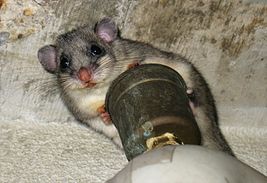
The largest of the dormouse: the body length of adults is 13-18 cm, weight - 150-180 g. Outwardly, the shelf looks like a tiny gray squirrel, but without tassels on rounded ears. Feet and palms bare, fairly wide, with moving tenacious fingers. Fingers that are able to retract perpendicular to the rest of the fingers are especially mobile on the I and V foot. The brushes are turned outward at an angle of almost 30 degrees - this allows the little regiment to move along thin branches. The tail is long - 10.9-15.4 cm, quite fluffy; gray above, whitish below.
The fur of the regiment is low, but lush and fluffy, since it consists mainly of down hair. The shelf is painted almost monotonously. Two colors predominate in its coloration: smoky gray or grayish-brown color of the back and light gray, yellowish or white color of the belly. Around the eyes there are usually thin dark rings, sometimes almost imperceptible.
Distribution
The shelf is widespread in the flat and mountain forests of Europe, the Caucasus and Transcaucasia , meeting from France and northern Spain to the Volga region , Turkey and northern Iran . Introduced in the UK , on the high Chiltern. It is found on the islands of the Mediterranean Sea: Sardinia , Corsica , Sicily , Crete and Corfu . Found in Turkmenistan near Ashgabat .
On the territory of Russia it is extremely uneven - its range is represented by isolated areas, the distance between which can be significant. Shelf can be found in the Kursk region and in the river basin. Volga : in the Volga-Kama region, in the Nizhny Novgorod region , Tatarstan , Chuvashia , Bashkiria ; on the left bank of the Volga is known only in the Samara region . In the north, its distribution is limited to the river. Okay . In the southern steppe regions of the European part of Russia, the regiment is absent and again occurs only within the lower zone and foothills of the Greater Caucasus Range . It is most common and numerous on the Isthmus of Caucasus and in Transcaucasia .
Lifestyle
A little more than other dormouse tied to broad-leaved and mixed forests, where the food supply is diverse. It prefers to inhabit dense forests with a noticeable admixture of wild fruit trees and berries. Often settles in orchards and vineyards or near them. In the mountains it rises to the border of deciduous forests - up to 2000 m above sea level. It inhabits areas of ripe forest with a predominance of oak , beech , hornbeam , linden, with a rich undergrowth of fruit shrubs - dogwood , hazel , honeysuckle , hawthorn . In the northeast of the Russian range, it lives in linden-oak forests with an admixture of maple , elm , aspen , hazel with blackberry and raspberry in the lower tier. Along the stony Volga shores lives in crevices of rocks.
Shelf leads a nocturnal arboreal lifestyle, almost not going down to earth. Like a squirrel , it is a fast, lively animal. Climbing trunks and thin branches perfectly; easily makes big (up to 7-10 m) jumps from tree to tree. He arranges nests in hollows of trees, much less often - in voids among stones or under fallen trunks. Inside builds a nest of moss, plant fibers, fluff. In places where artificial shelters for birds hang out, dormouse give them a clear preference, often arranging their nest on top of the bird and causing the death of egg and chick laying.
Nutrition
By the type of nutrition, the shelves are vegetarians whose diet consists of the vegetative parts of plants, seeds and fruits: acorns , hazelnuts , walnuts , chestnuts , beech nuts, various berries and fruits ( pears , apples , grapes , cherries , plums , mulberries). Bones are eaten out of fruits and grapes. Predation is not characteristic of them; invertebrates ( slugs , caterpillars, millipedes , bugs ) enter their stomach by chance along with plant foods.
Animals love ripe fruits and berries, therefore, during feeding, they first try the fruit and are not mature enough to be thrown to the ground. Unripe apples and pears scattered by sleepyheads often attract bears and wild boars . Half-eaten fruits are used for food and mouse-like rodents.
Life Cycle
Until the end of May-June, the dormouse is in hibernation. This animal awakens later than other sleepyheads. So, in the Caucasus, the regiments massively leave hibernation only in the second half of June, when the fruits of cherry plum and mulberry ripen in the forests and gardens. 10-12 days after the awakening of the males, when the females have time to enter estrus , the race begins. It proceeds noisily, accompanied by increased activity, fights between males. Marks that animals at this time leave on branches, stones and simply on the ground are so fragrant that even humans can sense them. Another sign of rutting is the sounds made by the animals at night, including grunts, grunts, sharp cries, often ending with a whistle; they can be repeated at different intervals throughout the night. Then you can hear the singing of the regiment, reminiscent of "ttsii-ttsii-ttsii"; it can last continuously up to 10 minutes.
After mating, the vapor breaks up. Pregnancy in a female lasts 20-25 days (according to other sources - 30-32 days); in a litter there are 1-10 (usually 4-6) cubs weighing 1-2 g. Newborns develop rather slowly. After 12 days, the ear canals open, at 13 days the first incisors are cut, and at 18-21 days the eyes open. Even before maturation, when the cubs reach the age of 15-16 days, the female begins to feed them from the mouth with chopped and softened food (leaves, berries, fruits). From day 25, the cubs try to feed on their own, and at the age of 5-6 weeks they leave the parental nest and begin to settle. Young regiments reach puberty the next year, and begin to breed only in the 2nd or even 3rd year of life. For the first time, breeding females mate later than the old ones; therefore, in the year, there are 2 breeding peaks at the end of June - in late June and early August.
The active period among the regiments is only 4-5 months a year. From September to November, the regiments begin to hibernate, with the adult males being the first to go into hibernation and, later than all, the year-old animals. At the end of summer, when daylight hours begin to decline, the regiments dig underground tunnels 90-180 cm long and 15-60 cm deep, where they go away during cooling. Some animals spend the winter in the haylofts, attics of houses, under the trunks of fallen trees, in root voids, in squirrel nests or even in empty hives. Often, several animals hibernate in one refuge - 4-8 each; usually females or young from the same brood. During hibernation, the metabolism in animals drops to 2% of the usual, however, being disturbed, they immediately wake up. In warm areas, animals sometimes interrupt their hibernation to feed themselves. During hibernation, as a rule, up to 2/3 of underyearlings die, who did not manage to accumulate enough fat reserves during the fall.
The regiment has few enemies, first of all it is owls. The limiting life span of half a year in nature is 4.5 years.
Conservation Status
The number of regiments varies greatly depending on the part of the range. They are very rare in the Baltic countries, but quite common in Western and Southern Europe . In the northern and northeastern parts of the range, the regiment lives mosaic, meeting in the upper Don and the middle reaches of the Volga . Moreover, it is very numerous in the Carpathians , the Caucasus , and Transcaucasia . Here, a shelf easily coexists next to a person, often inflicting tangible damage to orchards and especially vineyards. The animal begins to eat grapes long before it ripens, as soon as seeds are formed in the berry; apple trees , pears and other fruit trees also suffer from it.
The fur of the regiment is quite beautiful, it is procured in small quantities. The meat is edible; it was eaten in ancient Rome ; in some European languages, the dormouse is still called the “edible dormouse”. According to Pliny the Elder , Petronius , Martial, and the cookbook attributed to Apitius , the Romans fed the dormouse in terracotta pots, gliraria and served stuffed on the table [2] .
At home, snails are rarely kept, since these animals spend hibernation for about 7 months of the year, stay awake at dusk and at night and do not like to be watched. They fall into hibernation, even if they are kept in a warm room. In addition, the shelves in captivity do not become manual and can be bitten by careless handling.
Notes
- ↑ Sokolov V.E. The pagan dictionary of animal names. Mammals Latin, Russian, English, German, French. / edited by Acad. V. E. Sokolova. - M .: Rus. lang., 1984. - S. 190. - 10,000 copies.
- ↑ Stuffed Sonia in Ancient Roman // Arzamas.