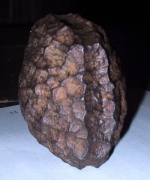
The Salzburg parallelepiped ( Salzburg Cube or Wolfsegg Iron ) is one of the “ paleo-artifacts ”. It is stored in the Heimathaus Museum in Vöcklabruck ( Austria ).
History
June 7, 1886 at a meeting of one of the sections of the natural history society of the Rhine region and Westphalia :
Dr. Gurlt presented the congregation with a strange iron meteorite, the so-called voice leader , which was in the tertiary brown angle. This meteorite is owned by the Carolina Augusta Museum in Salzburg and was gifted to it by the sons of Mr. Isidor Brown (Schöndorf, near Fecklabruck in Upper Austria). He was accidentally discovered by one worker on the “All Saints Day” (November 1), 1885, at the factory of the company (Brown), when, according to him, he chopped a piece of hard brown coal mined in Wolfzegg for burning. Golosiderit has an almost square section and looks like a cube , in which two opposite faces resembling pillows are strongly rounded, and the remaining four faces are narrowed due to this rounding and have a deep furrow along the entire length.
Without exception, all faces and furrows are covered with cups or regmaglips , so characteristic of meteorite iron, and a thin wrinkled oxide film. The maximum height of the voiceiderite is 67 mm, the maximum width is 62 mm and the maximum thickness is 47 mm, it weighs 785 grams, has a specific gravity of 7.7566, the hardness of steel and contains, in addition to chemically bonded carbon, an insignificant percentage of nickel, but quantitative analysis has not yet was carried out. On a small polished surface etched with nitric acid, Widmanstätten figures typical of meteorite iron are not found.
Dr. Gurlt did not doubt the meteoric nature of the mysterious formation, although he noted that its shape was too correct for a subject of natural origin. He tried to explain such correctness by the conditions of flight through the atmosphere, but his explanations were too rough. The high hardness and the absence of Widmannstetten figures, a pattern in the form of interwoven lines, were alarming supporters of the meteorite hypothesis. Some meteorites, for example, ataxites of these lines do not have, but ataxites contain a lot of nickel - up to 30%. This is clearly not consistent with the chemical composition of the find.
In 1919, Charles Fort , a well-known collector of obscure objects, first suggested the alien origin of the "parallelepiped." Morris K. Jesup adhered to the same point of view in the 1950s.
Modern research
In 1966-1967, the Museum of Natural History of Vienna conducted a quantitative analysis of the surface layers of the artifact by electron beam microanalysis. No traces of nickel , chromium or cobalt , as well as sulfur were found in the composition of the surface of the object, which caused the hypothesis of the meteorite origin of the object to be seriously shaken [1] , as well as the hypothesis of the object's relation to pyrites based on the absence of sulfur. Museum employee Dr. Gero Kurat ( German: Gero Kurat ) and Dr. Rudolf Grill ( Rudolf Grill ; Geologische Bundesanstalt - the state agency of geology) found that the item is most likely a counterbalance to the old mining winch and was smelted using lost-wax casting technology [1] .
There is a legend that the genuine “box” was lost in 1910 and replaced by a copy. In fact, a copy of the box is currently contained in it. Oberösterreichischen Landesmuseen in Linz (Austria), where it was exhibited from 1950 to 1958, and the original object is stored in the Heimathaus Museum in Vöcklabruck (Austria).