
Solar mass or mass of the Sun is an off-system unit of mass measurement used in astronomy to express the mass of stars and other astronomical objects (for example, galaxies ). It is denoted by M ☉ and is equal to the mass of the Sun :
- M ☉ = (1.98847 ± 0.00007) ⋅10 30 kg [1] [2] .
The solar mass is approximately 332,946 times the mass of the Earth [3] . About 99.86% of the mass of the solar system is contained in the sun ; the total mass of all the planets is only about 0.0013 M ☉ , and most of the total mass of the planets is in Jupiter (its mass is 1047.56 times less than the sun) [4] . Most of the individual stars in the Universe have a mass of 0.08 to 50 M ☉ , and the mass of black holes and entire galaxies can reach millions and billions of solar masses.
The solar mass can be calculated [5] according to the formula [6] following from Kepler’s third law :
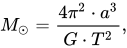
Where
- T - sidereal period of revolution of the planet around the Sun (for Earth T = 1 sidereal year ),
- a is the length of the semimajor axis of the planet’s orbit (for Earth a = 1 astronomical unit ),
- G - Newton's gravitational constant .
- a is the length of the semimajor axis of the planet’s orbit (for Earth a = 1 astronomical unit ),
See also
- Solar luminosity
- Solar radius
Notes
- ↑ 2014 Astronomical Constants http://asa.usno.navy.mil/static/files/2014/Astronomical_Constants_2014.pdf
- ↑ NIST CODATA http://physics.nist.gov/cgi-bin/cuu/Value?bg
- ↑ Astronomical constants 2015 // The Astronomical Almanac by US Naval Observatory
- ↑ http://astro-azbuka.info/astro/solar/jupiter ABC of Starry Sky
- ↑ Harwit, Martin (1998), Astrophysical concepts (3 ed.), Astronomy and astrophysics library, Springer, p. 72, 75, ISBN 0-387-94943-7 , < https://books.google.com/books?id=trAAgqWZVlkC&pg=PA72 >
- ↑ This formula is applicable for the case of an orbit close to circular, a small mass of the planet and neglect of relativistic effects.