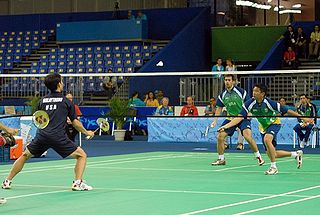
Badminton ( English badminton , from Badminton's own) is a sport in which players settle down on opposite sides of the area divided by a net and throw the shuttlecock over the net with racket strikes, aiming to “land” the shuttlecock on the enemy’s side and, conversely, so that it does not fall on own field. Two players or two pairs of players compete (couples can be not only of the same sex, but also mixed - a man and a woman). Included in the program of the Summer Olympic Games since 1992 .
Content
History
In the 19th century, English officers who served in India became fascinated with the ancient Indian game of puna , which can be considered a prototype of modern badminton. The British brought with them a passion for playing at home.
Modern tradition of the game originates in England, in the old manor Badminton House , the owner of which, a famous sports enthusiast and publisher of a series of books about sports, Charles Somerset, 8th Duke Beaufort , built the first badminton court in 1873 . In 1893, the badminton association of England published the first rules of the official rules of the game [1] .
The World Badminton Federation ( English Badminton World Federation (BWF) ) was established in 1934 . Since 1947, the largest men's team competition has been held - the Thomas Cup . Among women, the main team start - the Uber Cup has been held since 1955 .
Inventory
Racket
Originally, the rackets were made of wood. Modern racquets are made of various materials: from carbon fiber to aluminum , steel and titanium . Thanks to them, the projectile can withstand the tension of the strings and the impact load. Rackets for professional players, as a rule, are made of carbon-based composite materials and with the use of embedded structural elements from other materials. Rackets for fans and beginners can often be distinguished by the presence of a "tee" - a visually noticeable T-shaped knot at the junction of the rod and frame of the rim. On average, the mass of the racket is 70-100 grams. The main physical characteristics of the racquets that affect their playing properties, along with mass, also include the location of the center of gravity (the so-called “balance”), the stiffness of the rod and the bend rim, and the stiffness of the rod in torsion. Often, depending on these characteristics, some rackets are more often recommended to players with attacking and forceful play, while others are most likely to players who are more likely to defensive tactical schemes. In the model series of rackets intended for professional athletes, variations in the performance with a weight differing by several grams and with different arm thickness are possible inside one model. Most professional players use special winders on the racket handle - the so-called “grip”, designed to provide the best control over the grip of the racket.
Strings and their stretch
Originally, the strings were made from natural materials, now they are almost always synthetic. In sports badminton strings are used, which are an interlacing of synthetic microfibers and consisting of a core, a braid and a shell. For amateur racquets, the strings are tightened with a force of 80-110 N. For professional players, the tension force of the strings can reach 160 N. The diameter of the strings is in the range from 0.6 to 0.8 mm; about 10 meters of the string is required for stretching one racket. The process of stretching the rackets consists of two stages: first, the strings are passed through the holes in the rim and intertwined with each other, then they are successively taut. High-quality stretch, significantly affecting the gaming properties of the racket, is possible only on a special machine that provides a rigid fixation of the rim of the racket at several points, a precisely metered tension force and consistent fixation of the already tense strings with special clamps.
Shuttle
There are two types of shuttlecocks : plastic and feather (natural). Plastic shuttlecocks are recommended for lovers and for some types of training, where the main advantage of plastic flounces is durability. The flight characteristics of plastic shuttlecocks are different from those of feather shuttlecocks. The standard for competitions and training of professional athletes, as a rule, are feather shuttlecocks; Often a specific mark / series of feather shuttlecock is established in the regulations of a sporting event.
A plastic shuttlecock consists of a head (cork or synthetic) and a plastic “skirt” attached to it. The feather shuttlecock is made of 16 goose feathers and a cork head, covered with a fine husky leather. Feathers are glued into the holes around the head circumference, tied with thread, the thread is also glued. The weight of the shuttle shall be 4.74-5.50 g.
In production, shuttlecocks are sorted and graded according to the speed and trajectory of the flight, various groups receive different designations based on the results of sorting, which can be applied both on the package of shuttlecocks (tube of 3-6-12 pieces) and on the shuttlecock itself (for example, shuttlecocks can be labeled stickers on the inside of the head or a colored stripe along the rim of the head where it connects with feathers or a plastic skirt).
During one match of professional players, several feather shuttlecocks can be used: from 2-3 to a dozen or more at meetings of top-class athletes. Most of all shuttlecocks suffer from hitting the racket rim on them (such strokes are almost always the result of errors in technique and are characteristic of novice athletes). However, even with a flawless technique, the force of the shocks and the load on the shuttlecock are such that they can quickly cause a “razbaltyvanie” the junction of the feathers with the head or the breakdown of individual feathers, which immediately affects the flight path.
Playground
The game takes place on a rectangular pad measuring 13.4 by 5.18 meters. For a doubles game, a platform of 13.4 meters in size (11.88 when serving) is used for 6.10 meters. The height of the grid is 1.55 meters at the supports, 1,524 meters in the center (sagging); The grid is bounded above by a tape of 7.5-8 cm wide, folded in half, under which the cord is passed. Lines 4 cm wide are applied to the field with bright (white or yellow) paint and are an integral part of the field that they restrict (but, for example, do not apply while on the line). At a distance of 1.98 meters from the grid is the supply line. Between the feed line and the back line is the feed zone. The central line divides the feed zone into right and left zones.
Game
Feed, draw and errors
Submission is made from the right (even) or left (odd) supply area, depending on the account. According to modern rules (introduced in 2006 to improve the entertainment of matches) points are awarded in each draw, regardless of the filing accessory, the game is played up to 21 points; when the score is 20:20, the game continues to one side's superiority of 2 points, or up to 30 (the party with the first 30 points wins). In the doubles each team has one serve, as opposed to the old rules.
In a doubles game, the rules are somewhat more complicated. Only an athlete standing diagonally from the server must accept, but after hitting him (receiving the pitch) there is no strict order anymore - any player of the team, the one who is more comfortable, can beat the shuttle; if the serving team has won a point, the same player continues to serve, but already from another submission area, and the arrangement of the players of the receiving team does not change until they win a point on their serve!
According to the old rules, one point was awarded when the betting player won the draw. In the event that the serving player lost the rally, the serve went to the opponent and the score remained the same. Therefore, the game is often heavily delayed! In a doubles meeting, each team had 2 submissions, with the loss of both innings, the submission passed to the opponent. The submission was made from the appropriate submission field (even / odd) according to the number of points from the serving athlete, in the doubles match the first player (selected before the game started) served, as well as in a single game (the number of points is even - even field of submission), and the second the player submitted the opposite (the number of points is even - an odd field of supply). The game was played up to 15 points (11 for women). In the case of a tie score of 14–14 (10–10 for women), the party that first gained 14 (10) points chose whether the game will be up to 17 (13) or 15 (11) points.
The player is considered the winner of a separate draw in the following cases:
- Volan touched the ground (field) opponent.
- The rival sent a shuttlecock outside the playing field, touched the shuttle with its body or clothing.
- After hitting an opponent, the shuttlecock touched the ceiling or other objects in the vicinity of the site.
- The opponent during the rally touched the net with a body or a racket, transferred the racket or part of the body to the enemy’s side (however, the foul would not be counted if the initial contact of the racket with the shuttlecock was on the side of the striker and the racket was moved to another side by inertia).
- The rival couldn’t feed according to the rules (it is necessary to feed the diagonally placed field; do not step on the lines limiting the field of delivery; do not move and lift the legs off the ground; at the time of impact, the shuttle must be below the waist level and the racket rod must be sent down, if the server did not hit by shuttlecock - this is also a foul).
Modern Badminton
The speed of the shuttle after the impact of a professional athlete reaches 493 km / h, which is an absolute record for the speed of flight of the projectile.
For one game, the player runs about one and a half kilometers and makes up to 400 hits on the shuttlecock, and the match consists of two or three games. The record for the duration of one point is 108 beats for two, the draw lasted almost 2 minutes (Nguyen TM vs. JO Jorgensen at the 2013 World Championship).
To master the entire technical arsenal, professional athletes spend up to 10 years of intensive training.
Currently, Asian athletes ( China , Republic of Korea , Indonesia ) dominate the planet, winning up to 90% of medals at world championships. So, for example, according to the World Badminton Federation , Taiwanese badminton player Dai Ziying is recognized as the best female badminton player [2] . Following Asian countries are European countries: Denmark , Great Britain , Russia , Germany , the Netherlands , etc.
In the international arena, Russian badminton declared itself relatively recently, this is due to the rather late entry of our country into the world badminton community, and also to the fact that until 1992 the sport was not Olympic. The first serious achievements are associated with the name of the outstanding player Andrei Antropov , who became the champion of the USSR and Russia about 50 times. On the international arena, he won a number of titles at the European and World Cup stages, silver and bronze at the European Championships, bronze at the World Cup final, and 5th place at the Olympic Games.
More systematic successes have come to the Russian team recently. The 2009/2010 season was the best in all over 50 years of badminton development in the country. The Russians brilliantly performed at the personal European Championship 2009, winning the gold ( Nina Vislova / Valeria Sorokina ), silver ( Anastasia Russky paired with Petya Nedelcheva from Bulgaria ) and the bronze ( Ella Dil ) medal. We reached the finals of the European Championship and the quarterfinals of the World Championship among teams of girls. Immediately four athletes entered the top ten in the world ranking.
At the 2012 London Olympics, for the first time in history, the Russian badminton tournament won the women's doubles medal in the Olympic tournament . Valeria Sorokina and Nina Vislova won the bronze medal, beating the Canadian couple Alex Bruce and Michel Lee in the match for 3rd place on August 4. [3]
Speed Record
A record of the speed of a shuttlecock in men was made in “laboratory conditions”, and not in a real game, using the YONEX NANORAY Z-SPEED racket in August 2013, it was 493 km / h. [4] This speed is at the initial moment of flight, then it, of course, falls rapidly.
Forbidden Twist Feed
In the early 1980s, the Sidek-Spin twist revolutionized badminton. The principle of this submission - a sliding blow to the feathers of the shuttlecock gave it an unpredictable flight trajectory. Malaysian Misbun Sidek, thanks to the pitch he invented, was among the ten strongest players in the world. But soon the shortcomings of such a technique appeared. Flounces quickly fell into disrepair. Badminton lost the spectacle, since the draws after such a filing were reduced to 2-3 hits. The International Badminton Federation has banned the use of "Side-spin".
International Tournaments
Divided into several categories, differing in the number of accrued for the performance of rating points, prize money and prestige.
Table 1. Rating points depending on the category of the tournament [5]
| World Badminton Federation events | World Super Series Tournament | Grand Prix World Series Golden Tournament | World Cup | Stages of the European Cup - Challengers | Stages of the European Cup | Stages of the European Cup - futures | |
|---|---|---|---|---|---|---|---|
| Winner (1) | 12,000 | 9200 | 7,000 | 5000 | 4,000 | 2500 | 1700 |
| Silver medalist (2) | 10200 | 7800 | 5950 | 4250 | 3400 | 2130 | 1420 |
| Semifinalists (3,4) | 8400 | 6420 | 4900 | 3500 | 2800 | 1750 | 1170 |
| Quarter-finalists (5/8) | 6600 | 5040 | 3850 | 2750 | 2200 | 1370 | 920 |
| 9/16 | 4800 | 3600 | 2720 | 1920 | 1520 | 920 | 600 |
| 17/32 | 3000 | 2220 | 1670 | 1170 | 920 | 550 | 350 |
| 33/64 | 1200 | 880 | 660 | 460 | 360 | 210 | 130 |
| 65/128 | 600 | 430 | 320 | 220 | 170 | 100 | 60 |
| 129/256 | 240 | 170 | 130 | 90 | 70 | 40 | 20 |
| 257/512 | 120 | 80 | 60 | 40 | thirty | 20 | ten |
| 513/1024 | 60 | 40 | thirty | 25 | 20 | ten | five |
Table 2. Prize funds of international badminton competitions
| Competition Category | World Badminton Federation events | World Super Series Tournament | Grand Prix World Series Golden Tournament | World Cup | Stages of the European Cup - Challengers | Stages of the European Cup | Stages of the European Cup - futures |
|---|---|---|---|---|---|---|---|
| Prize fund | - | not less than $ 200,000 | not less than $ 120,000 | not less than $ 50,000 | not less than $ 15,000 | not less than $ 5000 | from $ 0 |
In accordance with the rules of the World Badminton Federation (BWF) and the European Badminton Federation (Badminton Europe) in one country are allowed to hold no more than one stage of the World Cup and no more than one stage of the European Cup. In Russia, this is the World Series Grand Prix tournament "Russian Open" ( 2007 (Golden Series), 2008 - Moscow, 2009, 2010, 2011 - Vladivostok) [6] and the European Cup (Challenger) White Nights [7] ( Gatchina , since 2007).
Notes
- Б Badminton history (inaccessible link) . The appeal date is April 5, 2008. Archived March 11, 2008.
- ↑ Taiwanese badminton player Dai Zi Ting ranked first in the world ranking (Rus.) , Taiwan • News (December 2, 2016). The appeal date is December 2, 2016.
- ↑ Russian badminton players for the first time in history won the Olympic award . RosBusinessConsulting (August 4, 2012). Circulation date August 4, 2012. Archived August 17, 2012.
- ↑ Record of initial speed of flight of the shuttlecock 493 km / h
- ↑ Badminton World Federation Archived September 29, 2007.
- ↑ Results of the "Russian Open" for 2007-2011.
- ↑ Russian International Badminton Tournament “White Nights” 2008 Archived July 4, 2008.