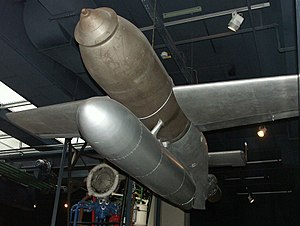
Henschel Hs 293 - German guided aerial bomb ( German: Gleitbombe - gliding bomb), created and designed for use on large naval targets . It is equipped with bearing surfaces, tail unit and jet accelerator . He is the ancestor of modern guided aircraft bombs (UAB) and at the same time the ancestor of anti-ship missiles (RCC).
UAB Hs 293 was designed and manufactured by Henschel Flugzeug-Werke AG in Berlin - Berlin-Schönefeld .
Content
History
Work on the creation of the Hs 293 began in 1939 in Germany , in the city of Schönefeld near Berlin , at the Henschel aircraft plant by specialists under the guidance of Professor Herbert Wagner . Intended to destroy sea targets (ships).
The main idea was that the bomb could be dropped by a bomber from a height of 1300-1400 m at a distance of about 8 km from the target, when the aircraft was out of reach of anti-aircraft fire of air defense systems. After the reset, the rocket accelerator accelerated the bomb to a speed of 190 km / h in 10 seconds of operation. Then the planning stage began towards the target, using radio command control . Hs 293 was aimed at the target from the airplane by the navigator-operator using the "Knüppel" handle on the control panel of the FuG-203 Kehl III transmitter. To prevent the navigator from visually losing sight of the bomb, a cylindrical block of signal tracers was installed in its rear part, the burning time of which was 100-110 s.
The first prototype Hs 293V-1 did not go beyond the drawings, but already in February 1940, the Hs 293V-2 model (the so-called model FZ21) was created. In July of that year, tests of the third prototype began, and in 1941 the pre-production model Hs 293A-0 went into production. Since January 1942, the Hs 93A-1 modification was launched into mass production; it began to enter the arsenal of the Luftwaffe units in 1943.
In April 1943, the formation of the first combat missile-carrying unit, II / KG100, began at the Graz airbase . Instead of the He 111H, the unit received Do 217E-5 bombers , which could accommodate two Hs 293A-1 bombs. The development of the application methods of Hs 293 was entrusted to the 36th training and test command, formed on the basis of the 13th KG100 squadron in July 1943.
Design
The Hs 293 is based on the standard SC 500 high-explosive bomb with a thin-walled steel body and an explosive charge of increased (60%) filling. The warhead of this 500 kg bomb is equipped with Trialen 105 explosive (15% RDX, 70% TNT, 15% powdered aluminum) weighing 294 kg [1] .
Structurally, Hs 293 consists of six assembly elements [2] :
- the actual SC 500 bomb, which forms the front of the hull and simultaneously the warhead;
- outboard rocket accelerator;
- wing consoles with a span of 3.1 m, in the middle of the bomb;
- horizontal tail unit ;
- tail section with instrument compartment;
- block tracers .
The Walter HWK 109-507 rocket launcher developed a thrust of 600 kg for 10 seconds. The purpose of the accelerator was not to provide its own thrust of the planning bomb, but to reduce the stage of its separation from the carrier aircraft and, accordingly, to get into the field of view of the navigator-operator as soon as possible. When discharged from a height of 1400 m, the planning range of Hs 293 was about 12 km. When a bomb was dropped, the warhead fuse was automatically transferred to the combat position.
A special sleeve inside the wing of the aircraft brought warm air to the bomb, while maintaining a constant temperature inside it, necessary for the normal operation of all devices. A block of tracers was installed on the tail end so that the navigator would not lose sight of the bomb. Considering that the approach of the planning bomb to the horizontal surfaces of the sea target ( deck ) occurs at ricochet angles, an anti- ricochet ring is installed in the head of the bomb [3] (see photo).
In the tail section is the plumage and radio equipment [2] . An 18-channel Strassburg receiver (FuG-230b) is installed in the instrument compartment, which demodulates signals and generates control commands for elevator and ailerons Hs 293 Kehl-Strassburg radio command lines in the frequency range 48.2 - 49.9 MHz.
The control of the bomb along two axes - the ailerons and elevator was based on the principle of proportional guidance in the polar coordinate system. The bomb had no rudder. To ensure constant balancing of the bomb in the elevator control channel, the speed indications determined by the air pressure receiver (LDPE) are used. To minimize rotational motion relative to the longitudinal axis, a gyroscopic device was additionally included in the aileron control channel, which made it possible to stabilize the bomb.
Due to the potential for radio suppression, an alternative to the Hs 239B with wired control has also been developed. Coils with a wire were mounted on the wingtips of the bomb and the carrier aircraft. The total length of the wire line was 30 km. Information on the combat use of the Hs 293B is not available.
At the end of 1944, a modification of the Hs 293D was developed, equipped with a Tonne compact television camera using the FB (Fernsehbild-Steuerung) principle of guidance, but it did not come to the mass production of a telecontrol bomb [4] .
Combat use
On July 31, 1943, the first Luftwaffe combat air group, equipped with the Hs 293 - II./ KG100 , was transferred to the airport in the city of Cognac off the coast of the Bay of Biscay .
On August 25, 1943 , in the first combat flight of 12 Do-217E-5 bombers of group II./KG100, they successfully attacked the 40th escort group, carrying out anti-submarine patrols in the area of Cape Finisterre . Four Hs 293 damaged the Landguard sloop , exploding in the immediate vicinity. Another bomb hit the sloop "Bidford" (HMS Bideford); 1 sailor died, while the sloop did not receive serious damage due to incomplete detonation of the charge.
Two days later, on August 27, English ships were attacked by 13 Do-217 missile carriers from Air Group II./KG100 in the Bay of Biscay, west of Vigo . One of the Hs 293 got into the aft artillery cellar of the flagship of the 1st support group - the British sloop Egret . The sloop exploded and sank very quickly, killing 122 sailors out of 188 crew members. The Canadian destroyer Atabascan (HMCS Athabaskan) was also severely damaged.
Because of these losses, the Allies were forced to withdraw anti-submarine ships 400 km to the west, which greatly facilitated the actions of German submarines, whose bases were located on the coast of the Bay of Biscay.
Subsequently, the guided bomb Hs 293 was successfully used against the Allied ships in the Atlantic and the Mediterranean theater of operations. Although the bomb was originally designed as anti-ship, it was also used to attack bridges during the Allied landings in Normandy.
| Application Data Hs 293 | |||||||
| date | Class | Ship name | Displacement, tons Tonnage, gross tons (for transport ships) | Area | Result | Note | |
|---|---|---|---|---|---|---|---|
| August 25, 1943 | Sloop | Bideford | 1105 | Bay of Biscay | Is damaged | Hit, 1 sailor died the charge did not detonate | |
| August 25, 1943 | Sloop | "Landguard" | 1980 | Bay of Biscay | Light damage | ||
| August 27, 1943 | Sloop | "Egret" | 1220 | west of vigo | Sunk | Direct hit | |
| August 27, 1943 | Destroyer | "Athabaskan" | 1870 | west of vigo | Severe damage | ||
| September 13, 1943 | Destroyer | Loyal | 1920 | at Salerno | Is damaged | ||
| September 13, 1943 | Hospital ship | "Newfoundland" | 6791 | at Salerno | Sunk | ||
| September 15, 1943 | Transport | Bushrod Washington | 7191 | at Salerno | Sunk | Operation Avalanche | |
| September 16, 1943 | Battleship | " Warspite " | 31520 | at Salerno | Is damaged | ||
| September 30, 1943 | Tank landing ship | LST 79 | 2750 | Ajaccio | Sunk | ||
| September 30, 1943 | Tank landing boat | LCT 2231 | 311 | Ajaccio | Sunk | ||
| October 04, 1943 | Transport | "Samite" | 7219 | northeast of Algeria | Is damaged | ||
| November 11, 1943 | Destroyer | "Rockwood" | 1025 | Aegean Sea | Light damage | later written off | |
| November 13, 1943 | Destroyer | "Dulverton" | 1025 | Aegean Sea | Badly damaged | After the evacuation of the crew flooded with torpedoes | |
| November 21, 1943 | Transport | "Marsa" | 4404 | southwest of ireland | Sunk | ||
| November 21, 1943 | Transport | "Delius" | 6055 | southwest of ireland | Is damaged | ||
| November 26, 1943 | Military transport | "Rohna" | 8602 | north of Bougie | Sunk | 1138 soldiers died | |
| January 23, 1944 | Destroyer | "Jervis" | 1690 | Antzio | Is damaged | ||
| January 24, 1944 | Hospital ship | "St. David » | 2702 | Antzio | Sunk | ||
| January 24, 1944 | Hospital ship | "St. Andrew » | 2702 | Antzio | Is damaged | ||
| January 24, 1944 | Hospital ship | Leinster | 4303 | Antzio | Is damaged | ||
| January 26, 1944 | Minesweeper | "Prevail" | 810 | Antzio | Is damaged | ||
| January 29, 1944 | Transport | Samuel Huntington | 7181 | Antzio | Sunk | ||
| January 29, 1944 | Light cruiser | " Spartan " | 5770 | Anzio | Sunk | ||
| February 15, 1944 | Destroyer | "Herbert C. Jones" | 1250 | Antzio | Is damaged | ||
| February 16, 1944 | Transport | Elihu Yale | 7176 | Antzio | Sunk | ||
| February 16, 1944 | Tank landing boat | LCT 35 | 283 | Antzio | Sunk | ||
| February 25, 1944 | Destroyer | Inglefield | 1530 | Antzio | Sunk | ||
| June 08, 1944 | Frigate | Lawford | 1140 | off the coast of Normandy | Sunk | ||
| June 09, 1944 | Destroyer | "Meredith" | 1140 | off the coast of Normandy | Sunk | ||
| August 15, 1944 | Tank landing ship | LST 282 | 2366 | off the coast of southern France | Sunk | ||
| August 15, 1944 | Tank landing ship | LST 312 | 2366 | off the coast of southern France | Sunk | ||
| August 15, 1944 | Tank landing ship | LST 384 | 2366 | off the coast of southern France | Is damaged | ||
Countermeasures
On September 27, 1943, the Allies captured Foggia , where the main German air base at the Mediterranean theater of operations was located. There they managed to capture a large number of FX-1400 and Hs 293, which were still in special packing crates. The capture of weapons samples and their control systems allowed the Allies to create quite effective countermeasures, in the form of active radio jamming stations emitting radio signals at the same frequency as the radio links of German missile control systems and planning air bombs.
Ship captains were advised to quickly maneuver and use smoke screens, as well as destroy these bombs in flight with small-caliber anti-aircraft artillery, to avoid being hit by guided bombs.
Other countermeasures consisted in increasing the effective range of naval anti-aircraft artillery, for which the barrels of the 127-mm universal guns were replaced by longer ones, as well as covering the ships with their own fighters that attacked German carrier bombs [5] .
Further Development
In the years 1944-1945, Japan, based on German experience, developed a similar radio-controlled bomb Kawasaki Ki-147 I-Go . The bomb was tested in the last months of the war from the Mitsubishi Ki-67 Hiryu , but due to the destruction of the Japanese economy and low technical level, the Japanese failed to organize mass production of guided weapons.
See also
- FX-1400 (Fritz-X, radio controlled bomb )
- Ruhrstahl X-4
- V-1
- McDonnell LBD Gargoyle
- ASM-N-2 Bat
- Kawasaki Ki-147 I-Go
- UB-2000F "The Seagull"
- Weapon of retaliation
Literature
- Shirokorad A. B. The Fiery Sword of the Russian Navy. - Moscow: Yauza, Eksmo, 2004 .-- S. 22-26. - 416 p. - (Top secret). - ISBN 5-87849-155-9 .
- Zefirov M.V. Guided Luftwaffe bombs // Luftwaffe Assy: Bomber Aviation. - M.,: "Publishing house AST", 2002. - S. 48-62. - 478 p. - ISBN 5-17-009972-X .
Notes
- ↑ The Dawn of the Smart Bomb on ausairpower.net
- ↑ 1 2 HS.293, Radio controlled glider bomb. Catalog of Enemy Ordnance Material, Part 2, Page 315. The Office of the Chief of Ordnance, Washington DC, 1945
- ↑ US Army Technical Manual #TM 9-1985-2, German Explosive Ordnance . ibiblio.org/hyperwar. Date of treatment August 1, 2013.
- ↑ Asy of the Luftwaffe, 2002 , p. 62.
- ↑ Anti-ship aircraft guided weapons in naval operations during World War II | Nikkuro Blog | Comt
Links
Russian-speaking
- Hs 293 . Corner of the sky. Aviation Encyclopedia (2004). Date of treatment November 11, 2009. Archived March 30, 2012.
- The use of German guided bombs . Corner of the sky. Aviation Encyclopedia (2007). Date of treatment November 11, 2009. Archived March 30, 2012.
- M.Zefirov. Asa Luftwaffe. Bomber aircraft. - AST , 2003 .-- 477 p. - (Military Historical Library). - 7000 copies. - ISBN 5-17-019104-9 .
Foreign Languages
- The Dawn of the Smart Bomb . Air Power Australia (2006). Date of treatment November 11, 2009. Archived March 30, 2012.