“Lubyanka” is the station of the Sokolnicheskaya line of the Moscow metro . It is located under Lubyanka Square between the Chistye Prudy and Okhotny Ryad stations. Located in the Tver , Meshchansky , Basmanny and Krasnoselsky districts of the Central Administrative District of Moscow .
| Lubyanka | |
|---|---|
 Sokolniki line | |
| Moscow subway | |
 | |
| Area | Tver , Meshchansky , Basmanny , Krasnoselsky |
| County | TsAO |
| opening date | May 15, 1935 |
| Design name | Dzerzhinsky Square |
| Former names | Dzerzhinskaya (until November 5, 1990 ) |
| Type of | Pylonic three-vaulted deep vault |
| Depth, m | 32,5 |
| Number of platforms | one |
| Platform type | island |
| Platform shape | straight |
| Architects | N. A. Ladovsky ; reconstruction: N. A. Alyoshin , A. F. Strelkov [1] |
| Lobby Architects | D.F. Fridman , I.I. Loveyko (south lobby) [1] |
| Design engineers | A. F. Denishchenko |
| The station was built | Mine No. 13-14 Mosmetrostroy (managers A. Baryshnikov, K. Kuznetsov); reconstruction of 1973-1975 - SMU-5 Mosmetrostroy (supervisor N. Fedorov) |
| Transitions at the station |  Kuznetsk Bridge Kuznetsk Bridge |
| Exit to the streets | Lubyanka Square , Nikolskaya Street , Theater Pass and New Square |
| Ground transportation | A : m2, m3, m5, m7, m8, m9, m10, m27 , 38, 101, 122, 144, 158, 904, K; H1, H2, H3, H6 ; Eb : t25 |
| Mode of operation | 5: 30-1: 00 |
| Station code | 009 |
| Nearby Stations | and |
 | Object of cultural heritage, Object No. 7737149000 |
The station was opened May 15, 1935 as part of the first metro section. The station got its current name along Lubyanka Square, under which it is located (the original name is “Dzerzhinskaya”). It has a transition to the Kuznetsky Most station of the Tagansko-Krasnopresnenskaya line .
History and origin of the name
Start of construction
The Soviet government in the 1920s decided to revive the metro project in Moscow, proposed in the last years of the existence of the Russian Empire [2] . The compilation of the new project was entrusted to the Moscow City Railways Department [2] . Specialists of this department developed a project in 1925-1930, providing for four diametrical and one ring lines with a total length of about 50 km [2] . In June 1931, at the plenum of the Central Committee of the All-Union Communist Party of Bolsheviks , the final decision was made on the construction of the Moscow Metro [3] .
In August 1931, the organizational bureau of the new institution, Metrostroy , was created, and on September 23 Metrostroy itself was officially established [4] . In his technical department, the design of the subway began according to the concept of the Moscow City Railway [5] . The line from Sokolniki through Kalanchevskaya Square to Krymskaya Square with a branch to Smolenskaya Square was identified as a priority line [5] .
After the June plenary session, the design of the first stage of the metro began [6] . At the end of 1931, a shallow line was proposed from Gavrikova Street to the Palace of Soviets . Already in this project, the station “Dzerzhinsky Square” is mentioned. Preparatory work and the construction of first stage plots were started in the spring of 1932. In April 1932, additional exploratory drilling began along the first stage. Decree of the Council of People's Commissars of the USSR No. 806 of May 25, 1932, it was decided to build a site from Sokolniki to Theater Square on a deep foundation. Subsequently, and on the site from Sokolniki to Kalanchevskaya Square, due to the complexity of the penetration, it was necessary to return to shallow laying [6] .
The construction of the Dzerzhinskaya station began in December 1933 [7] . Construction was carried out through two shafts No. 13 and 14, which were located along the right station tunnel. Mine No. 13, passed at the southeastern end of the station, was liquidated in November 1934 during the redevelopment of the streets. Mine No. 14 at the northern end of the square is preserved as a permanent ventilation [7] .
Hydrogeological issues
The construction was carried out in difficult hydrogeological conditions. Directly under the bridge was a three-meter sandy cultural layer , below it a three-meter layer of moraine clays, then up to a mark of –12 m - quicksand [8] . Below the quicksand lay a seven-meter layer of black Jurassic clays , which tended to swell upon contact with air, even lower - a thin layer of aquifer gravel and unstable carbon fiber clays flooded by Neglinnaya water [8] . The station tunnels had to pass through Jurassic clays, relying on the carbon layer [8] . A layer of aquifer gravel was not identified during the survey: it was already stumbled upon during construction. Unplanned opening of the aquifer additionally flooded the layer of carbonaceous clays, complicating the construction [8] . Due to the action of water and air, the clay layers surrounding the tunnels softened and “almost lost their importance as supports” - excavation arches began to subside, threatening to completely overwhelm the station [8] . In March 1934, the station became an emergency site; it was necessary to urgently strengthen the workings with concrete and steel structures [8] . It turned out that Lubyanka clays retain their natural mechanical properties for about five days, and then sharply lose their strength [8] . Therefore, the builders changed the technique of sinking: after passing two meters of excavation, it was necessary to immediately stop further sinking and urgently concreted the passed segment [8] .
According to the initial design, the station was planned as a three-vault pylon, but adverse conditions forced the builders to abandon this plan. At the "emergency" meeting on March 27, 1934, builders announced that it was impossible to build a three-vault station on Lubyanka Square [8] . Opinions were divided: some suggested going around Lubyanka Square, others didn’t build a station under the square, others suggested building a two-vault station [8] . L. M. Kaganovich demanded that construction continue at the selected location [8] , and then a decision was made to build a two-vault station without an extended central hall, [7] at a mark three meters below the originally selected [8] .
Exploitation and renaming
The station was opened on May 15, 1935 under the name "Dzerzhinskaya" as part of the first launch site of the Moscow Metro of 13 stations - Sokolniki - Park Kultury with the branch " Okhotny Ryad " - " Smolenskaya ".
In the 1970s, the central section of the Tagansko-Krasnopresnenskaya line was built . Its intersection with the Kirov-Frunze line was planned under Dzerzhinsky Square. To ensure a change to a new line, it was decided to reconstruct Dzerzhinskaya with the completion of a full-fledged central hall. In 1968, the second exit from the station from the eastern end was built [7] . Then the construction of the central hall began. The transition to the Kuznetsk Bridge was opened in 1975 [1] .
The station is named after Lubyanka Square, which is accessed. The name of the square goes back to the name of the ancient tract Lubyanka (first mentioned in the document from 1716). At the end of the 15th century, migrants from Novgorod settled in this part of Moscow, whose independence was crushed by Ivan III in 1470-1480. They were named in memory of the ancient Novgorod street Lubyanitsa . The same was probably also named after the natural boundary (the term bast - subcortex, inner bark, especially linden - was previously widely used on the farm, and it is likely that the natural boundary got its name). In 1926-1990, the square was called Dzerzhinsky Square - in honor of the revolutionary , Soviet statesman, founder of the Cheka, Felix Edmundovich Dzerzhinsky ( 1877 - 1926 ). On November 5, 1990 , the station was renamed and received its current name [1] .
On October 14, 2008 , the south lobby was closed for escalator repairs [9] . It was originally planned to open it on December 26 of that year. The lobby reopened on May 15, 2014 [10] .
Architecture and Design
|
The architectural solution of the station under construction was entrusted to the Fifth planning workshop of N. A. Ladovsky with the support of the Fifth design workshop of D.F. Fridman . So, despite the victory of Stalinist architecture that has already taken place, the modernist architects and personally rationalist Ladovsky, have been given the opportunity to realize their ideas in the subway. "Dzerzhinsky Square" and the ground lobby of the " Red Gate " became the "swan song" of the school of rationalism [11] .
Lobby
The station has two underground vestibules, connected by stairs and arched pedestrian corridors with exits along the perimeter of Lubyanka Square (from 1926 to 1990 - Dzerzhinsky Square) [12] . There are ticket offices, turnstiles and escalator tunnels leading to the station hall [13] .
The western lobby opened with the station in 1935. The escalator tunnel coming from the underground entrance, which was built on the site of the dismantled foundation of the Vladimir Gate of the Kitaygorod wall , initially had three H-series escalators, but in 1997 they were replaced with new ET-3M cars. Lifting height - 21.8 meters, tilt length - 43.6. The exits of the western lobby are built into the reconstructed pre-revolutionary building [14] (modern address: Nikolskaya St. 12/1/2, Building 1), adjacent to the former Kalyazinsky Compound (Maly Cherkassky Lane 1/3 Building 1). Before the demolition of the Kitay- Gorod wall (1927-1934), the building was separated from the square by the Vladimir Gate of Kitay- Gorod. The first draft of the lobby, compiled by Ladovsky, suggested that the lobby should be the pedestal of the monument to F.E. Dzerzhinsky . According to N. Ya. Collie , “ Lazar Moiseevich subjected this project to harsh criticism, which taught us a lot, because the criticism was deeply substantiated and principled” [15] . Ladovsky handed over the design of the ground lobby to I. I. Loveyko from the workshop of Friedman, who designed the new facade of the old building. The double entrance and exit portals of the metro became “a kind of“ double “version of the ground lobby of the Krasnye Vorota station” according to the design of Ladovsky [16] . The shape of the portals assumed the highlighting of arches with reflected light [15] . The resulting large bulky building [12] was criticized by contemporaries. Leo Kassil wrote that “the station above the ground is a bit gloomy, - a high dull gray wall with bas-reliefs and two semicircular doors below <...> either a dam, or a power plant, or a reinforced concrete cooling tower , if any” [17] . In 1957, with the construction of the " Children's World ", an underground passage was constructed from the front entrance with access to the department store.
The eastern lobby was opened in 1968, as the first stage of the reconstruction of the station under the future interchange hub. Given the historic building, two escalator inclinations were made for compactness. The small slope (height - 7 meters, length - 14) initially consisted of three escalators of the LP-6I series, in 1995 they were replaced by ET-5M. A large slope is located parallel to the axis of the platform, on the south side and a 180-degree turn. Aisles between escalators are connected by two aisles. The large slope (height - 21.4 m, length - 42.8 m) retained the three original LT-4 escalators.
A small cash room is located at the beginning of Myasnitskaya Street , on Lubyanka Square. It is connected to a long passage, which repeats the southeast perimeter of Lubyanka Square, with eight exits to the street. Two exits are located on the corner of the FSB building (Lubyanka Square and official drive to Furkasovsky Lane ); two at the corner of the FSB Computing Center ( Lubyansky proezd and Myasnitskaya street); two more go to the park in front of the Polytechnic Museum , on each side of the Solovetsky Stone memorial (Lubyansky passage and New Square, respectively). Finally, the last two exits are located directly next to the ground portals of the west lobby.
During the construction of the underground passage, a passage was also made into the underground entrance hall of the western entrance hall, which allows underground passage from the Detsky Mir to the FSB building, as well as from one underground entrance hall to the other without leaving the surface.
Station Halls
At the opening, the station did not have a central hall and consisted of two parallel apron tunnels, united only by a small hall when leaving the escalator [14] . The station’s architectural design was designed by Ladovsky, advised by N. Ya. Collie [15] . “Dzerzhinsky Square” (as it was called in the project) was one of the most complex design stations - both because of the close two-hall structure with massive supports and because of the slight curvature of the tunnels themselves [15] .
Unlike other architects of the first stage of the metro, who created light, airy interiors in order to avoid the “underground feeling” [18] , Ladovsky did not mask, but intentionally emphasized and creatively processed the “tunnel character” given by the engineering form [14] . To hide the curvature of the paths and tunnels, he decorated the cylindrical surface of the tunnel, lined with Ufalean marble [15] , a complex series of transverse rings (analogues of supporting arches [15] ), which created a special dynamics of space in Dzerzhinsky Square [14] . Other architects avoided the underground black, and Ladovsky, on the contrary, used contrasting black stone in the decoration of the columns [14] . According to the lighting project, the platform was supposed to be flooded with bright light, and the paths and the wall behind them were illuminated relatively dimly [15] . Ladovsky also planned to use dynamic “light guides” - red “for landing” and blue “for exit”, but this part of the project was not implemented [14] . The walls of the entrance hall between escalators and apron tunnels were decorated with gray Ufalean marble, the ceilings were white [15] .
Almost all of the original decoration of the station was lost during the reconstruction of the 1970s - only fragments of the marble lining of the tunnels remained from Ladovsky’s work [14] . In 1973-1975, the station was completely rebuilt and received a central hall, from which the passage to the Kuznetsky Most station of the Tagansko-Krasnopresnenskaya line was built . Underground passages were also built with exits to Lubyanka Square , to the Polytechnic Museum , Detsky Mir and Myasnitskaya Street [1] .
The design of the reconstructed station is a three - vaulted pylon of deep laying (laying depth - 32.5 meters). The pylons are finished with white marble “koelga” [19] . The floor is laid out in black and red granite (before the reconstruction, the coating was asphalt ). The track walls are lined with white porcelain tiles [1] . In the southwestern end of the Lubyanka, a fragment of the initial decoration of the station has been preserved. A marble bust of F.E. Dzerzhinsky is installed in the escalator hall (after renaming the station, he was moved to the People’s Metro Museum ). The station, having gained a central hall, became a model station of the 1970s [14] .
Transition to Kuznetsky Most Station
Through the central hall of the station, the transition to the Kuznetsky Most station of the Tagansko-Krasnopresnenskaya line is carried out. The transition begins in the center of the room. Below the hall is a transverse escalator chamber. On one side of the camera, a pair of escalators operate on the descent, on the other, on the ascent [20] . All four initial escalators of the LP-6I model were replaced in 1993 with the ET-5M. Lifting height - 6.8 meters, tilt length - 13.6.
On the north side, two walkways adjacent to the escalator chamber are designed to facilitate the movement of oncoming human flows [20] . These walkways then connect into a wide vaulted corridor. Finally, a slope of four LT-5 escalators, with a length of 14 meters and a height of 7, lowers the Kuznetskiy Most station passing into the southern end of the station [20] .
Gallery
|
Station in numbers
- The station code is 009 [1] .
- Picket PK5 + 48 [21] .
- In March 2002 , the passenger flow was: at the entrance - 40.7 thousand people, at the exit - 40.9 thousand people [22] .
- The opening time of the station for passengers to enter: the northern lobby at 6 hours 30 minutes, the southern lobby at 5 hours 30 minutes; station closing time: the northern lobby at 22 hours 30 minutes, the southern lobby at 1 am [23] .
- The time table of the passage of the first train through the station [24] :
| By even numbers | Weekdays days | Weekends days |
|---|---|---|
| By odd numbers | ||
| Towards the station " Pure ponds " | 06:00:00 | 06:00:00 |
| 06:00:00 | 06:00:00 | |
| Towards the station « Охотный Ряд » | 05:38:00 | 05:38:00 |
| 05:38:00 | 05:38:00 |
Location
Станция метро «Лубянка» Сокольнической линии расположена между станциями « Чистые пруды » и « Охотный Ряд ». Выход в город через наземные вестибюли и подземный переход на Лубянскую площадь , Никольскую улицу , Театральный проезд и Новую площадь .
Ground public transportation
Станция метро «Лубянка» имеет выход к нескольким остановкам наземного общественного транспорта [25] :
- На Театральном проезде находится остановка автобусов м2, м3, м10, м27, 38, 101, 144, 904, К; Н1 и Н2 (ночные).
- На Лубянском проезде находится остановка автобусов м2, м3, м9, м10, м27, 38, 101, 144, 904; Н1, Н2 и Н6 (ночные).
- На Политехническом проезде находится остановка автобусов м5, м7, м8, м27, 158, Т25; Н3 (ночной).
- На Мясницкой улице расположена остановка «Лубянская площадь» автобусов м9, 122; Н6 (ночной).
Маршруты автобусов и троллейбусов (данные на 2019 год) [26] [27]
| Route | Следует к станциям метро | Конечный пункт 1 | Конечный пункт 2 |
|---|---|---|---|
| author № м2 | « Багратионовская », « Парк Победы », « Кутузовская », « Арбатская » / « Александровский сад » / « Библиотека имени Ленина », « Театральная » / « Охотный Ряд », «Сухаревская», «Проспект Мира». | Fili | Riga station |
| author № м3 | « Кропоткинская », « Библиотека имени Ленина », « Электрозаводская » | Стадион «Лужники» (южн.) | Станция метро « Семёновская » |
| author № м5 | « Нагорная », Верхние Котлы , « Тульская », « Серпуховская » / « Добрынинская », « Новокузнецкая » / « Третьяковская », « Китай-город » | Нагорный бульвар | Станция метро «Лубянка» |
| author № м7 | « Рязанский проспект », Нижегородская , « Марксистская », « Таганская-кольцевая », « Китай-город » | 138-й квартал Выхина | Станция метро «Лубянка» |
| author № м8 | « Авиамоторная », « Площадь Ильича » / « Римская », « Китай-город » | Дангауэровка | Станция метро «Лубянка» |
| author № м9 | « ВДНХ », « Алексеевская », « Рижская », «Проспект Мира»- кольцевая / радиальная , « Сухаревская », « Чистые пруды » / « Тургеневская » | Станция метро « Владыкино » | Станция метро « Китай-город » |
| author № м10 | « Петровско-Разумовская », « Тимирязевская », « Дмитровская », « Савёловская », « Менделеевская » / « Новослободская », « Тверская » / « Пушкинская » / « Чеховская », « Охотный Ряд » | Лобненская улица | Станция метро « Китай-город » |
| author № м27 | Нижегородская , Таганская / Таганская / Марксистская , Китай-город , Лубянка, Охотный Ряд / Театральная , Библиотека имени Ленина / Арбатская , Кутузовская / Kutuzovskaya | Карачаровский путепровод | Станция метро « Парк Победы » |
| author № 38 | « Марьина Роща », « Цветной бульвар » / « Трубная », « Театральная » / « Охотный Ряд » | Рижский вокзал | Станция метро « Китай-город » |
| author Number 101 | «Белорусская»- кольцевая / радиальная , « Маяковская », « Тверская » / « Пушкинская » / « Чеховская », « Охотный Ряд » | Дворец спорта « Мегаспорт » | Станция метро « Китай-город » |
| author № 122 | « Сокольники », « Красносельская », «Комсомольская»- кольцевая / радиальная , « Чистые пруды » | Дворец спорта « Сокольники » | Лубянская площадь |
| author 144 | Площадь Гагарина / « Ленинский проспект », «Октябрьская»- кольцевая / радиальная , « Библиотека имени Ленина » | Станция метро Тёплый Стан | Станция метро « Китай-город » |
| author № 158 | « Павелецкая » | 3-й Павелецкий проезд | Станция метро «Лубянка» |
| author № 904 | « Пятницкое шоссе », « Тушинская », « Сокол », « Аэропорт », « Динамо », «Белорусская»- кольцевая / радиальная , « Маяковская », « Пушкинская » / « Тверская », « Охотный Ряд » / « Театральная » | 4-й микрорайон Митина | Станция метро « Китай-город » |
| author № К (кольцевой) | « Китай-город », « Театральная » / « Охотный Ряд », « Библиотека имени Ленина » / « Александровский сад » / « Боровицкая », « Полянка », « Добрынинская » | Павелецкий вокзал | Paveletsky railway station |
| элк. № т25 | « Электрозаводская », « Бауманская » | Проспект Будённого | Станция метро «Лубянка» |
| author № Н1 | « Юго-Западная », « Площадь Гагарина » / « Ленинский проспект », «Октябрьская»- кольцевая / радиальная , « Библиотека имени Ленина », « Театральная », « Китай-город », « Охотный Ряд », « Чеховская » / « Тверская » / « Пушкинская », « Маяковская », «Белорусская»- кольцевая / радиальная , « Динамо », « Аэропорт », « Сокол », « Войковская », « Водный стадион » | Озёрная улица | Аэропорт Шереметьево |
| author № Н2 | « Славянский бульвар », « Парк Победы », « Кутузовская », « Библиотека имени Ленина », « Театральная » | Беловежская улица | Станция метро « Китай-город » |
| author № Н3 | « Щёлковская », « Первомайская », « Партизанская », Измайлово , « Семёновская », « Электрозаводская », « Бауманская » | Уссурийская улица | Станция метро « Китай-город » |
| author № Н6 | « Медведково », « Бабушкинская », « Свиблово », « Ботанический сад » / Ботанический сад (МЦК), « ВДНХ », « Алексеевская », « Рижская », «Проспект Мира»- кольцевая / радиальная , « Сухаревская », « Чистые пруды » / « Тургеневская » | Осташковская улица | Станция метро « Китай-город » |
Attractions
Рядом со станцией метро «Лубянка» находится большое количество достопримечательностей [28] .
Выход на Театральный проезд:
| Выход к Лубянскому проезду:
|
Incidents
29 марта 2010 года в 7:56 по московскому времени произошёл взрыв. Взрывное устройство сработало во втором вагоне. В результате взрыва погибли 23 человека, десятки получили ранения разной степени тяжести [29] . На станции планировалось разместить мемориальную доску, но по неизвестным причинам это не было сделано.
|
Станция «Лубянка» в культуре
Станция «Лубянка» упоминается в постапокалиптическом романе Дмитрия Глуховского « Метро 2033 ». Согласно книге, станция принадлежит Союзу Советских Социалистических Станций Московского метрополитена, чаще именуемому «Красной линией» [30] .
See also
- Список станций Московского метрополитена
- 1935 год в истории метрополитена
Notes
- ↑ 1 2 3 4 5 6 7 Лубянка (недоступная ссылка) . Официальный сайт Московского метрополитена. Дата обращения 10 декабря 2012. Архивировано 15 декабря 2012 года.
- ↑ 1 2 3 Наумов, 2010 , с. 71.
- ↑ Наумов, 2010 , с. 72.
- ↑ Наумов, 2010 , с. 72-73.
- ↑ 1 2 Наумов, 2010 , с. 73.
- ↑ 1 2 Лисов И. Проектирование и первые очереди строительства . metro.molot.ru. Дата обращения 15 ноября 2011. Архивировано 14 августа 2011 года.
- ↑ 1 2 3 4 Лубянка . metro.molot.ru. Дата обращения 14 мая 2012. Архивировано 1 июня 2012 года.
- ↑ 1 2 3 4 5 6 7 8 9 10 11 12 Морган, 1935 .
- ↑ Южный вестибюль станции метро «Лубянка» закрылся на ремонт . Lenta.ru. Дата обращения 10 мая 2012. Архивировано 1 июня 2012 года.
- ↑ В Москве открыт после ремонта южный выход со станции метро «Лубянка» . ИА Regnum. Дата обращения 5 марта 2015. Архивировано 16 мая 2014 года.
- ↑ Кавтарадзе, 2005 , с. 47-48.
- ↑ 1 2 Наумов, 2010 , с. 144.
- ↑ Основные характеристики эскалаторов . Официальный сайт Московского метрополитена. Дата обращения 6 февраля 2012. Архивировано 22 августа 2011 года.
- ↑ 1 2 3 4 5 6 7 8 Кавтарадзе, 2005 , с. 48.
- ↑ 1 2 3 4 5 6 7 8 Колли, 1935 .
- ↑ Кавтарадзе, 2005 , с. 48—49.
- ↑ Кавтарадзе, 2005 , с. 49. Процитирована статья Кассиля «Подмосковная архитектура», опубликованная 23 февраля 1935 года в «Архитектурной газете», № 11, с. 3.
- ↑ Кавтарадзе, 2005 , с. 48: «Главным лозунгом архитекторов первой очереди стала фраза о „парализации ощущения подземности“»..
- ↑ Виницкий М., Гликин Г. Реконструкция «Дзержинской». // «Метрострой», № 4, 1973. С. 4-5.
- ↑ 1 2 3 Наумов, 2010 , с. 347.
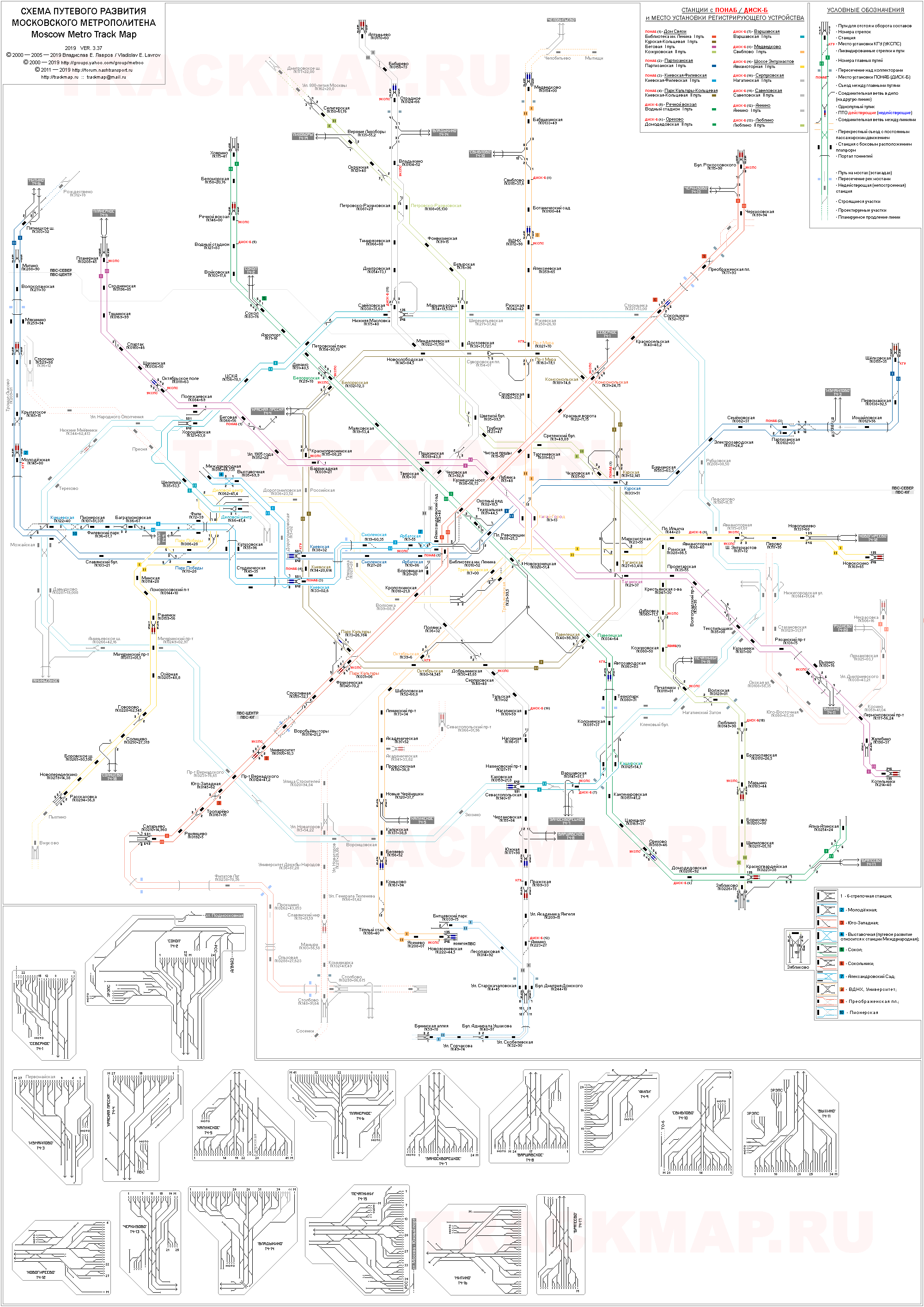
- ↑ Схема путевого развития Московского Метрополитена . trackmap.ru. Дата обращения 14 марта 2011. Архивировано 28 августа 2011 года.
- ↑ Исследования пассажирских потоков. Март 2002 года . metro.ru. Дата обращения 26 апреля 2012 года. Архивировано 25 января 2012 года.
- ↑ Режим работы станций и вестибюлей (недоступная ссылка) . Официальный сайт Московского метрополитена. Дата обращения 14 мая 2012 года. Архивировано 15 декабря 2012 года.
- ↑ Расписание поездов . mosmetro.ru . ГУП « Московский метрополитен ».
- ↑ Метро «Лубянка» на Яндекс-картах . Яндекс.Карты. Дата обращения 15 мая 2012.
- ↑ Search for a bus route in Moscow. Lubyanka (inaccessible link) . I will come. Date of treatment March 18, 2012. Archived June 1, 2012.
- ↑ Search for the Moscow trolleybus route. Lubyanka (inaccessible link) . I will come. Date of treatment March 18, 2012. Archived June 1, 2012.
- ↑ The article indicates only those attractions that are listed on the information boards of the station
- ↑ The death toll in the explosion at Lubyanka reached 23 people , Gazeta.Ru (03/29/2010 10:19). Date of treatment April 7, 2010.
- ↑ Glukhovsky D.A. Metro 2033. - M .: Popular literature, 2007. - 400 p. - Additional, circulation of 100,000 copies. - ISBN 978-5-903396-09-2 .
Literature
- Zverev V. Metro Moscow. - M .: Algorithm, 2008 .-- 272 p. - ISBN 978-5-9265-0580-8 .
- M.A. Zelenin , S.M. Kravets , V.L. Makovsky. The architecture of the Moscow metro. - M .: State Architectural Publishing House of the Academy of Architecture of the USSR, 1941.
- Zinoviev A.N. Stalin metro. Historical guide. - M. , 2011 .-- 240 p. - ISBN 978-5-9903159-1-4 .
- Kavtaradze S.A. The Moscow metro is 70 years old. - M .: World Art Museum, 2005 .-- 127 p. ISSN 1726-3050
- Collie, N. Ya. Metro architecture // How we built the metro . - M .: Polygraphic book, 1935. - 100,000 copies.
- Kravets S. M. Architecture of the Moscow Metro named after L. M. Kaganovich. - M .: Publishing House of the All-Union Academy of Architecture, 1939. - 83 p.
- Morgan, J. Station "Dzerzhinsky Square" // How we built the subway . - M .: Polygraphic book, 1935. - 100,000 copies.
- Naumov M.S., Kusy I.A. Moscow metro. Guide. - M .: Around the World, 2006 .-- 360 p. - ISBN 5-98652-061-0 .
- Naumov M. S. Under seven hills: The past and present of the Moscow metro. - M .: ANO IC Moskovedenie; Moscow Textbooks OJSC, 2010. - 448 p. - ISBN 978-5-7853-1341-5 .
- Cherednichenko O. Metro-2010. Underground City Guide. - M .: Eksmo, 2010 .-- 352 p.
Links
- Official site (old version) . Date of treatment January 1, 2014.
- Site "Moscow metro" . Date of treatment January 1, 2014.
- The site "METRO.Photoalbum" . Date of treatment January 1, 2014.
- The site "Walking on the subway" . Date of treatment January 1, 2014.
- The site "Encyclopedia of our transport" . Date of treatment January 1, 2014.
- "Lubyanka" on the site metro.molot.ru
- Lubyanka in the Underground program on Radio801 (Retrieved January 5, 2014)
- Lubyanka on news.metro.ru