
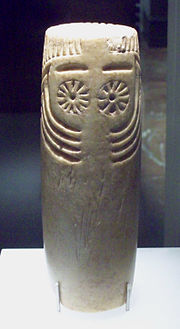
Iberian conceptual art is a large group of prehistoric images, mainly cave drawings, found on the Iberian Peninsula and related to the first metallurgical cultures of the peninsula (in some places even before the Iron Age). The chronology of the Iberian schematic images remains controversial, but most archaeologists attribute them to the period 4-1 thousand BC. e. In a number of places, the latest examples of conceptual art coexisted with the early stage of Levantine art .
The main characteristic of this art, as the name implies, is its schematism , that is, an image of only basic fragments or outlines, without details. Sometimes the images are so abstract (as opposed to realistic prehistoric images in the caves of Spain of the Paleolithic era) that they cannot be compared with real objects.
The schematism at that time was not characteristic only of Spain, but spread throughout the Mediterranean .
Links
- El arte esquemático-abstracto en Cantabria
- Pinturas rupestres esquemáticas de Fuencaliente
- Aproximación al arte Levantino y Esquemático
- El arte rupestre del noroeste español y las corrientes culturales entre el Atlantico, la Meseta y el Mediterráneo , por Antonio Beltrán Martínez
- www.arterupestre.es Arte Rupestre del Arco Mediterráneo de la Península Iberica.