
Gravis Ultrasound or GUS is a sound card for IBM PC-compatible computers , released by the Canadian company Advanced Gravis Computer Technology Ltd in 1992 . It was popular in the mid-1990s demoscene due to its high sound quality compared to other cards in its price range.
Gravis Ultrasound was the first map for the IBM-PC platform, which used table-wave synthesis , with digitized recording of sounds of real musical instruments.
Versions
Ultrasound Classic

The first Ultrasound model released in the summer of 1992 . In the final version (v3.74), the ability to record 16-bit, 44.1 kHz sound was added using a daughter card from Crystal Semiconductor containing the CS4231 codec . On the card, 256 KB of RAM was installed, with the ability to expand to 1024.
Ultrasound MAX
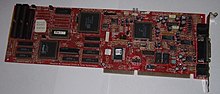
GUS version with integrated CS4231 codec, 512 KB RAM (expandable up to 1024) and CD-ROM interface. The CS4231 met the requirements of the Windows Sound System specification (via I / O ports, but not at the hardware level) and a partial SoundBlaster software emulation.
Ultrasound Plug & Play (PnP)

It was supposedly produced by Synergy under an ODM contract (which was reflected in the Synergy logo on the back of the board, although early releases of GUS PnP did not have the Synergy logo and were obviously produced by another company, very few such cards were issued). It was based on AMD InterWave technology with a new set of sounds flashed in 1 MB ROM . There was no RAM in the standard version (but a place for installation was provided). In the Pro version, the RAM was 512 KB, for compatibility with GUS Classic. The card was equipped with an ATAPI CD-ROM interface . In 2014, an adapter was developed and produced by enthusiasts that allows you to install a 72-pin SIMM with a maximum capacity of 16 MB on the Pro version without any modifications to the card itself.
Ultrasound Ace
The budget version of Ultrasound Classic with 512 KB of RAM (expandable to 1024). It did not contain a game port, it was not possible to record sound. Advertised as a competitor to Wave Blaster- compatible cards, it could work together with SoundBlaster Pro / 16, as an extension for table-wave synthesis. The prototype of this card was called “Sound Buddy”.
Ultrasound Clones and OEMs
Almost all clones used the original versions of the Gravis GF1 and AMD Interwave chips.
- Ultrasound CD3 - OEM version of Ultrasound Classic with 512-1024 KB of RAM, had AT-BUS CD-ROM interfaces: Sony, Mitsumi and MKE / Panasonic standards. Made by Synergy.
- Gravis Ultrasound Extreme and ViperMAX are OEM versions that combine Ultrasound Classic with the Audiodrive ESS1688 sound chip to emulate Sound Blaster Pro and AdLib . Produced by Synergy.
- Primax SoundStorm Wave (GF1).
- Expertcolor MED3201 - used a truncated version of the GFA1 - AM78C200 Interwave LC. In the first version - Am78C201KC.
- Compaq Ultra-Sound 32 (Interwave)
- STB Systems Soundrage 32 (Interwave)
- Core Dynamics DYNASonix 3D / PRO (Interwave)
- Philips PCA761AW (Interwave)
- Reveal WAVExtreme 32 (Interwave)
- Enthusiasts are currently developing a new clone based on Interwave. The selected name is ARGUS .
See also
- Wikimedia Commons has Gravis Ultrasound media files