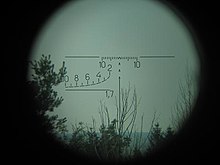

The thousandth is a unit of measurement of angles , adopted in artillery and representing a 1 ⁄ 1000 fraction of a radian (approximately 1/6283 turns , i.e. [1] ) rounded for ease of angular calculation. Different thousandths are accepted in different armies:

- USSR and some armies of the countries-formations: 1 ⁄ 6000 turnovers.
- NATO: 1 ⁄ 6400 turnover (there it is called mil , short for milliradian ).
- The Swedish army, which is not a member of NATO, adopted the most accurate definition of 1 ⁄ 6300 turnover.
However, the divisor 6000, adopted in the Soviet , Russian and Finnish armies , is better suited for oral counting , since it is divisible by 2, 3, 4, 5, 6, 8, 10, 12, 15, 20, 30, 40, 50, 60, 100, 150, 200, 250, 300, 400, 500, etc. up to 3000, which allows you to quickly translate into thousandth angles obtained by rough measurement on the terrain with improvised means.
To increase the accuracy of the calculation when using the divider 6000, a five percent correction is applied (see below).
Content
Background
When shooting direct fire , when the gunner sees his own gaps, the sight can be marked out in any suitable units: if the error is 5 divisions to the right, the next shot to the left is 5 divisions. However, when shooting from a closed position , when the spotter controls the fire, you have to translate the distance into an angular correction (and vice versa, a measured angle in meters on the ground).
For small angles therefore it is convenient to measure angles in radians. If, when firing at 10 km, the spotter reports that the shells went 100 m to the left, an adjustment of 0.01 radians is made.
| Mil is an angular measure of the deflection of a bullet (projectile) in height or in the lateral direction, 1/6400 part of the circumference, or approximately 1/1000 of the range. Type approval: “The right deviation of the projectile in the lateral direction is 5 mil (or 5 mrad)”, means that the fall of the bullet (projectile) is noted 5 m to the right of the shooting direction per kilometer range. [2] |
However, in addition to adjusting the fire, the military has many other tasks: calculate the azimuth , mark an inaccessible object on the map ... For this, it is desirable that units of measure are used in which the full circle is expressed as a round number with as many divisors as possible.
In the USSR and Russia
In the Armed Forces of the Warsaw Pact countries , including the USSR, and subsequently Russia and a number of other post-Soviet states, a thousandth, equal to 1/6000 , was adopted for measuring angles. A synonym for this unit of measurement is the small division of the goniometer . In thousandths, the scales of many instruments used in military affairs ( binoculars , stereo tubes , rangefinders , optical sights , compasses , chord angle meters , compasses , artillery circles) are graduated. Sometimes it is also used the fact that the minute scale of a regular watch can be considered as calibrated in hundreds of thousandths (that is, the angle between minute divisions on the dial is 100 thousandths).
Based on the equality of one revolution 2 π radians, 360 degrees and 400 degrees , there are the following relationships between all these units:
- 1 thousandth = 1 ⁄ 6 · 10 −3 turns ≈ 0,000 167 turns;
- 1 thousandth = 2 π ⁄ 6000 radians ≈ 1.0472 · 10 −3 radians;
- 1 thousandth = 0.06 degrees = 3.6 arcminutes = 3 angles. minutes 36 ang. seconds = 216 arc seconds;
- 1 thousandth = 1 ⁄ 15 degrees ≈ 0.066667 degrees;
- 1 revolution = 6000 thousandths;
- 1 radian = 6000 ⁄ 2 π thousandths ≈ 954.92 thousandths;
- 1 arcsecond = 1 ⁄ 216 thousandth ≈ 4.6296 · 10 −3 thousandth;
- 1 angular minute = 10 ⁄ 36 thousandth ≈ 0.2778 thousandth;
- 1 degree = 50 ⁄ 3 thousandth ≈ 16.667 thousandth;
- 1 hail = 15 thousandths.
The great convenience of such a non-standard unit of measurement of angles is its good adaptability to calculating the linear and angular sizes of objects on the ground without any means of mechanizing the account.
Let an object of size W be observed from a distance L at a small angle α (i.e., the condition commonly found in artillery practice), and can be applied. Then, when expressing the angle α in the radian measure, the relation
Replacing the radian measure with thousandths, we get as a result:
For most practical calculations, an approximate version is used, but in some cases, an error of 5% arising from this is unacceptable and then the coefficient 0.955 is not discarded.
Simplified equality is called the thousandth formula .
From this formula follows the rule for better memorizing the ratio: “an object with a linear size of 1 meter , 1 kilometer away from the observer, is visible at an angular value of 1 thousandth.”
The thousandth formula is applicable at angles when the sine of the angle is approximately equal to the angle itself in radian measure. The conditional limit of applicability is an angle of 300 thousandths (18 degrees).
Thousandth as a characteristic of the accuracy of combat automatic weapons
In the USA, the unit of measurement mil (milliradian) is used as a measure of the accuracy of firing automatic weapons. For example, “ the dispersion indicators declared by the developer (Alliant Techsystems) when firing automatic guns“ Bushmaster II ”and“ Bushmaster III “are about 0.3-0.4 mrad, which is a very impressive characteristic ” [3] . In other words, the accuracy of the battle when firing from these cannons is characterized by a value of 0.3-0.4 thousandths of a range, and at a distance of 1 km the deviation on the side will be about 0.3-0.4 meters. Accordingly, at a distance of 2 km, the shells of these guns are highly likely to fall into a shield 2 × 2 m in size.
Another example: The accuracy of firing a GAU-8 / A cannon is characterized by the following parameters: 5 mrad, 80 percent; this means that when firing at a range of 1220 m, 80 percent of all shells fall into a circle with a radius of 6.1 m [4] .
See also
- Goniometer divisions
Links
- Angle Measure - Thousandth Basics of Small Arms Shooting
Notes
- ↑ Thousand
- ↑ Carlucci Donald E., Jacobson Sidney S. Ballistics. Theory and Design of Guns and Ammunition. CRC Press, 2008, p. 477.
- ↑ Ammendments and Additional Notes to “RAPID FIRE” (updated 17 January 2009) Archived February 5, 2012.
- ↑ Dispersion of PGU-14 ammunition during air strikes by combat aircrafts A-10 near urban areas. In: 13th Seminar on New Trends in Research of Energetic Materials, Czech Republic, 2010 Pardubice, April 21-23, 2010