Gaius Duilius ( Latin: Gaius Duilius ; 3rd century BC) - Roman military leader and politician from the plebeian clan Duiliev , consul 260 BC e. Member of the First Punic War , who won the first victory in the history of Rome at sea.
| Guy Duilius | |||||||
|---|---|---|---|---|---|---|---|
| lat Gaius duilius | |||||||
| |||||||
| |||||||
| |||||||
| Birth | |||||||
| Death | after 231 BC e. | ||||||
| Kind | Duilia | ||||||
| Father | Guy Duilius | ||||||
| Rank | |||||||
Content
Origin
Gaius Duilius belonged to a plebeian family, whose representatives before him called themselves Duelies [1] [2] . According to the Capitol fasts , his father and grandfather had a mark of Mark [3] .
Biography
The first mention of Gaia Duillia in the sources dates back to 260 BC. e., when he became consul with patrician Gnei Cornelius Scipio Azina [4] [5] . At that time the first war of Rome with Carthage was going on . In this war, Scipio Azina led the fleet, and Gaius Duilius led the army in Sicily . But soon Gnei Cornelius was locked with 16 ships in the Aeolian harbor and was captured, so his colleague had to take naval command [6] [7] .
Since before this the Romans had never waged war on the sea, their fleet was clearly inferior to the enemy in maneuverability. Realizing this flaw, the Roman sailors began to use boarding crows - cantilever bridges attached to the front masts. When approaching the enemy, these bridges were lowered onto the deck of the Carthaginian ship; they were so wide that the soldiers could walk along them two in a row. From this moment, the crew of the Roman ship consisted of two maniples . As a result, the battle assumed the character of a land battle, and the Romans could fully use at sea the superiority of their infantry [8] [9] . There is an assumption that the "crows" began to be used in 260 BC. e., in the squadron of Guy Duilius [10] [6] .
The consul was determined. Upon learning that the Carthaginian sailors were robbing the surroundings of the Sicilian city of Mila , he moved there, intending to give battle. The commander of the enemy fleet, Hannibal, the son of Guiskon was so sure of his victory that he swam towards the Romans, not paying due attention to the battle formation. His squadron was stretched during the transition and entered the battle in parts; therefore, the Romans were able, after imposing a boarding battle on the enemy, capture the entire Carthaginian vanguard and strike at the main forces. Even Hannibal’s quinquereme was captured. Seeing the superiority of the enemy, the Carthaginians fled, having lost a total of 50 ships [11] [12] .
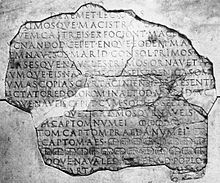
After this battle, Guy Duilius returned to land: after a nine-day siege, he took Egesta . At the end of summer, Duilius returned to Rome. As the first military commander in Rome’s history to win at sea, he was awarded a triumph and one more unique honor: whenever he returned from a feast, he had to be accompanied by a torch torch and a flutist [13] . To glorify the victory of Duilia, a rostral column ( columna rostrata ) appeared on the forum, decorated with the noses of the ships captured at the Battle of Mila [14] .
In 258 BC e. Guy Duillius was a censor together with Lucius Cornelius Scipio [15] , his successor on the consulate and command in Sicily. The last time he is mentioned in the sources in connection with the events of 231 BC. e. as a dictator who organized the next election of magistrates [16] . According to Cicero , Duilia often saw Mark Portius Cato , born in 234 BC, returning from a feast accompanied by a torchlight and flutist. e. [17] [18]
Notes
- ↑ Cicero, 1994 , Orator, 153.
- ↑ Duillius, 1905 , s. 1776.
- ↑ Capitoline fasts , 260 BC e.
- ↑ Duillius 3, 1905 , s. 1777.
- ↑ Broughton R., 1951 , p. 205.
- ↑ 1 2 Rodionov E., 2005 , p. 94-95.
- ↑ Duillius 3, 1905 , s. 1778.
- ↑ Polybius, 2004 , I, 22.
- ↑ Rodionov E., 2005 , p. 83-84.
- ↑ Duillius 3, 1905 , s. 1779.
- ↑ Duillius 3, 1905 , s. 1779-1780.
- ↑ Rodionov E., 2005 , p. 95-96.
- ↑ Titus Livy, 1994 , Perioch, 17.
- ↑ Duillius 3, 1905 , s. 1780.
- ↑ Broughton R., 1951 , p. 206.
- ↑ Broughton R., 1951 , p. 226.
- ↑ Cicero, 1974 , On Old Age, 44.
- ↑ Duillius 3, 1905 , s. 1781.
Sources and Literature
Sources
- Titus Livy . The history of Rome from the foundation of the city. - M .: Nauka, 1994 .-- T. 3 .-- 576 p. - ISBN 5-02-008995-8 .
- Macrobium Saturnalia. - M .: Krug, 2013 .-- 810 p. - ISBN 978-5-7396-0257-2 .
- Polybius . General story . - M .: AST, 2004 .-- T. 1 .-- 768 p. - ISBN 5-17-024958-6 .
- Mark Tullius Cicero. About old age // About old age. About friendship. About duties. - M .: Nauka, 1974. - S. 7-30.
- Mark Tullius Cicero. Three treatises on oratory. - M .: Ladomir, 1994 .-- 475 p. - ISBN 5-86218-097-4 .
- Fasti Capitolini . Site "History of Ancient Rome". Date of treatment March 23, 2017.
Literature
- Rodionov E. Punic wars. - SPb. : St. Petersburg State University, 2005 .-- 626 p. - ISBN 5-288-03650-0 .
- Broughton R. Magistrates of the Roman Republic. - New York, 1951. - Vol. I. - P. 600.
- Münzer F. Duillius // Paulys Realencyclopädie der classischen Altertumswissenschaft . - 1905. - Bd. V, 2. - Kol. 1776-1777.
- Münzer F. Duillius 3 // Paulys Realencyclopädie der classischen Altertumswissenschaft . - 1905. - Bd. V, 2. - Kol. 1777-1781.
Links
- Guy Duilius - in Smith 's Dictionary of Greek and Roman Biography and Mythology.