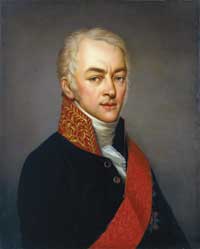
Count Aleksei Kirillovich Razumovsky (September 12 ( 23 ), 1748 - March 23 ( April 4 ), 1822 ) was a Russian statesman from the Razumovsky family. Acting chamberlain (1775), senator (1776-1807), Minister of Education (1810-1816). Valid Privy Councilor (1807).
| Alexey Kirillovich Razumovsky | |||||||
|---|---|---|---|---|---|---|---|
 | |||||||
| Predecessor | Zavadovsky, Pyotr Vasilyevich | ||||||
| Successor | Golitsyn, Alexander Nikolaevich | ||||||
| Birth | |||||||
| Death | |||||||
| Burial place | |||||||
| Father | Razumovsky, Kirill Grigoryevich | ||||||
| Mother | Ekaterina Ivanovna Naryshkina | ||||||
| Spouse | Varvara Petrovna Sheremeteva (1759-1824) | ||||||
| Children | , , , , and | ||||||
| Awards |
| ||||||


The builder of the Gorenka estate near Moscow and the palace on Yauza . The ancestor of the noblemen of Perovsky : father of Anthony Pogorelsky , grandfather of A.K. Tolstoy , great-grandfather of Sofia Perovskaya .
Content
Biography
The eldest son of Count K. G. Razumovsky , the last hetman of the Zaporizhzhya Army . He received a thorough education: a special “institute” was organized for him and his brothers, in which Schletser first introduced the teaching of statistics , entitled “Knowing Your Fatherland”; he later attended lectures at the University of Strasbourg . At first, he served only the court service in 1775, was bestowed the title of a real chamberlain (corresponded to the rank of IV class according to the Table of Ranks ).
June 27, 1786 was appointed senator with the production of privy councilors . In 1795, due to disagreement to approve the law proposed by the empress, Razumovsky resigned.
He rejoined the service only in 1807. On November 2, 1807, Razumovsky was appointed trustee of Moscow University , which, in combination, entrusted him with the guardianship of the Moscow school district , and was promoted to actual secret adviser . In this position, he issued a decree on the election of the rector for three years (instead of one year) and patronized the Society of Naturalists , on whose behalf he formed an expedition to study the Moscow province.
January 1, 1810 Razumovsky was appointed Minister of Education and a member of the Council of State . In the first two years of his ministry, 72 parish schools, 24 county schools, several gymnasiums and other educational institutions were opened; improved teaching; increased supervision of foreign educators; several learned societies are open; The first department of Slavic literature was established at Moscow University. With the personal assistance of Razumovsky, the charter of the Tsarskoye Selo Lyceum was worked out and its opening took place on October 19, 1811 .
Honorary Member of Moscow University (1812) [3] .
After 1812, he became much cooler in the service, and for the last two years he did not do business at all.
Being a member of the Masonic lodge and a follower of Osip Pozdeyev , with whom he had corresponded for a long time (it was printed by A. Vasilchikov in his book “The Razumovsky Family”), Razumovsky was influenced by the Jesuits and, mainly, the famous Count Joseph de Mestra . The latter “literally disposed of him, dictated what he should teach Russian and what not to teach”; according to his instructions, the Greek language, archeology, natural history, astronomy, chemistry and the history of philosophical systems were thrown out of the original lyceum program as “not illuminating the mind with useful truths, but obscuring with delusions and perplexities”. He introduced theology as the main discipline in all educational institutions. Under the influence of the same de Mestra, Razumovsky introduced new censorship restrictions and began a fight with the Vilna trustee Adam Czartoryski for the Russification of the Western Territory, which de Mestre was a supporter of. The failure in the fight against Czartoryski and the government’s distrust of the Jesuits forced Razumovsky to ask for the resignation of the minister and member of the Council of State, which was given to him in August 10, 1816.
The first two years after this, Razumovsky lived in Moscow and in his Gorenka estate near Moscow, where he had a botanical garden, which until the 1830s was considered one of the wonders of Moscow. Since 1816 he lived in Little Russia, in the town of Pochepe , Mglinsky district, where he died. He was buried in the family crypt, but then reburied in the Transfiguration Church of Novgorod-Seversky . According to Vigel , all the sons of the hetman Kirill Razumovsky "were stuffed with French literature, clothed in foreign forms, revered themselves as Russian Montmorency , were kind at the court and unbearable outside his aristocrats." To this book. A. Vasilchikov adds that the eldest of them, Alexei, was " exorbitant pride ... and harsh in the circle of his family ."
Family
Razumovsky was married on February 23, 1774 to one of the richest bride in Russia, Varvara Petrovna Sheremeteva (02/01/1750-27.05.1824), the second daughter of the general-general Count P. B. Sheremetev . Around 1784, at the request of her husband, Varvara Petrovna left the family and lived alone in her own house in Moscow - in 1796 the house on Maroseyka (No. 2) was completed. In marriage had three daughters and two sons.
- Peter (1775-1835), in 1783 he was recorded as a sergeant in the Izmaylovsky regiment, studied abroad at the University of Gottingen ; adjutant with his grandfather, hetman K. G. Razumovsky ; in 1797, a lieutenant colonel, later colonel, commander of a grenadier battalion, in the army of his uncle, infantry general I.V. Gudovich , freemason. In 1801 he retired and was granted the title of Chamberlain. While living in St. Petersburg, he made many debts, which prompted his father to bother about transferring his son to serve in Odessa, in 1806, with the rank of acting state councilor, he was appointed an official on special assignments under the Novorossiysk governor. He died in Odessa on July 18, 1835 .
- Cyril (1777-1829), chamberlain, suffered from insanity, in 1806-1807 he was a prisoner of the Shlisselburg and Peter and Paul Fortress, later he was transferred to the Spaso-Evfimiev Monastery , after the death of his father he was transferred to Kharkov, where he died in 1829.
- Catherine (1777-1780)
- Barbara (1778-1864), since 1802 married to Prince N. G. Repnin-Volkonsky ; was a well-known philanthropist who did a lot for women's education.
- Catherine (1781-1849) [4] , beloved maid of honor of Empress Elizabeth Alekseevna and an employee of the Patriotic Society . Since 1811, she was married to the trustee of the St. Petersburg School District and the future Minister of Education, Count Sergei Semenovich Uvarov .
Having got rid of his legal wife, Alexei Kirillovich settled the bourgeois Marya Sobolevskaya [5] . He had ten illegitimate children, delicately called "pupils" (five sons and five daughters) - Perovsky [6] .
- Nicholas (1785-1858), (the only one of ten children who had the patronymic “Ivanovich”) was the governor in Crimea, the Feodosia town governor.
- Alexey (1787-1836), Russian writer (pseudonym - Anthony Pogorelsky), member of the Russian Academy.
- Maria (1791-1872), wife of General M.K. Kryzhanovsky , cavalier lady (1837).
- Leo (1792-1856), statesman, minister of internal affairs, minister of destinies.
- Vasily (1795-1857), statesman and military leader, cavalry general, adjutant general, governor general of the Orenburg and Samara provinces.
- Elizabeth (Praskovya) (1795 -?)
- Anna (1796-1856), husband - Count Konstantin Petrovich Tolstoy (1779-1870), son - Alexei Konstantinovich Tolstoy .
- Olga (1798-1833), husband - Mikhail Nikolayevich Zhemchuzhnikov , among his sons - Alexei , Alexander , Lev and Vladimir Zhemchuzhnikov.
- Sophia (1812-1883), husband - Vladimir Vladimirovich Lvov .
- Boris (1815-1881), military and statesman, adjutant general, member of the State Council.
Varvara Petrovna, wife Varvara Alekseevna Ekaterina Alekseevna Alexey Perovsky Vasily Perovsky Anna Perovskaya Sophia Perovskaya
Rewards
- Order of St. Alexander Nevsky (April 14, 1808).
- Order of St. Vladimir I degree (October 25, 1811).
Notes
- ↑ 1 2 CERL Thesaurus - A consortium of European science libraries .
- ↑ Pogorelsky // Brief Literary Encyclopedia - M .: Soviet Encyclopedia , 1968. - V. 5. - P. 825–826.
- ↑ Chronicle of Moscow University
- ↑ Sirotina O. A. Methods of studying personal and family archives. According to the materials of the Uvarov Foundation. The dissertation for the degree of candidate of historical sciences. - Moscow, 2014
- ↑ Lib.ru/Classics: Tolstoy Alexey Konstantinovich. Dmitry Zhukov. Alexey Konstantinovich Tolstoy
- ↑ Perovsky Vasily Alekseevich
Literature
- Vasilchikov, Alexander Alekseevich. Razumovsky family
- Razumovsky, Alexei Kirillovich // Brockhaus and Efron Encyclopedic Dictionary : in 86 volumes (82 volumes and 4 additional). - SPb. , 1890-1907.
- Presidents of MOIP - Participants of the Patriotic War of 1812