Zambia ( English Zambia ), full official form - Republic of Zambia [6] ( English Republic of Zambia ) - a state in South Africa .
| Republic of Zambia | |||||
|---|---|---|---|---|---|
| English Republic of zambia | |||||
| |||||
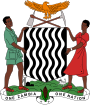
| Motto : “ One Zambia, One Nation ” | |||||
| Anthem : “Stand and sing about the proud and free Zambia” | |||||
 | |||||
| Independence date | October 24, 1964 (from the UK ) | ||||
| Official language | English | ||||
| Capital | Lusaka | ||||
| Largest cities | Lusaka, Kitwe , Ndola , Livingston , Kabwe , Chingola , Luanshya , Mufulira | ||||
| Form of government | presidential republic [1] | ||||
| The president | Edgar Lungu | ||||
| Vice President | Inonge Vina | ||||
| Territory | 38th in the world | ||||
| • Total | 752,614 km² | ||||
| •% water surface. | one | ||||
| Population | |||||
| • Evaluation (2015) | ▲ 16 100 587 [2] people ( 66th ) | ||||
| • density | 21.7 people / km² | ||||
| GDP ( PPP ) | |||||
| • Total (2016) | $ 65.1 billion [3] ( 99th ) | ||||
| • Per capita | 3896 [3] dollars ( 141st ) | ||||
| GDP (nominal) | |||||
| • Total (2016) | $ 21 billion [3] ( 106th ) | ||||
| • Per capita | 1256 [3] dollars ( 149th ) | ||||
| HDI (2018) | ▲ 0.588 [4] ( middle ; 144th place ) | ||||
| Names of residents | Zambians | ||||
| Currency | Zambian Kwacha (ZMK) | ||||
| Internet domain | |||||
| ISO code | |||||
| IOC Code | |||||
| Telephone code | +260 | ||||
| Time Zones | +2 | ||||
| Car traffic | |||||
Borders on the Democratic Republic of the Congo in the north, Tanzania in the northeast, Malawi in the east, Mozambique , Zimbabwe , Botswana and Namibia in the south, Angola in the west, and has no access to the sea . On October 24, 1964, the British protectorate of Northern Rhodesia declared independence within the Commonwealth of Nations and changed its name to modern. The capital of the state and the largest city is Lusaka .
Content
Etymology
In the colonial era, the country was called Northern Rhodesia in honor of the British politician Cecil Rhodes , after declaration of independence in 1964, the country began to be called "Zambia" from the hydronym Zambezi [7] .
Physico-geographical characteristics
Geographical position
Zambia is located in South Africa . A state with a tropical climate without access to the sea, located mainly on a plateau . By area (752 614 km²) it occupies 38th place in the world. The basin of the Zambezi river flowing along the western and southern borders of the country occupies about three quarters of the state’s territory, the rest belongs to the Congo basin . A small territory in the north-east of the state belongs to the drainless basin of Lake Rukva , located in Tanzania . On the border between Zambia and Zimbabwe, on the Zambezi River, waterfalls are located, including the famous Victoria Falls .
Minerals
The country's bowels contain reserves of copper, cobalt, emeralds, gold, silver, uranium, lead, zinc, coal, manganese.
History
The territory of modern Zambia has been inhabited since ancient times. At the end of the 1st millennium BC. e. - beginning of n. e. Khoisan tribes of gatherers and hunters were scattered by several streams of mass migrations of Bantu-speaking tribes coming from the north, from Central and West Africa, as well as from the southern Ngoni tribes. Zambia is considered one of the oldest centers of iron metallurgy in tropical Africa. Before its arrival, Europeans had a number of small early state and tribal associations ( Bemba , East Lund and Bis) with a high level of development of material culture on its territory. At the end of the XVII century. in the northeast of Zambia, a strong independent early state entity, Kazembe-Lunda, arose. Another very influential political entity was the state of Lozi (Barotse) , formed by the middle of the 18th century. along the middle part of the upper reaches of the Zambezi River and still existing as a semi-autonomous Barotseland formation within the Western Province of Zambia. [eight]
The first Europeans ( Portuguese merchants ) appeared on the territory of modern Zambia in the XVIII century. They (as well as Arab merchants) bought slaves, ivory and copper. In the XIX century, this region interested Britain , Germany and Belgium . The greatest success in Zambia was achieved by the British. Since 1891, Barotseland (now the Western Province of Zambia) has become a British protectorate . In the same year, Britain and Portugal signed an agreement on the division of the Zambezi River Basin.
Northern Rhodesia
The discovery in this region at the end of the 19th century of the richest deposits of copper and polymetallic ores stimulated the penetration of the British South African Company (BSAC), created by Cecil Rhodes, into Zambia. The company began to develop the local mining and copper industries, build cities and railways .
The company received from the British government a monopoly on the development of a vast territory - from the origins of the Congo to the Zambezi. In 1895, the territories where BSAC worked, received the name of Southern, North-Western and North-Eastern Rhodesia (a name formed from the surname of Rhodes) - the latter two were merged in 1911 into Northern Rhodesia . Only in 1924, Northern Rhodesia was granted the official status of a colony of the British crown; a governor was appointed to the country (with the preservation of the Baroceland protectorate).
In the 1920s and 30s, the colony developed successfully thanks to the extraction of minerals and the immigration of the white settlers who founded the farms.
In 1953-1963, Northern Rhodesia, together with Southern Rhodesia and Nyasaland, entered the Federation of Rhodesia and Nyasaland .
In 1963, Northern Rhodesia received a constitution and self-government. At the beginning of 1964, elections to the Legislative Council were held, in which the left radical party UNIP, led by Kenneth Kaunda, won.
Independence
On October 24, 1964, the country gained independence and its name is the Republic of Zambia. Kenneth Kaunda became president.
In April 1967, Kaunda proclaimed its concept of "building Zambian humanism." In this concept, the capitalist form of the economy was rejected, instead of which state regulation was introduced.
In November 1968, Kaunda dissolved Parliament. Since 1969, the process of nationalization began, primarily in the key industry - the copper industry. In December 1972, a one-party system of government was introduced in Zambia. The process of nationalization in various areas of the economy was continued.
With the beginning of the construction of “Zambian humanism”, increasingly aggravated difficulties began in the life of the country - an increase in consumer prices, an increase in unemployment, and a shortage of basic food products. Despite the ban on strikes since 1970, the number of such protests has increased.
With its largest natural resources, Zambia has become one of the poorest countries in the world. In 1991, Kenneth Kaunda allowed a multi-party election. The Multi-Party Democracy Movement won the election, and on November 2, 1991, Kaunda lost power. The era of “building Zambian humanism” has ended.
The new president of Zambia was the leader of the Movement for Multi-Party Democracy, trade union leader Frederick Chiluba , who sharply criticized the politics of Kaunda. He abolished centralized economic management, abolished state subsidies, and began the privatization of nationalized enterprises. The new head of state managed to maintain popularity and win the 1996 presidential election, but as early as the next year the discontent of part of the society with Chiluba’s policies resulted in an attempted military coup, of which Kaund was accused of organizing. After several years of martial law, Chiluba held a new presidential election.
On January 2, 2002, Levy Patrick Mwanavasa , also a representative of the Multi-Party Democracy Movement, became the new president.
On June 29, 2008, in connection with the deadly disease of Mwanawasa, the duties of the president began to be performed by the vice president, representative of UNIP, Rupee Banda . After the death of Mwanavasa on August 19, 2008, he won the presidential election and became the new president of Zambia.
In 2011, the next presidential election was held. The victory was won by a candidate from the United National Independence Party, Michael Sata, who won 43% of the vote, while his rival, Rupee Banda - 36%. Michael Sata took office on September 23, 2011, but died on October 28, 2014 in London, where he was undergoing treatment. The interim president was vice president Guy Scott .
January 20, 2015 held an early presidential election. The victory was won by the Minister of Defense and Justice Edgar Lungu . His term of office was 18 months - until the end of the current presidential term.
On August 11, 2016, the next presidential election was held. Edgar Lungu was elected President and won 50.35% of the vote. The inauguration took place on September 13, 2016. Speaking at the inauguration ceremony, Edgar Lungu said that over the next five years the country will begin to restructure the monocultural structure of the economy, which is overly dependent on copper production to promote diversification of production, development of agriculture and the private sector.
The country has diplomatic relations with the Russian Federation (established with the USSR on October 30, 1964).
Political structure
Government system
Zambia is a democratic republic with a multi-party system .
According to the Economist Intelligence Unit, the country in 2018 was classified by the index of democracy as a hybrid regime [9] .
Executive Power
The head of state, the head of government and the supreme commander-in-chief is the president , who is elected for a term of five years in direct elections no more than two terms. He has the right to appoint and dismiss the cabinet of ministers, as well as the vice president, decide on issues of war and peace, convene the National Assembly, and veto bills passed by parliament.
Legislature
The National Assembly consists of 158 deputies, of which 150 are elected through direct elections and 8 are appointed by the president. If a decision is not made, the National Assembly may be dissolved by the president. All members of parliament are elected for a five-year term. [ten]
Administrative Division
Administratively, the territory of Zambia is divided into 10 provinces:
- Central
- Copperbelt
- East
- Luapula
- Lusaka
- Muchinga
- North
- Northwest
- South
- Western
In turn, they are divided into areas.
Population
Demographics
The population of Zambia is about 14.5 million people, of which Bemba is 21.5%, Tonga 11.3%, Lozi 5.2%, and other 45.9%. [11] . The population density is 19.3 people per km². 39.2% of the country's population live in cities (2011) [11] .
By gender, there is a slight predominance of women (50.03%) over men (49.97%) (2012) [11] . 46.3% of the population belongs to the age group under 15 years old, 27.8% - from 15 to 29 years old, 15.6% - from 30 to 44 years old, 6.6% - from 45 to 59 years old, 2.9% - from 60 to 74 years, 0.7% - from 75 to 84 years, 0.1% - 85 years and above (2012) [11] . Average life expectancy (2012): 49.6 years (men), 52.8 years (women) [11] .
Fertility - 43.1 per 1000 inhabitants (2012), mortality - 13.4 per 1000 inhabitants (2012). According to 2009 estimates, 13.5% of the adult population (15–49 years old) is infected with the immunodeficiency virus [11] .
The economically active population is 5,416,300 people (2011), that is, 40.6% of the total population. 79.7% of the economically active population are workers aged 15 to 64 years, the number of women is 43.7% of the economically active population. Unemployment is more than 14% (2006) [11] .
Languages
Official: Bemba - 35.1%, Nyanja - 10.7%, Tonga - 10.6%, Lozi - 5.7%, Lunda - 2.2%, Caende - 2%, Luvalu - 1.7%, English - 1.7%. The following languages are also widespread: nsenga - 3.4%, tumbuka - 2.5%, lala - 2% and about 60 other indigenous languages (about 26% of the population; according to the 2000 census).
Religion
Christianity ( Catholics , Lutherans , Anglicans , Adventists , Pentecostals from the Assembly of God , the Church of God , etc.) and Christian-African cults 50-75% (including Catholics - 28% of the country's population, according to 2005 [12] ) Muslims make up about 5% [13] .
There are adherents of Hinduism and Sikhs . In addition, there are a small number of Jews , mainly Ashkenazi . Adherents of the Baha'i faith make up 1.5% of the population (about 160 thousand people) [14] ).
Of the anti-Trinitarians , Jehovah's Witnesses are common. The highest number of publishers in 2013 was 170,861 (over 1%). At the Lord's Supper in 2013, 763,915 people attended (5.3% of the population) [15] [16] .
Economics
Natural resources - copper, cobalt , zinc , lead , coal , emeralds , gold , silver , uranium , hydropower resources.
Zambia in the era of “building humanism” became the poorest country in the world [17] , 82% of the population live below the poverty line [18] .
Under the reign of Kenneth Kaunda , the socialist type of economy prevailed in the country. After the transition to a multi-party system in 1991, economic reform began. The transition to private entrepreneurship has led to economic growth.
GDP per capita in 2009 - $ 1.5 thousand (200th place in the world).
So far, 85% of workers are employed in agriculture (19% of GDP). Cultivated - corn , sorghum , rice , peanuts , sunflowers , vegetables , tobacco , cotton , sugarcane , tapioca , coffee . Cattle, goats , pigs , poultry are raised.
Industry (6% of employees, 31% of GDP) - mining of copper ore and other metals, processing of agricultural products.
The monetary unit of Zambia is kwacha , consists of 100 ngwe .
On January 1, 2013, kwachi was denominated with a change in its codes in the ISO 4217 standard: a new letter code - ZMW (old - ZMK); digital - 967 (894). The ratio of 1000 ZMK: 1 ZMW. Three zeros were removed from banknotes and new banknotes with a face value of 2, 5, 10, 20, 50 and 100 kvach were put into circulation. Old banknotes are in circulation along with new ones in the ratio according to the conducted denomination until July 15, 2013. Then they can be exchanged at the central bank without limiting the amount. The design and color scheme of the new banknotes almost completely matches the old series.
Foreign Economic Relations
In 2017, Zambia's foreign trade amounted to [19] $ 9.7 billion (for export). US $ 8.5 billion (by import), foreign trade surplus of US $ 1.21 billion.
The main export goods: copper (raw and refined) - 74%, cobalt - 2.4%, tobacco - 2%, as well as other agricultural products (sugar, corn, soy, etc.). Main buyers: Switzerland - 38%, China - 15%, India - 9.5%, South Africa - 7.3%
The main imported goods: Mineral raw materials - 26%, including copper ore (9.7%) and crude oil (4.6%), petroleum products - 7.6%, chemicals - 21.6%, machinery and equipment - 19.6%, vehicles - 8.2%. The main suppliers: South Africa - 31%, Democratic Republic of the Congo - 21%, China - 14%, Kuwait - 5%.
Included in the international organization of ACP countries .
Foreign Policy
In 1964, Zambia became an independent state from Great Britain . In its foreign policy, Zambia has consistently supported anti-colonial movements in southern Africa , advocated for the abolition of apartheid in the Republic of South Africa, and deployed training camps for rebel organizations of the Organization of Peoples of South West Africa on its territory [20] .
Culture
Literature
The first book published in Zambia was a 19th century Bible . Literature in the country initially developed thanks to translations - some translators, such as Sol Dress and L. D. Raditladi, translated a number of plays by William Shakespeare into the Nyanja language.
Media
The state television and radio company - ZNBC ( Zambia National Broadcasting Corporation "Zambian National Broadcasting Corporation"), includes the television channels ZNBC TV1, ZNBC TV2, ZNBC Radio 1, ZNBC Radio 2, ZNBC Radio 4.
Sport
In Zambia, the most common sports are athletics , boxing , cricket and football . Zambia has been participating in the Summer Olympics since 1964 (in 1964, under the name Northern Rhodesia, all subsequent years under the name Zambia). At the Olympic Games in Los Angeles in 1984, Kate Mwila won a bronze medal in boxing. And in 1996 in Atlanta, Samuel Mathete won a silver medal in the 400m hurdles. Zambia's national football team won the African Cup of Nations in 2012 .
Notes
- ↑ World Atlas: The most detailed information / Project leaders: A. N. Bushnev, A. P. Pritvorov. - Moscow: AST, 2017 .-- S. 72. - 96 p. - ISBN 978-5-17-10261-4.
- ↑ Department of Economic and Social Affairs: Population Division. World Population Prospects 2017 . United Nations (2017).
- ↑ 1 2 3 4 Report for Selected Countries and Subjects: Zambia . IMF (October 2017).
- ↑ Human Development Indices and Indicators . United Nations Development Program (2018). - Human Development Report on the UN Development Program website. Date of appeal September 14, 2018.
- ↑ http://chartsbin.com/view/edr
- ↑ States and territories of the world. Reference information // Atlas of the world / comp. and preparation. to the ed. PKO "Cartography" in 2009; ch. ed. G.V. Pozdnyak . - M .: PKO "Cartography": Onyx, 2010. - S. 16. - ISBN 978-5-85120-295-7 (Cartography). - ISBN 978-5-488-02609-4 (Onyx).
- ↑ Pospelov, 2002 , p. 158.
- ↑ ZAMBIA & 124; Encyclopedia Krugosvet . www.krugosvet.ru. Circulation date May 22, 2019.
- ↑ Democracy Index 2018: Me too? Political participation, protest and democracy . The Economist Intelligence Unit (The EIU) . Date of treatment January 25, 2019.
- ↑ CIA . Zambia . The World Factbook (2014).
- ↑ 1 2 3 4 5 6 7 Britannica. World data: Zambia . Date of treatment August 22, 2014.
- ↑ A monk sets a fine example in poor Zambia. - Catholic Times: January 12 2005
- ↑ Bureau of Democracy, Human Rights and Labor (US Department of State). International Religious Freedom Report 2003 (link not available) . Date of treatment November 3, 2008. Archived on August 23, 2011.
- ↑ The largest Baha'i communities in the world
- ↑ 2011 Report of Jehovah's Witnesses Worldwide . Archived on June 19, 2012.
- ↑ Jehovah's Witnesses Yearbook 2012.
- ↑ The poorest countries
- ↑ UN statistics
- ↑ Zambia on the oec.world foreign trade directory
- ↑ http://countrystudies.us/south-africa/83.htm
Literature
- Yudin, Yu.A. Federation of Rhodesia and Nyasaland // New Forms of Colonial Administration / M. , 1960
- Svanidze N.A. Agriculture of Northern Rhodesia / M., 1963
- Demkina L.A. Crash of the Federation of Rhodesia and Nyasaland / M., 1965
- Konovalov E.M., Republic of Zambia / M., 1965
- Frangulyan V.I. Economy of the Republic of Zambia / M., 1967
- Polyakov B.S. Zambia / M., 1969
- Ivanov Yu. M. Development of capitalism in the African village of Rhodesia and Zambia / M., 1970
- Berezin V.I. Zambia on the way to gaining economic independence / M., 1972
- Aleksandrov U., Linets U. Zambia / M., 1973
- Zavarnov N. A. The highest bodies of power and management in the states of East Africa (Tanzania, Zambia, Kenya, Uganda) / M., 1973
- Chuvaeva M.A. Republic of Zambia // Ways and methods of economic development of African countries / M., 1975
- Peryshkin E.V. Political system of the Republic of Zambia / M., 1980
- Republic of Zambia (reference book) / M., 1982
- Velich A. Humanism in Zambia // International Politics - 1969 - No. 473
- Rybin V. Signs of the copper belt // M. Children's literature 1987
- Pospelov E. M. Geographical names of the world. Toponymic dictionary / resp. ed. R. A. Ageeva. - 2nd ed., Stereotype. - M .: Russian dictionaries, Astrel, AST, 2002. - 512 p. - 3,000 copies. - ISBN 5-17-001389-2 .