Clever Geek Handbook
📜 ⬆️ ⬇️

Functional equation

A functional equation is an equation expressing the relationship between the value of a function at one point and its values ​​at other points. Many properties of functions can be determined by examining the functional equations that these functions satisfy. The term “functional equation” is commonly used for equations that are not reducible by simple methods to algebraic equations . This irreducibility is most often due to the fact that the arguments of the unknown function in the equation are not the independent variables themselves, but some of these functions from them.

Examples

Functional equation:

f(s)=2sπs-onesin⁡(πs2)Γ(one-s)f(one-s){\ displaystyle f (s) = 2 ^ {s} \ pi ^ {s-1} \ sin \ left ({\ frac {\ pi s} {2}} \ right) \ Gamma (1-s) f ( 1-s)} {\displaystyle f(s)=2^{s}\pi ^{s-1}\sin \left({\frac {\pi s}{2}}\right)\Gamma (1-s)f(1-s)} ,

WhereΓ(z) {\ displaystyle \ Gamma (z)} \Gamma(z) - Euler gamma function , satisfies Riemann zeta functionζ {\ displaystyle \ zeta} \zeta .

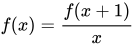
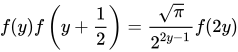
The gamma function is the only solution to this system of three equations:

f(x)=f(x+one)x{\ displaystyle f (x) = {f (x + 1) \ over x}} {\displaystyle f(x)={f(x+1) \over x}}
f(y)f(y+one2)=π22y-onef(2y){\ displaystyle f (y) f \ left (y + {\ frac {1} {2}} \ right) = {\ frac {\ sqrt {\ pi}} {2 ^ {2y-1}}} f (2y )} f(y)f\left(y+{\frac  {1}{2}}\right)={\frac  {{\sqrt  {\pi }}}{2^{{2y-1}}}}f(2y)
f(z)f(one-z)=πsin⁡(πz){\ displaystyle f (z) f (1-z) = {\ pi \ over \ sin (\ pi z)}} {\displaystyle f(z)f(1-z)={\pi  \over \sin(\pi z)}} ( Euler addition formula )

Functional equation:

f(az+bcz+d)=(cz+d)kf(z){\ displaystyle f \ left ({az + b \ over cz + d} \ right) = (cz + d) ^ {k} f (z)} {\displaystyle f\left({az+b \over cz+d}\right)=(cz+d)^{k}f(z)} ,

Wherea,b,c,d {\ displaystyle a, b, c, d} a,b,c,d are integers satisfying equalityad-bc=one {\ displaystyle ad-bc = 1} {\displaystyle ad-bc=1} , i.e:

|abcd|=one{\ displaystyle {\ begin {vmatrix} a & b \\ c & d \ end {vmatrix}} \, = 1} {\displaystyle {\begin{vmatrix}a&b\\c&d\end{vmatrix}}\,=1} ,

determinesf {\ displaystyle f} f as a modular form of orderk {\ displaystyle k} k .

Functional Cauchy Equations:

  • f(x+y)=f(x)+f(y){\ displaystyle f (x + y) = f (x) + f (y)} f(x+y)=f(x)+f(y) - all linear homogeneous functions satisfyf(x)=ax {\ displaystyle f (x) = ax} {\displaystyle f(x)=ax} ,
  • f(x+y)=f(x)f(y){\ displaystyle f (x + y) = f (x) f (y)} {\displaystyle f(x+y)=f(x)f(y)} - satisfy all exponential functionsf(x)=exp⁡(αx)=ax {\ displaystyle f (x) = \ exp \ left (\ alpha x \ right) = a ^ {x}} {\displaystyle f(x)=\exp \left(\alpha x\right)=a^{x}} ,
  • f(xy)=f(x)+f(y){\ displaystyle f (xy) = f (x) + f (y)} {\displaystyle f(xy)=f(x)+f(y)} - satisfy all logarithmic functionsf(x)=αlog⁡(x)=loga⁡(x) {\ displaystyle f (x) = \ alpha \ log \ left (x \ right) = \ log _ {a} \ left (x \ right)} {\displaystyle f(x)=\alpha \log \left(x\right)=\log _{a}\left(x\right)} ,
  • f(xy)=f(x)f(y){\ displaystyle f (xy) = f (x) f (y)}   - satisfy all power functionsf(x)=exp⁡(αlog⁡(x))=xa {\ displaystyle f (x) = \ exp \ left (\ alpha \ log \ left (x \ right) \ right) = x ^ {a}}   .

The functional equations of Cauchy are reduced to each other. So, the equationf(xonex2)=f(xone)f(x2) {\ displaystyle f (x_ {1} x_ {2}) = f (x_ {1}) f (x_ {2})}   reduced to equationg(yone+y2)=g(yone)+g(y2) {\ displaystyle g (y_ {1} + y_ {2}) = g (y_ {1}) + g (y_ {2})}   after replacementg(y)=log⁡|f(exp⁡y)| {\ displaystyle g (y) = \ log \ left | f (\ exp y) \ right |}   (for this, of course, you need tof(x) {\ displaystyle f (x)}   was not identical zero). In the class of continuous functions and in the class of monotone functions, the given solutions are the only ones, except for the degenerate solution.f(x)≡0 {\ displaystyle f (x) \ equiv 0}   . However, in a wider class of functions, quite exotic solutions are possible, see the article “Hamel Basis” .

Others:

  • f(x+y)+f(x-y)=2[f(x)+f(y)]{\ displaystyle f (x + y) + f (xy) = 2 [f (x) + f (y)]}   - quadratic equation or parallelogram identity , satisfiesf(x)=kx2 {\ displaystyle f (x) = kx ^ {2}}   ,
  • f(x+y2)=f(x)+f(y)2{\ displaystyle f \ left ({\ frac {x + y} {2}} \ right) = {\ frac {f (x) + f (y)} {2}}}   - Jensen equation, satisfy all linear functionsf(x)=ax+b {\ displaystyle f (x) = ax + b}   ,
  • f(x+y)f(x-y)=f(x)2{\ displaystyle f (x + y) f (xy) = f (x) ^ {2}}   - the Lobachevsky equation (version of the Jensen equation), satisfiesf(x)=acx {\ displaystyle f (x) = ac ^ {x}}   ,
  • f(x+y)+f(x-y)=2[f(x)f(y)]{\ displaystyle f (x + y) + f (xy) = 2 [f (x) f (y)]}   - d'Alembert equation,
  • f(h(x))=f(x)+one{\ displaystyle f (h (x)) = f (x) +1}   - ,
  • f(h(x))=cf(x){\ displaystyle f (h (x)) = cf (x)}   - , the solution is the Koenigs function related to the functionh(x) {\ displaystyle \ textstyle h (x)}   .

Recurrence Relationships

A particular type of functional equations is a recurrent relation containing an unknown function of integers and a shift operator .

Linear recurrence relations:

a(n)=Σi=one,kci⋅a(n-i){\ displaystyle a (n) = \ sum _ {i = 1, k} c_ {i} \ cdot a (ni)}  

(Wherecone, c 2 , ... , c k {\ displaystyle c_ {1}, c_ {2}, \ dots, c_ {k}}   - constants not dependent onn {\ displaystyle n}   ) have a theory, the analogue of which is the theory of linear differential equations. For example, for a linear recurrence relation:

a(n)=3a(n-one)+foura(n-2){\ displaystyle a (n) = 3a (n-1) + 4a (n-2)}   ,

it is enough to find two linearly independent solutions; all other solutions will be their linear combinations.

To find these solutions, one has to substitute the trial function in the recurrent relationa(n)=λn {\ displaystyle a (n) = \ lambda ^ {n}}   with undefined parameterλ {\ displaystyle \ lambda}   and try to find thoseλ {\ displaystyle \ lambda}   for which this recurrence relation will be satisfied. For the given example, we obtain a quadratic equationλ2=3λ+four {\ displaystyle \ lambda ^ {2} = 3 \ lambda +4}   with two different rootsλ=-one {\ displaystyle \ lambda = -1}   andλ=four; {\ displaystyle \ lambda = 4;}   therefore, the general solution for a given recurrence relation is the formulaa(n)=donefourn+d2(-one)n {\ displaystyle a (n) = d_ {1} 4 ^ {n} + d_ {2} (- 1) ^ {n}}   (constantsdone {\ displaystyle d_ {1}}   andd2 {\ displaystyle d_ {2}}   are selected so that whenn=one {\ displaystyle n = 1}   andn=2 {\ displaystyle n = 2}   the formula gave the desired values ​​for the valuesa(one) {\ displaystyle a (1)}   anda(2) {\ displaystyle a (2)}   ). In the case of multiple roots of a polynomial, additional test solutions are functionsnλn, {\ displaystyle n \ lambda ^ {n},}  n2λn {\ displaystyle n ^ {2} \ lambda ^ {n}}   and so on.

One of the widely known recurrence relations isa(n)=a(n-one)+a(n-2) {\ displaystyle a (n) = a (n-1) + a (n-2)}   defining the Fibonacci sequence .

Solving Functional Equations

There are some general methods for solving functional equations.

In particular, it may be useful to use the concept of involution , that is, the use of the properties of functions for whichf(f(x))=x {\ displaystyle f (f (x)) = x}   ; the simplest involutions:

f(x)=-x{\ displaystyle f (x) = - x}   ,f(x)=onex {\ displaystyle f (x) = {\ frac {1} {x}}}   ,f(x)=oneone-x+one {\ displaystyle f (x) = {\ frac {1} {1-x}} + 1}   ,f(x)=one-x {\ displaystyle f (x) = 1-x}   .

For example, to solve the equation:

f2(x+y)=f2(x)+f2(y){\ displaystyle f ^ {2} (x + y) = f ^ {2} (x) + f ^ {2} (y)}  

for allx,y∈R {\ displaystyle x, y \ in \ mathbb {R}}   andf:R→R {\ displaystyle f: \ mathbb {R} \ to R}   putx=y=0 {\ displaystyle x = y = 0}   :f2(0)=f2(0)+f2(0) {\ displaystyle f ^ {2} (0) = f ^ {2} (0) + f ^ {2} (0)}   . Thenf2(0)=0 {\ displaystyle f ^ {2} (0) = 0}   andf(0)=0 {\ displaystyle f (0) = 0}   . Next, puttingy=-x {\ displaystyle y = -x}   :

f2 ( x - x ) = f 2 ( x ) + f 2 ( - x ){\ displaystyle f ^ {2} (xx) = f ^ {2} (x) + f ^ {2} (- x)}  
f2(0)=f2(x)+f2(-x){\ displaystyle f ^ {2} (0) = f ^ {2} (x) + f ^ {2} (- x)}  
0=f2(x)+f2(-x){\ displaystyle 0 = f ^ {2} (x) + f ^ {2} (- x)}  

The square of a real number is non-negative, and the sum of non-negative numbers is zero if and only if both numbers are equal to 0. Sof2(x)=0 {\ displaystyle f ^ {2} (x) = 0}   for allx {\ displaystyle x}   andf(x)≡0 {\ displaystyle f (x) \ equiv 0}   is the only solution to this equation.

Literature

  • Golovinsky, I. A. Early history of analytical iterations and functional equations. // Historical and mathematical research. M .: Science, vol. XXV, 1980, p. 25-51.
  • Kuczma M. On the functional equation φn (x) = g (x). Ann. Polon. Math 11 (1961) 161-175 .
  • The functional theory of the relationship between the laws and inequalities. Warszawa - Kraków - Katowice: Polish Scientific Publishers & Silesian University, 1985.
  • Likhtarnikov L.M. Elementary introduction to functional equations. St. Petersburg: Lan, 1997.

Links

  • Functional Equations: Exact Solutions at EqWorld: The World of Mathematical Equations.
  • Functional Equations: Index at EqWorld: The World of Mathematical Equations.
  • IMO Compendium for problem solving.
Source - https://ru.wikipedia.org/w/index.php?title=Functional_alignment&oldid=94694491


More articles:

  • Zero Theorem
  • Elephants Can Remember
  • Mitchell, John Cameron
  • Sabal
  • Jetstar Airways
  • Mikhailov, Viktor Pavlovich
  • Daich Samuel Aronovich
  • Nicholson, John (race car driver)
  • Shannon's theorem - Hartley
  • Tonner (football club)

All articles

Clever Geek | 2019