Matthias (Matvey) I Corvin ( Matyash Hunyadi ; February 23, 1443 , Kolozhvar, now Cluj-Napoca , Transylvania - April 6, 1490 , Vienna , Austria ) - the Hungarian king from the Transylvanian magnate clan Hunyadi , at which the medieval Hungarian kingdom reached its peak of power .
| Matvey I Corwin | |||||||
|---|---|---|---|---|---|---|---|
| Hunyadi mátyás ( Matei Corvin ) | |||||||
| |||||||
| Coronation | March 29, 1464 | ||||||
| Predecessor | Laszlo V | ||||||
| Successor | Ulus II | ||||||
| Birth | |||||||
| Death | |||||||
| Burial place | Szekesfehervar | ||||||
| Kind | |||||||
| Father | |||||||
| Mother | |||||||
| Spouse | , and | ||||||
| Children | and | ||||||
| Autograph | |||||||
Matthias ( Matvey ) was proclaimed king of Hungary on January 24, 1458 . He was also the king of Croatia (since 1458), the Czech Republic (since 1469) and the Duke of Austria (since 1487). After decades of feudal chaos, it restored Hungarian statehood through multilayer reforms. The first Renaissance ruler of Eastern Europe , patron of artists and architects. His rivalry with Frederick III resulted in an armed conflict with the Habsburgs , during which Corwin took Vienna . He received the nickname “Corwin,” or “ Raven, ” because this particular bird is depicted on his coat of arms. In Hungarian his name sounds like Hunyadi Mátyás or Mátyás király (“King Matthias”), in Latin Matthias Corvinus (“raven”), in Slovak Matej Korvín , in Czech Matyáš Korvín , in Romanian Mateivin , Serbo-Croatian Matija Korvin . In his honor, the asteroid (1442) of Corvin was named [1] . Matvey I Corvin is present as the ruler of the country of Hungary in Sid Meier`s Civilization: Gathering Storm.
Content
- 1 Origin
- 2 Climbing the throne
- 3 Domestic policy
- 4 Foreign policy
- 4.1 Fighting the Ottoman Empire
- 4.2 Wars in the Czech Republic and Austria
- 5 Matthias Hunyadi and culture
- 6 Recent years
- 7 The meaning of government
- 8 In culture
- 8.1 In computer games
- 9 notes
- 10 Literature
- 11 Links
Origin
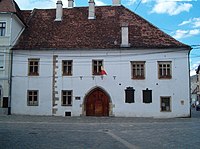
The youngest son Erzhebet Siladya and the outstanding commander Janos Hunyadi , who led the fight against the Ottoman Turks advancing on the Balkan Peninsula and gained considerable authority thanks to this. Among the educators of Matthias were leading Central European representatives of humanism - Janos Vitez and Grigory Syanotsky . According to Antonio Bonfini , Matthias was taught "all the languages of Europe", except Greek and Turkish; this, of course, is an exaggeration, but he really owned, in addition to Hungarian, Polish, Czech, German, Italian and Latin . In accordance with an agreement with Serbian despot Yuri Brankovich and his son-in-law, Count of Slovenia Ulrik Zillei, in 1451, Matthias became engaged to his daughter Erzhebet (Elizabeth), who, however, died back in 1455.
Near Belgrade in 1456, his father, Janos Hunyadi, temporarily stopped the advance of the Turks, but soon died as a result of the outbreak of the plague , and his success caused fears in the circles behind the young king Laszlo V (Ladislav Postum). In order to prevent the Hunyadi family from taking power, in 1457 the king ordered the execution of Hunyadi’s eldest son, Laszlo Hunyadi , on charges of treason and involvement in the killing of Ulrik Zilleya , and the 14-year-old Matthias Hunyadi was imprisoned first in Vienna and then in Prague . In response to the persecution against the Hunyadi family, immediately after the sudden death of Laszlo V on November 23, 1457, a struggle broke out in the country of the national middle nobility for the election of Matthias Hunyadi as the next king.
Climbing the throne
In January 1458, the townspeople and the relatively poor nobility proclaimed Matthias king of Hungary, standing on the Danube ice at the Buda fortress. At the same time, Mathai’s uncle on the maternal side, Mihai Siladia, arrived with a 15,000th militia at a meeting in Rakosmez and forced the baron landowners to approve Matthias Hunyadi as king. The newly proclaimed ruler himself was still imprisoned in Prague until February 1458 , while his mother Erzhebet Silady was paid a ransom of 60,000 gold florins for his son, and the crown of St. Stephen remained in the hands of the Holy Roman Emperor Frederick III of Habsburg (Austria) )
However, Matthias’s ascension to the throne did not stop the confrontation in society: for influence over Hunyadi, a hidden struggle broke out between the factions of Mihai Siladia (around which the barons were grouped) and the Esztergom archbishop Janos Vitez , a humanist thinker and educator of the new king. The winner was Janos Vitez, who entered into negotiations with Jiří (George) Podebrad , a former cup-hussite who became king of the Czech Republic in 1458 (in fact, he released Matthias for ransom).
Thanks to the strengthening of the position of Janos Vitez, he became the new chancellor, and the daughter of Jiří Podebrad Katalina (Katarzyna) Podebrad became the first wife of Matthias Hunyadi in 1463 (the queen will die in childbirth at the age of only 14 years old, and their child also survived her little). In turn, Mihai Siladi, demanding the rank and power of a regent, was removed from public administration and sent on a campaign against the Turks, from which he was no longer destined to return. The powerful family of Garai, supported by Siladya, was deprived of power. Large landowners - barons led by the Palatine Laszlo Garay and the Transylvanian governor Miklos Uylaki - opposed such decisions of the king and prompted Frederick III to invade Western Hungary. The unrest of the barons continued until 1463.
In the summer of 1463, Matthias bought the Sacred Crown of Istvan I from the Austrian Habsburgs for 80,000 gold forints , the same agreement under which Frederick III declared Matthias the adopted son and stipulated the right for his dynasty to take the Hungarian throne if Matthias died without leaving heir, subsequently serve as a formal basis for the claims of the Habsburgs to the throne of Hungary. The Hungarian ruler was crowned with the Holy Crown on March 29, 1464 .
Domestic Policy
At the beginning of the reign of Matthias Corvin, his policy was determined by Janos Vitez. Matyash Hunyadi and Janos Vitez began centralization of the country, which provided for the strengthening of royal power as opposed to the barons and the formation of the state apparatus from the middle nobility, burgher citizens and wealthy peasants. Feudal recruiting kits conducted by aristocrats were replaced by a regular hired national army - the "Black Army".
In order to ensure the independence of the royal army from the barons, a financial reform was carried out. Under Matthias, a regular tax collection was established (1467), in addition, the king for 33 years of his reign more than 40 times announced the introduction of an “emergency tax”. The work of the Treasury was established, the apparatus of which consisted of people of low origin and was headed by the merchant and Ban Ban of Slavonia , a Jewish cross- breed Janos Ernust. As a result, the annual income of the crown has quadrupled and could reach one million forints. On the other hand, tough tax levies caused an uprising of the union of three nations in Transylvania. Matthias’s suspicions that the rebels were supported by the Moldavian ruler Stephen III the Great , provoked the Hungarian invasion of Moldova , which ended in defeat at the Battle of Baia .
Foreign Policy
Thanks to the reorganization of the army and the tax system, Matthias Corvin could wage wars in the Czech Republic, Serbia , and Austria. In 1462, he carried out a number of minor military operations in Slovakia and returned to Hungary several fortresses previously occupied by Hussite mercenaries under the command of Jan Iskra from Brandys . Especially for the conduct of external wars, Matthias created the then-advanced mercenary "Black Army", every fourth infantryman in which - for the first time in Western Europe - was armed with a wick arquebus .
Fighting the Ottoman Empire
In 1464, Matthias Hunyadi, on the call of Pope Pius II, went on a military campaign against the Ottoman Turks, who in 1459 actually subjugated Serbia, and took the Bosnian fortress of Egg . However, the death of the pope overturned Matthias plans to organize a pan-European crusade and forced him to stop military operations. During the reign of Matthias, on the whole, a cease-fire was maintained with the Sultan, and only sporadic raids of the Turks occurred. One of these attacks on Transylvania was repelled in 1479 by two commanders of the Hungarian king, Pal Kinigi and Istvan Batori , near Kenyirmieso .
Subsequently, the Hungarian king held the idea that Hungary was not able to stop Turkish expansion alone or in a situational alliance, and in order to effectively counter the growing power of the Ottoman Empire, it was necessary to create a single Danube monarchy that would unite Hungary, the Czech Republic, Austria and, possibly, Poland into the rights of a personal union and could surpass the Ottoman in military potential. This tendency towards the rapprochement of the Central European states was traced from the XIII century , and in this regard, the main rivals of Matthias were the Habsburgs and Jagiellons , who also claimed to be a unifier in the region. This position of Matthias caused discontent and a significant part of his comrades-in-arms, who came to the conclusion that the king pursues only his own ambitions, and the concentration of efforts to fight neighboring Christian countries distracts attention from the real enemy of Hungary - the Ottoman Port. A considerable part of the feudal lords opposed Corvin, and Janus Pannonius and Archbishop Janos Vitez became the ideological inspirers of the movement. The latter was imprisoned in Esztergom, where he soon died.
Wars in the Czech Republic and Austria
In the years 1468 - 1478, a ten-year war continued for the possession of the Czech Republic . For Hungary, it began when on April 8, 1468 in Požoni, Matthias issued a manifesto in which he declared himself the defender of the Catholic faith and declared war on Jiří from Podebrady. Soon he sent Protasius Olomoucki to Krakow , offering the Polish king an alliance and asking for the hands of his daughter Jadwiga , but did not receive a positive response.
On May 3, 1469, Corwin was proclaimed king of the Czech Republic in Olomouc , however, until the death of Jiří from Podebrady, this title remained formal for Matthias. However, on May 27, 1471, another Czech congress in Kuttenberg elected King 15-year-old Vladislav Jagiellon, the future (from July 15, 1490 ), King of Hungary Ulaslo II . A protracted confrontation began, but thanks to the capture and successful retention of Wroclaw (Boroslav, Breslau), Matthias managed to achieve peace from the Polish-Czech army. As a result, in 1478, the royal title was retained both by Matthias and Vladislav, and Czech possessions were divided between two rulers: the Czech Republic itself went to Vladislav, and Silesia and Moravia - to Corvin.
The possession of Silesia was key to trade hegemony in Central Europe , but Austria needed to be eliminated for political dominance. Taking advantage of the non-payment of indemnity by Frederick III, Hungary in 1482 declared war on Austria, which successfully ended for Matthias. In 1485, he took possession of Vienna, which became his new residence. Towards the end of his reign, Matthias annexed Austria, Slavonia , Styria and Carinthia , formerly owned by the Habsburgs, to his possessions. In 1482, Matthias Hunyadi established diplomatic relations with the Russian state (the diplomatic representative of the Grand Duke of Moscow Ivan III Fyodor Kuritsyn ).
Matyash Hunyadi and Culture
In 1476, after the death of his first wife , Matthias married the daughter of the Neapolitan king Fernando I Beatrice of Aragon , and Hungary joined the culture of the Italian Renaissance ; the queen was popular among the people, encouraged the educational activities of the king. At the request of Beatrice, Matthias sent General Balas to Italy, who in 1481 robbed the city of Otranto from the Turks, captured on the eve of Mehmed II . However, the king’s marriage with Beatrice was marred by the absence of sons.
The splendor of the royal court in Buda, the “Pearl of the Danube”, attracted scientists, cultural figures, humanists and simply educated people from all over Europe . Corvin 's famous library became the largest on the continent, second only, perhaps, to the Vatican . According to various estimates, up to 2500 codes could be stored in the Matthias library, which was a huge collection at that time; some of them existed only in one copy (the treatise of the Byzantine emperor Konstantin Bagryanorodny “ On Ceremonies ” and “Church History” by Nicephorus Callistus ). The king did not spare money for the purchase and correspondence of books, as well as their translation from ancient Greek to Latin. Although the German Andreas Hess began printing in Buda in 1473, most of the volumes in the Corvin library are illustrated manuscripts. Most often, they were ordered in Florence through the booksellers there and were illustrated by famous Florentine miniaturists . Over time, a scriptorium was created for the correspondence, design and binding of books at the royal court in Buda . The keepers of the library were highly educated humanists Marzio Galeotto and Tadeo Ugoletti .
Although the library of Corvin included the works of the fathers of the Christian church, Byzantine writers and medieval scholastics, and the works of the writers of the Early Renaissance in bilingual (Greek-Latin) versions, but its main difference from similar collections of that time was the presence of a large number of Greek-language secular books by ancient authors, which reflected the personal interests of the king. He liked to read the writings of historians - Libya , Caesar , Curtius Rufus and Celia Italik (the correspondence of Matthias with the Italian historian Pomponius Summer , which he thanks for sending the work of Celia about the Second Punic War ) was preserved. Well versed in philosophy and theology , he could participate on equal terms in discussions at court. He was also familiar with works on military science and tactics, and was interested in astronomy and astrology .
Cities in the north of the kingdom, including those located on the territory of modern Slovakia, became centers of Renaissance, and Hungary began to exert a significant cultural influence on a number of neighboring states, up to the Grand Duchy of Lithuania . In 1465, Matthias Corvin founded the Istropolitan Academy in Bratislava , the first university in Slovakia . Under Matthias Hunyadi, in 1488, Chronica Hungarorum was published by Janos Turoci , in which the Hungarians were proclaimed descendants of the Huns , and Corwin - “the second Attila ”.
Recent years
During Palm Sunday celebrations in Vienna in 1490, King Matthias fell down and died on April 6 after two days of torment. According to the professor of medicine at the University of Budapest, Friedias Koranyi , the king died of a stroke due to a stroke , the German physician Dr. Herwig Egert admits poisoning .
The funeral service took place in Vienna's St. Stephen's Cathedral , and the remains are buried in the Basilica of Szekesfehervar on April 24 or 25, 1490.
Since the king’s marriages did not lead to the birth of the heir, the only surviving descendant of Matthias was his illegitimate son Janos Corvin , born in 1473 from a lover named Barbara. In his last years, Matthias tried to achieve recognition of him as his legal heir to the throne, but in vain.
The Meaning of the Board
In historiography, the reign of Matthias Corvin is considered to be the time of the last exaltation of the independent Hungarian kingdom. In general, Matthias created a centralized state, but in the conditions of aggression by the Ottoman Empire and high social tension within the Hungarian kingdom, it could not exist stably for a long time.
Folklore preserved his memory as a “fair king” - even the proverb “Matthias died and justice died with him”. In the eyes of his contemporaries, Corwin earned the glory of the “last knight” of medieval Europe, reinforced by his own propaganda steps, in particular, the statement about the origin of the Hungarian king from the Roman emperors from the Julius-Klavdiev and Aeneas dynasty .
In Culture
In computer games
Represents Hungary in Sid Meier`s Civilization VI.
Notes
Literature
- Matthias and his Legacy: Cultural and Political Encounters between East and West. - University of Debrecen, 2008. - ISBN 978-963-473-276-1 .
- Birnbaum, Marianna D. The Orb and the Pen: Janus Pannonius, Matthias Corvinus and the Buda Court. - Balassi Kiadó, 1996. - ISBN 963-506-087-4 .
- Matthias Corvinus, the King: Tradition and Renewal in the Hungarian Royal Court 1458-1490. - Budapest History Museum, 2008 .-- ISBN 978-963-9340-69-5 .
- Farbaky, Peter. Italy & Hungary: Humanism and Art in the Early Renaissance / Peter Farbaky, Louis A. Waldman. - Harvard University Press, 2011 .-- ISBN 9780674063464 .
- Feuer-Tóth, Rózsa. Art and Humanism in Hungary in the Age of Matthias Corvinus. - Akadémiai Kiadó, 1990. - ISBN 963-05-5646-4 .
- Gastgeber, Christian. Matthias Corvinus und seine Zeit: Europa am Übergang vom Mittelalter zur Neuzeit zwischen Wien und Konstantinopel [Matthias Corvinus and His Time: Europe in Transition from the Middle Ages to Modern Times between Vienna and Constantinople] : [ him. ] / Christian Gastgeber, Ekaterini Mitsiou, Ioan-Aurel Pop ... [et al. ] . - David Brown Book Company, 2011 .-- ISBN 978-3-7001-6891-1 .
- Klaniczay, Tibor. Matthias Corvinus and the Humanism in Central Europe / Tibor Klaniczay, József Jankovics. - Balassi Kiadó, 1994. - ISBN 963-7873-72-4 .
Links
- Map of Europe in 1500.
- The Squash and the Colt , a folk tale reflecting Matthias' wisdom and sense of justice
- Bibliotheca Corviniana Digitalis - National Széchényi Library, Hungary
- Map of Europe in 1500.
| Predecessor: Laszlo V | King of hungary 1458 - 1490 | Successor: Ulus II |