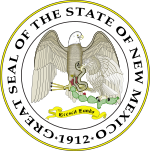
The Great Seal of the State of New Mexico is the official state symbol of the state of New Mexico . Historically, in the United States, the design of the state seal is also the state emblem. The modern look of the seal and coat of arms was approved in 1913 .
History
The first print option was developed shortly after the creation of the Government of the Territory of New Mexico in 1851 . The original seal was lost, perhaps it was placed as one of the memorials in the first stone when laying the monument to the soldiers in Santa Fe Plaza. The prints of the original seal show that it depicted an American eagle, squeezing an olive branch in the claws of one paw, and three arrows in the other. In the ring around the image was the inscription “Great Seal of the Territory of New Mexico” ( Great Seal of the Territory of New Mexico ).
In the early 1860s, an unknown official put into circulation a new seal, the design of which is close to the modern one. It depicts an American eagle with spread wings protecting the smaller Mexican eagle (Mexican eagle - a symbol depicted on the coat of arms of Mexico ). The inscription “Territory of New Mexico” ( New Mexico Territory ) was on the edge of the print, and the date MDCCCL (1850 in Roman numerals) was on the bottom.
The reason and time for the appearance of the Latin inscription “Crescit Eundo” (“Growing on the go”) is unknown . In 1882, Secretary of State of the New Mexico Territory V.G. Rich ( WG Ritch ) approved a sample print with this inscription. This version was positively accepted and approved as the official seal and coat of arms by the legislative assembly of the territory in 1887 .
In 1912, New Mexico became the 47th state of the United States, and the Legislative Assembly appointed a commission to develop the state seal and coat of arms. The commission included then Governor William McDonald, Attorney General Frank Clancy, Chief Justice Clarence Roberts and Secretary of State Antonio Lucero. The commission worked for a year and a half, and came to the conclusion to leave the previous seal and coat of arms, replacing them with only the date for 1912. In 1913, the official New Mexico State Seal was approved. In 2005, state senator Joseph Carraro proposed replacing the motto on the coat of arms with the Latin dictum “Antiqua suspice, crastina accipe” (“Respecting the past, embracing the future”) [1] , explaining this by the incomprehensibility of the existing motto for contemporaries.
Emblem Description
The official description [2] states:
The coat of arms of the state shall be the Mexican eagle grasping a serpent in its beak, the cactus in its talons, shielded by the American eagle with outspread wings, and grasping arrows in its talons; the date 1912 under the eagles and, on a scroll, the motto: "Crescit Eundo." The great seal of the state shall be a disc bearing the coat of arms and having around the edge the words "Great Seal of the State of New Mexico.
“On the state emblem there is a snake holding a beak in its beak, and a Mexican eagle in the claws of a cactus, which is protected by an American eagle with spread wings, holding arrows in its claws; date 1912 under the eagles and the motto on the scroll is “Crescit Eundo”. The state seal must be a disc with the coat of arms and bears the inscription “Great Seal of the State of New Mexico”.
The Mexican eagle is a symbol of Mexico, on the emblem of which is a golden eagle ( golden eagle ). The golden eagle with a snake in its beak and a cactus in its claws reflects the ancient myths of the Aztecs , the indigenous people of Mexico. Modern New Mexico was founded by Spanish colonists, was part of New Spain, and then Mexico. The image of the Mexican eagle emphasizes the national traditions of the Aztecs and Spanish settlers. The larger American eagle, which protects the wings of the Mexican eagle, symbolizes a change in the status of the territory in 1846 , when it came under the jurisdiction of the United States. The American eagle holds arrows in its claws, and its gaze is directed to the Mexican eagle. In general, the composition reflects the dominant position of the United States while respecting the cultural, historical and national traditions of the local population.
The date 1912 indicates the time of the founding of the state of New Mexico. The Latin motto “Crescit Eundo” (“Growing on the go”) originally indicated the continued expansion of New Mexico. The modern interpretation refers to the continuous expansion of the state’s economy and culture.
Notes
- ↑ Senate Bill 953, 2005
- ↑ New Mexico State Code of Law, 12-3-1 Archived July 12, 2012.