Sosvinsky urban district - a municipality in the Sverdlovsk region of Russia . Refers to the Northern Management District .
| City District | |||
| Sosva district | |||
|---|---|---|---|
| |||
| A country |  Russia Russia | ||
| Subject of the federation | Sverdlovsk region | ||
| Adm Centre | Sosva | ||
| Includes | 24 settlements | ||
| Population ( 2018 ) | ↘ 13,889 [1] people | ||
| • percentage of the population of a constituent entity of the Russian Federation - 0 32% | |||
| Coordinates of the administrative center | |||
| Head of the City District | Makarov Gennady Nikolaevich | ||
| Timezone | MSK + 2 ( UTC + 5 ) | ||
| OKTMO code | 65721000 | ||
| http://adm-sosva.ru/ | |||
 | |||


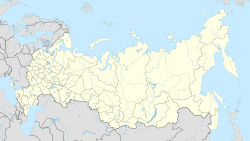

Administrative center - urban settlement (working village) Sosva .
From the point of view of the administrative-territorial structure of the region , the urban district is located in the territory of the administrative-territorial unit Serovsky District . [2] [3]
Geography
Sosva urban district is located in the north of the Sverdlovsk region . The total land area of the municipality is 4733 km².
Forest Fund
The territory of the district belongs to the Sredneuralsky forest region, taiga zone. Pine, spruce, as well as cedar, birch and aspen predominate. Of particular value are the cedar forests. Well-known cedar forests Yakimovskiy and Monastyrsky (near-settlement), Teterinsky, cedar forests on Tankovsky swamp, etc. The lands of the forest fund occupy more than 85% of the territory of the district. The state forest fund belongs to Sotrinsky forest area (the total area of 771418 hectares includes a part of Alapaevsky MO and Serovsky GO). In addition, there are tracts (formerly rural forests) - the Romanov State Farm (13,210 hectares) and the Koshaysky State Farm (1,938 hectares). The fauna is typical for the taiga forest zone.
Rivers
The main waterway of the Sosva urban district is the Sosva river (635 km), flowing through the Sosva city district from north-west to east, into which the Lyalya river (268 km) and a number of other small-sized rivers and streams flow. Of the significant are the Rumor (70 km), Negla (26 km), Tesma (40 km). The Sosva River is navigable below from the village of Sosva. At the time of intense logging along the Sosva River, molar rafting was carried out.
Minerals
Gold, manganese, iron and nickel ores were mined in explored minerals in the Sosva district of the city in different years, the organization of the extraction of building sand, crushed stone, and brick clay is possible.
In the southeastern part of the Sosvinsky urban district, the reserves of the Sosvinskoe deposits of underground mineral waters have been explored, the extent of which spread over the halo is about 25 km According to the conclusion of the Medical Scientific Center for the Prevention and Protection of Industrial Workers, water from well No. 6, located in the village of Sosva, can be used as mineral drinking water for treating patients with chronic gastritis, colitis, liver and biliary tract diseases, and metabolic diseases. In 1997, Metmash OJSC organized an industrial spill of Sosva mineral waters with subsequent sale through a trading network. Other natural springs (Koshaysky and Neglinsky) are located in the distribution area of this underground mineral water.
Infrastructure
Transport communication with other settlements of the Sverdlovsk region is carried out by railway Ekaterinburg - Alapaevsk - Serov, as well as by roads of federal and regional importance Serov - Sosva - Gari. Transport communication within the Sosva urban district is carried out mainly by road along federal, regional, and regional roads of Sosva - Romanovo - Maslova - Serov, Sosva - Koshai - Vostochny.
History
On January 1, 2006, in accordance with the Order of the Government of the Sverdlovsk Region No. 736 dated June 30, 2005, the Serovsky District municipality was renamed Sosvinsky urban district , the administrative center of which was the city of Serov .
On July 12, 2007, by the law of the Sverdlovsk region, 10 rural territories were transferred to the structure of the Serov urban district : Morozkovo, Elovka, Semenovo, Pospelkovo, Andrianovichi, Marsyaty, Novaya Elovka, Krasnoyarka, Klyuchevoy, Pervomaysky. The administrative center of the district becomes the village of Sosva .
History of the area before the formation of the district
In the 16th — 19th centuries, the emergence of many settlements in the Sosva urban district was associated with the development of the lands of Zauralye and Siberia, and in the 20th century with the development of the timber and woodworking industry and the relocation, including forced ones, of people from other regions of the country.
Initially, the Voguls ( Mansi ) settled on the Sosva River. After the campaign of Yermak (1581) against Kuchum, the systematic development of the Trans-Ural lands by the Russian people began. The Sosva River is an important waterway of that time. It was the beginning of the road to the Ob. Since 1600, Russian settlers gradually settled the land along the Sosva River.
The village of Koshai was founded in 1600 simultaneously with the cities of Verkhoturye and Turin. Koshaysky guard tied Verkhoturye and Pelym. Koshay is not only the oldest settlement in the area, but also one of the oldest in the area (older than Pelym).
The villages of Koshaevs, Strunins, Alekseevka, Kopylov, Romanovo, Yakimov, Matushkina and others appear. The discovery of salt springs on the Negle River and the setting up of a guard in Koshaya to protect the craft, the establishment of customs, and then the construction of the church in 1718 contributed to the development of Koshay. Locality acquired the status of the village. Appeared parish. The Sosva parish included the settlements of newly baptized voguls: Mishin, Kumychev, Akhmachyov, Sotrina, Morozkov, Tsipilev, Onisimov. In 1816, there were already 18 villages in the Sosva parish. The most significant settlements were: the Esaulkova, Anisimkovy, Kopylov, Denezhkin and Mishin.
After the construction of the city of Verkhoturye, the road to Tobolsk was built through the town of Pelym. Along the "Tobolsk" tract settled archers and townspeople. The villages of Monastyrka, Matushkina, Maslova, Andreevichi, Semenova, Alekseevskaya, Romanovo and others appeared.
In 1839 a church was built in the village of Romanovo, the town acquired the status of a village. The Romanovsky parish included the villages of Tolmachyova, Monastyrka, Yakimov, Matushkina, Tarakankova, Denisova, Maliy Mys (Kopylova), Panshina, Titova, Morozkov, Pospelkov, Maslov.
The first mention of the village Maslova (Ivanovichi) appeared in 1734 . There was a village of many small settlements.
A number of localities in the Okrug (Molva, Tyumen, Ust-Berezovka, Ust-Khmelevka) were founded in the early 20th century after the Stolypin reform by migrants from western Russia.
Sosva village was formed in 1880 during the construction of the foundry. Supervised the construction of a mining engineer Apollon Nikitin. In 1885 the first blast furnace was put into operation. By the beginning of the 20th century, about 3,000 people worked at the plant. Sosvinsky iron foundry ended its existence on May 25, 1926 , and from September 21, 1932 in the r. P. Sosva began to build a woodworking plant. Since January 11, 1938, a department of the North-Ural camp of the NKVD of the USSR has been created in the village of Sosva.
The appearance of the village of Vostochny is associated with the formation and development of the Otradnovsky timber industry enterprise (1949), to which the Ovrazhny timber industry enterprise was transferred. In the 50s, in the village of Vostochny, Predtursky MLC was built. Since the construction of the village was carried out in three different places at once, it is divided into three microdistricts (Ovrazhinsky, Otradnovsky, Dokovsky).
Sosva parish unchanged existed until it was transformed in 1923 into an area by the decision of the XII Congress of the RCP (b). Until 1931, the Sosva District was part of the Urals Region. In July 1931, the Sosvinsky District was included in the Nadezhda District as the Sosvinsky Village Council and village councils of settlements that were previously included in the Sosvinsky District (Resolution of the All-Russian Central Executive Committee of June 10, 1931). In 1933, the Nadezhdinsky District was liquidated, its territory was annexed to the Nadezhda City Council (Resolution of the All-Russian Central Executive Committee of June 20, 1933). In 1939, on the basis of the Decree of the Presidium of the Supreme Soviet of the USSR dated July 7, 1939, the city of Nadezhdinsk was renamed Serov. In 1940, the Serov District was formed again. In 1959, the Serov district was liquidated. Sosva village council passed to the Serov city council. Verkhotursky region was replenished with Romanovsky, Koshaysky, Maslovsky and other village councils. In 1965, the Serov district was re-formed.
Population
 | ||||||||||||||||||||||||||||||||||||
Composition of the urban district
Sosva urban district and Serovsky district (from October 1, 2017) [2] includes the following localities:
| No | Locality | Type of locality [2] | Population |
|---|---|---|---|
| one | Sosva | settlement, administrative center | ↘ 8249 [1] |
| 2 | Oriental | village | ↘ 4673 [4] |
| 3 | Denisova | village | ↘ 20 [4] |
| four | Green | village | ↘ 3 [4] |
| five | Kiselyov | village | ↘ 0 [4] |
| 6 | Kopylova | village | ↗ 41 [4] |
| 7 | Koshai | village | ↗ 811 [4] |
| eight | Nettle | village | ↘ 2 [4] |
| 9 | Kuropashkina | village | ↘ 30 [4] |
| ten | Maslova | village | ↘ 183 [4] |
| eleven | Matushkina | village | ↘ 12 [4] |
| 12 | Mishina | village | ↘ 49 [4] |
| 13 | Rumor | village | → 51 [4] |
| 14 | Monastery | village | ↘ 19 [4] |
| 15 | New Dawn | village | → 0 [4] |
| sixteen | New Dawn | village | ↗ 7 [4] |
| 17 | Stepson | village | ↘ 159 [4] |
| 18 | Romanovo | village | ↘ 588 [4] |
| nineteen | Sosva New | village | ↘ 21 [4] |
| 20 | Tyumen | village | ↘ 0 [4] |
| 21 | Corner | village | ↘ 2 [4] |
| 22 | Ust-Berezovka | village | ↘ 3 [4] |
| 23 | Ust-Khmelevka | village | ↘ 38 [4] |
| 24 | Charms | village | ↘ 0 [4] |
Economy
The main gas pipelines of the SRTO (northern districts of the Tyumen region) - Ural, Urengoy - Center and the Surgut - Polotsk, Kholmogory - Klin oil pipelines pass through the territory of the Sosvinsky urban district. ".
The most important sectors in the economy of the Sosva urban district are the timber and woodworking industries. In total, 6 state-owned enterprises of federal property, 4 municipal enterprises, 1 open joint-stock company, 1 closed joint-stock company, 11 limited liability companies and 5 peasant farms, 77 individual entrepreneurs, 3 public organizations are registered in the territory of the Sosvinsky urban district.
The main forest and woodworking enterprises: LLC Argus-SFK, FBU OIK-4 OUHD GUFSIN of Russia in the Sverdlovsk region, LLC Taejnoe, LLC Sosvinsky forest, GU Sotrinsk forestry, LLC Torgovy House "Sosva" ", LLC" Otradnovsky forestry ", LLC" Trade House "Factory" and others.
Attractions
In December 2008, a memorial sign, a symbol of the center of the Sverdlovsk region, was installed on the 21 km of the Sosva-Vostochny highway. It has been established that the geographical center of the Sverdlovsk region is located at 58 degrees 59.86 minutes north and 61 degrees 44, 51 minutes east long here, almost four hundred kilometers from Ekaterinburg.
Features
The remote location of the territory and the presence of colonies left its mark in the perception of the Sosva region. In the Sverdlovsk region, the following sayings became famous: “To whom Sochi da Gagra is to whom Sosva da Gary”, “Three Sverdlovsk holes - Sosva, Gari, Tabory”.
Notes
- ↑ 1 2 3 Population of the Russian Federation by municipalities as of January 1, 2018 . The appeal date was July 25, 2018. Archived July 26, 2018.
- ↑ 1 2 3 Law of the Sverdlovsk Region “On the Administrative-Territorial Structure of the Sverdlovsk Region” of April 13, 2017 N 34-OZ
- List of administrative-territorial units and settlements of the Sverdlovsk region (order of January 11, 2016 N 8-P, Ministry of Construction and Infrastructure Development of the Sverdlovsk Region)
- ↑ 1 2 3 4 5 6 7 8 9 10 11 12 13 14 15 16 17 18 19 20 21 22 23 24 All-Russian population census of 2010. Population size and location of the Sverdlovsk region . The date of circulation is June 1, 2014. Archived June 1, 2014.
- ↑ Sverdlovsk region. Estimate of the number of resident population on January 1, 2009-2014
- Population of the Russian Federation by municipalities. Table 35. Estimated number of resident population on January 1, 2012 . The date of circulation is May 31, 2014. Archived May 31, 2014.
- ↑ Population of the Russian Federation by municipalities as of January 1, 2013. - M .: Federal State Statistics Service Rosstat, 2013. - 528 p. (Table 33. Population of urban districts, municipal districts, urban and rural settlements, urban settlements, rural settlements) . The appeal date is November 16, 2013. Archived November 16, 2013.
- ↑ Table 33. The population of the Russian Federation by municipalities as of January 1, 2014 . Circulation date August 2, 2014. Archived August 2, 2014.
- ↑ Population of the Russian Federation by municipalities as of January 1, 2015 . Circulation date August 6, 2015. Archived August 6, 2015.
- Population of the Russian Federation by municipalities as of January 1, 2016
- ↑ Population of the Russian Federation by municipalities as of January 1, 2017 (July 31, 2017). The date of circulation is July 31, 2017. Archived July 31, 2017.