The Keepers (found in Watchmen ) is a limited edition of twelve comic books published by DC Comics from September 1986 to October 1987, and later reprinted as a graphic novel . The authors of the series are writer Alan Moore , artist Dave Gibbons and colorist John Higgins - Used as prototypes of superheroes , the rights to use of which were recently acquired by DC Comics from another company that published comics - Charlton Comics . Since the story proposed by Moore did not leave the possibility of further use of many of the heroes, the editor is Dick Giordano convinced writers to create new characters [1] .
| Keepers | |
|---|---|
| Watchmen | |
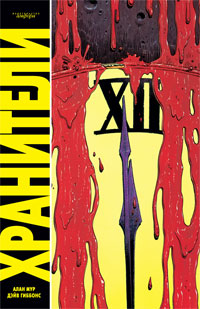 Cover of the Russian edition | |
| Story | |
| Publisher | DC Comics |
| Format | Limited edition |
| Periodicity | Monthly |
| Publication Dates | September 1986 - October 1987 |
| Number of issues | 12 |
| Characters | Walter Kovacs / Rorschach Adrian Weidt / Ozimandia Edward Blake / Comedian John Osterman / Dr. Manhattan Daniel Dryberg / Night Owl II Lori Yuspechik / Silk Ghost II |
| Creators | |
| Screenwriters | Alan Moore |
| Artists | Dave Gibbons |
| Font | Dave Gibbons |
| Paints | John Higgins |
| The authors | Len Wayne ( editor ) Barbara Kesel ( editor ) |
| Site | |
Moore used history as a means of reflecting the social problems of the time and criticizing the concept of superheroes. The action of the comic takes place in an alternative reality of the 1980s, where superheroes appeared in the 1940-1960s and helped the United States win the war in Vietnam . A few years later, the United States is on the verge of a nuclear war with the USSR , and costumed heroes are outlawed, and most of them retired, but some continue to secretly work for the government. The plot is based on an investigation into the murder of a former hero, funded by the government, which, in the denouement of the comic strip, reveals the terrifying truth and the death of millions of people in order to prevent a nuclear war .
A distinctive feature of the novel is its non-linear narrative structure. Gibbons arranged nine frames per page [2] , and also used repeated characters, such as a bloody yellow emoticon [3] . All issues except the last include additional fictitious documents - articles, books, photographs, newspaper clippings, which take place in the described fictional world and tell the background of events [4] . Starting with the third chapter, the plot is intertwined with another comic strip - The Legends of the Black Schooner, which is read by a boy near a newsstand.
The Keepers received positive reviews from both specialized comic books and the mass media. The novel is considered one of the best in the history of comics and has been awarded many awards along with the creators. After a number of film adaptation attempts, in 2009 the film of the same name directed by Zack Snyder was released , which was ambiguously evaluated by critics [5] [6] .
Story
The action of the "Guardians" takes place in the 1980s in the United States of America in an alternative reality. The main difference from the real world is the existence of costumed heroes. The bifurcation point falls on 1938, and subsequent events have changed, for example, the course of the Vietnam War , in which Dr. Manhattan intervenes and ceases hostilities in a short time, as well as the presidency of Richard Nixon , who, according to the plot, was elected for a third term, which implies that the Watergate scandal did not exist [7] . The described events are as close to reality as possible - none of the heroes, except Doctor Manhattan, has superhuman capabilities, described by the word vigilantes - someone who is vigilant, personally administering justice, “the avenger in the mask”. Dr. Manhattan is perceived by the government as a strategic weapon against the Soviet Union and at the same time accelerates the growth of tension between the two countries [8] . After some time, the heroes ceased to enjoy the trust of the police and the public, and the government adopted a decree of Senator Kinne on August 3, 1977, officially outlawing costumed heroes [9] .
Key Events
October 1985, New York police unsuccessfully investigate the death of a certain Edward Blake, thrown out of the window of his own apartment. Rorschach , the last “masked hero", who refused to stop his activities after it was banned by the government, is interested in the murder. Rorschach discovers a hiding place in Blake’s apartment with a suit and outfit of Comedian, a former masked hero who is rumored to have been recruited by the government. Rorschach concludes that someone “eliminates the avengers” [10] . Rorschach is trying to bring other heroes to the investigation, emphasizing that if you do not find the killer, they can become the next victims. He warns Daniel Dryberg (Night Owl II), Adrian Weidt ( Ozimandia ), John Osterman (Dr. Manhattan) and his girlfriend Lori Yuspeshik (Silk Ghost II).
Meanwhile, many artists, writers and scholars are missing, and leaflets about the missing can be seen with promises of rewards. After Blake’s funeral, Dr. Manhattan was publicly accused on television of allegedly causing cancer in people he had close contacts with, including his former lover Jenny Slater. Manhattan takes the charges to heart and teleports to Mars , wanting to stop communicating with people. After his escape, the balance of power between the USA and the USSR is disrupted. The Soviet Union invades Afghanistan , testing America’s reaction.
Unknown makes an attempt on the life of Adrian Weidt, but dies himself. Together with previous events, this reinforces Rorschach's hypothesis about a conspiracy against former masked heroes, and he decides to visit a former criminal named Moloch Mystic, who spoke with Comedian shortly before his death. Having entered the apartment, Rorschach discovers that Moloch is dead and the house is surrounded by police. Rorschach realizes that he was framed and falls into the hands of the police.
Unsatisfied with the relationship with John Osterman, whose superpowers are gradually moving him away from people, Lori Yuspeshik gets close to Daniel Dryberg. Remembering the common heroic past, Lori and Daniel realize that they miss without incident. They put on their costumes again and decide to return as crime fighters. It seems to Dryberg that Rorschach’s theory of a conspiracy against former heroes has some truth, and he and Lori decide to release Rorschach from prison.
Rorschach, by the time Lori and Daniel appeared, had already climbed out of the cell on their own during a riot by the prisoners. They pick him up and discuss how the investigation has progressed. Suddenly, Dr. Manhattan appears and convinces Lori to go with him to Mars "to convince to save the world." During a debate on Mars, Lori accidentally finds out that the murdered Edward Blake, whom she despised for trying to rape her mother, is her biological father. Dr. Manhattan thinks about the complexity of human inner life and decides that humanity is worth saving.
Meanwhile, the Night Owl and Rorschach together come to the conclusion that the same person is behind the death of Comedian and Moloch, the detention of Rorschach and public accusations of Dr. Manhattan, and everything indicates that this person is Adrian Weidt. Rorschach describes his suspicions at the end of his diary and sends it by mail to Novy Dozorny, a small New York newspaper of extreme right - wing views, of which he was a regular reader. After that, Rorschach and the Night Owl set off for Adrian’s base in Antarctica .
Rorschach and the Night Owl meet Adrian Weidt, who tells them his plan to prevent a nuclear war between the US and the USSR by rallying the two countries against a common enemy - the monster artificially created by Weidt must destroy the population of New York by imitating an alien attack , “destroy millions to save billions. " Adrian also confirms all the conclusions of the heroes, admitting that he killed Comedian and Moloch, fabricated charges against Dr. Manhattan, staged an attempt on himself and framed Rorschach. In addition, he declared his involvement in the disappearances of artists, scientists and writers around the world - all these people secretly worked on the creation of the Weidt monster, after which they were killed. Nocturnal Owl and Rorschach are trying to stop Weidt, but Adrian claims that he has already implemented his plan 35 minutes ago.
When Dr. Manhattan and Lori Yuspechik return to Earth, they see the bloody, extinct New York. Manhattan discovers that tachyons blocking his ability to predict the future are emitted from Antarctica, and together with Laurie, he teleports to Weidt's base, where he learns about Adrian's involvement in the incident. Manhattan and Weidt are trying to annihilate each other, but it all ends when Adrian turns on the televisions broadcasting news that the USSR and the US are teaming up to fight the new alien threat. All the heroes, except Rorschach, acknowledge that it is in the interest of humanity to keep Weidt's plan secret. Rorschach refuses to compromise “even in the face of the Apocalypse” and declares that he will reveal the truth to people, and only death can stop him. Dr. Manhattan kills Rorschach.
In the finale, Dr. Manhattan leaves the Earth, finally abandoning what is happening on it. Lori and Dryberg change names and get married. The editor of the New York newspaper "New Watch" complains that because of the new political situation he has nothing to write about, and asks the assistant to pick up something from the collection of old rejected materials. The plot ends when the assistant reaches out to a basket of papers, on top of which lies Rorschach's diary.
Characters
- Daniel Dryberg / Night Owl II is a professional ornithologist [11] , a retired superhero who previously used owl themes in his costumes. Dreiberg's character is based on a DC Comics superhero named Ted Kord, also known as the Blue Beetle [1] . Like Ted Kord, who is the second person to wear the pseudonym Blue Beetle, Dryberg became the second Night Owl after Hollis Mason, who worked on the first team of costumed heroes [12] . Richard Reynolds in the book Super Heroes: A Modern Mythology ( Russian Superheroes: Modern Mythology ) noted that despite the fact that the character is officially based on the hero of Charlton Comics, the Night Owl is more likely to be more related to the DC universe, in particular, to Batman [13] , while Klok expressed the opinion that Dreiberg’s character is closest to “Middle-aged Clark Kent ” [14] .
- Walter Joseph Kovacs / Rorschach is a vigilante wearing a white mask of fabric invented by Dr. Manhattan, on which black spots symmetrically move, similar to the Rorschach test . Despite the law prohibiting the activities of masked avengers, he continues to fight crime alone, which is why he himself received the status of a criminal and is wanted by the police. Moore described Rorschach as "the quintessential character of Steve Ditko , whose last name began with" K "and which has a mask of strange design," referring to Mr. Hey, created by Ditko in 1967. The Rorschach prototype in Charlton became the superhero Question [1] . Comic book historian Bretford Wright believes that Rorschach considers his appearance in this world to be random, and the world itself to be morally empty and hopeless [15] . Moore also said that he did not plan the death of Rorschach until the fourth release, when he realized that his uncompromising attitude would not allow him to live to the end of the story [16] .
- John Osterman / Dr. Manhattan - "superman", after the prohibition of the costumes of heroes working under a contract for the government of the United States . Former nuclear physicist with whom an accident occurred in 1959, and it was decomposed into atoms . Having managed to assemble his body back, Osterman gained power over matter and space, which made his possibilities practically divine. At the same time exists in the past, present and future and is aware of this. His body is not sensitive to gravity , cold, heat, vacuum conditions, to any material and non-material obstacles. The basis for Dr. Manhattan was Captain Atom, a Charlton character [1] . Moore originally wanted to make a character somehow connected with a nuclear threat, but soon decided to use a more advanced hero, like Dr. Manhattan, instead of Atom. Unlike other superheroes, for whom scientific knowledge was not required, Moore tried to delve into the basics of nuclear physics, working on the creation of Osterman. Moore believed that such an improved person who sees matter at the quantum level is not able to perceive time linearly - as ordinary people see it, and therefore it will inevitably move away from humanity. Moore wanted to make a character devoid of emotions, like Spock from the television series Star Trek [16] . Gibbons created a character with blue skin, like Rogue Trooper , and later made it more saturated in color, and the glow is explained by the Vavilov – Cherenkov effect [17] . Moore was not sure whether DC would allow the character to be completely naked, and Gibbons later, portraying Manhattan's nudity, carefully selected the angle so that the genitals did not stand out clearly, especially in the frontal plane [18] . In the story, it is the government that insists that John Osterman use the pseudonym Dr. Manhattan so that the adversary associates the superhero with the Manhattan project and also chooses a character for himself. He is offered the symbol of the atom , but Osterman refuses in favor of the symbol of the hydrogen atom , "which he respects" [19] .
- Edward Blake / Comedian [20] is one of two heroes recruited by the government following a 1977 Kinna decree prohibiting the activities of costumed crime fighters. His murder, which occurs shortly before the beginning of the first chapter, sets the starting line of the Guardians. Despite this, Blake repeatedly appears in flashbacks and memoirs, from which it follows that he was a member of the first team of heroes, the Militias, which operated in the 1950s and 1960s [9] . The comedian was based on Peacemaker, the character of Charlton, with elements of Nick Fury - spy, director of the organization Sch.I.T. in the Marvel universe . Moore and Gibbons described the Comedian as "a kind of Gordon Liddy , only much tougher ” [1] , and Richard Reynolds described him as“ ruthless, cynical and nihilistic, but still capable of a deeper, unlike the rest, understanding of the role of the costumed hero ” [9] . The plot is the father of Lori Yuspeshik, and despite the fact that he tried to rape her mother, Sally, it is shown that Lori was conceived after a voluntary sexual relationship between Blake and Sally Yuspeshik.
- Laurel Yuspeshik / Silk Ghost II - a hereditary costume hero, daughter Sally Yuspeshik, who was part of the first team of the Militias. At the peak of her career, her mother, who has Polish roots, changed her surname to Jupiter, considering her a more suitable public person. Lori grew up in the shadow of Sally, which is why they have a tense relationship. For a long time she was the mistress of Doctor Manhattan, after decree Kinna lived with him for many years, in the course of the plot of the novel she became close to Daniel Dreiberg and married him in the finale. In fact, the prototype of Laurie was the heroine of the Night Shadow of Charlton Comics, but Moore was not impressed and used elements of the DC Black Canary and an earlier version of the Phantom Lady Quality Comics [1] .
- Adrian Weidt / Ozimandia is a wealthy businessman who left the hero two years before Kinn's decree and built a large corporation engaged in energy , genetics , perfumes, films and toys, which has its interests in the sports industry. He became a hero in a suit after being introduced to history, ancient teachings and the cultural heritage of Egyptian civilization. One of two heroes who voluntarily declassified their identity, along with Hollis Mason. Weidt’s views are deep and complex, he evaluates the picture as a whole, sees the connection in a complex [1] . His idol is Alexander of Macedon , who inspired him during his superhero activities. PR specialists use Weidt’s personal qualities to replicate his image of “the most intelligent person on earth.” The prototype of the character was the hero Charlton Comics Thunderer. Richard Reynolds noted that Weidt possesses the features inherent in supervillains - he is absolutely not constrained by morality and, without visible remorse, kills even the most attached to him people, if he finds it rational, and is confident that he helps the whole world [21] . He is the actual antagonist of the whole series, which becomes clear in the final chapter.
Creation
I probably just thought that there would be a good way to start the comic: "The famous superhero is found dead." Solving the mystery, we would bring superheroes to the very heart of this world and show a reality that is very different from the image of the hero in the eyes of the general public. - Alan Moore about the origin of the idea of "Guardians" [1] |
In 1985, DC was acquired from Charlton Comics line of characters [22] . During this period, writer Alan Moore was preparing a storyline using new characters that he would partially rewrite, as was done in his Miracleman series back in the early 1980s. Moore thought that a team of the Mighty Crusaders and MLJ Comics be suitable for the plot , an imprint from Archie Comics , and therefore came up with a mysterious murder of one of its members - a hero nicknamed Shield, whose body is found in the harbor [1] . Moore believed that the line of characters to be used does not matter, but ultimately abandoned the idea with MLJ Comics and used characters who had previously appeared in the Who Killed the Peacemaker series ( Russian Who killed the peacemaker ) by Charlton Comics [18] , and proposed the idea to the then DC editor Dick Giordano [22] . Giordano appreciated the story proposed by Moore, but was against the use of the heroes of Charlton Comics, explaining that after the end of the series the heroes would either be dead or just stop appearing [23] . Instead, Giordano persuaded Moore to create new characters, despite the initial discontent of Moore, who believed that the "fresh" characters would not resonate among readers. Moore later commented that he was satisfied, and the work on the new characters was good enough, but because they seemed to some extent familiar [1] .
Artist Dave Gibbons , who had collaborated with Moore earlier, learned that Moore had begun work on a new project with new characters. Gibbons expressed a desire to participate, and Moore sent him the first outline of the plot [24] . After Gibbons got acquainted, he informed Giordano that he wanted to start work on the series and was approved [25] . Gibbons recommended colorist editor John Higgins because of his unusual style; Higgins discussed the details of the contract and agreed to join [18] , and Len Wayne took over as editor of the series, while Giordano controlled only a few details. Both later left control of the series, and Giordano remarked, “For God's sake, who can do Moore's literary editing?” [22]
Having received the go-ahead to work on the project, Moore and Gibbons spent the whole day discussing the details of the characters, environment and design [23] . Both agreed that "Super-duper-man", a parody of Superman , shown in the Mad TV show in April - May 1953, was quite successful, and therefore it is worth taking it as a basis, adding more drama instead of comedy [23] . Moore and Gibbons described the ideas as “the story of familiar old-fashioned superheroes in a whole new world” [26] , as well as their intentions to create a kind of “superhero Moby Dick ” with all his obsession [16] . Moore came up with the names of the characters and their description, and left the specifics of their appearance, manner of communication and interaction to Gibbons [18] . Gibbons said that he deliberately did not take on character design, but “did it at leisure, maybe two or three weeks just by sketching,” Rorschach became his favorite character: “You just had to draw a hat. If you can draw a hat, then you have already painted Rorschach. You just need to add the shape of the face and black spots on it - and you're done ” [27] .
Moore started the script of the series ahead of schedule to avoid publication delays that DC faced during the release of the limited series Camelot 3000 ( Rus. Camelot 3000 ) [28] . Later, in an interview, he said that it was not in vain that he started work earlier, since there was only enough time for six issues, and twelve were planned. Moore decided to alternate the main narrative with passages telling the origin of the characters [2] . Moore wrote a detailed script and handed it to Gibbons. The script of the first issue was a hundred pages of typewritten text, with descriptions of each frame and all the insets between pages [29] . Gibbons numbered each page to immediately arrange them in the correct order and avoid mixing [29] , and set about pencil sketches. The work on the design lay entirely with Gibbons, and the editorial office provided him with a certain creative freedom, but sometimes Moore or other editors participated in the work, with whom both authors contacted and clarified some details or corrections [2] [4] .
Despite all attempts to catch the deadline, in November 1986, Moore announced that the series was likely to be delayed and only five issues were fully prepared [29] . The main reason for the delay was that Gibbons received Moore's script in parts and worked on the drawings as he received the next chapter. Work slowed down after the fourth release; Gibbons, talking about the process of creating a comic strip, mentioned that Moore was not constant - he could send one sheet of the script, three or six at once [30] When the editors began to beat the deadlines, the creators began using the services of a taxi driver who transported the manuscripts of Moore Gibbons for 50 miles. When the deadlines were already running out, Dave's wife and son helped him in the details - they drew the frames or borders of the panels on the pages to save time [2] . Moore even cut one of the Ozimandian monologues because Gibbons was unable to fit everything on one page, a scene where Rorschach was unable to sneak past Ozimandia unnoticed [31] . Assessing the finished work, Gibbons came to the conclusion that it resembles the television movie “ Architects of Fear ”, which was released as part of the television series “ Beyond the Possible ” [2] .
Artistic Features
Moore and Gibbons with the help of the "Guardians" were able to demonstrate the positive qualities and artistic features of graphic novels . In a 1986 interview, Moore said that he wanted to show how comics achieved success where other formats of works are often powerless, and also emphasized the differences between comics and cinema. According to Moore, “Guardians” are suitable for re-reading “four or five times”, and some references or allusions to cultural phenomena become clear only after repeated reading [16] . Gibbons noted that at a certain stage of creation, the novel ceased to be a simple "fairy tale", and the main direction of development is based on the so-called McGuffin ; the plot itself is not as interesting and important as the links, allusions, and topics discussed between the lines [32] .
Gibbons said that he deliberately made the decoration of the series unlike the standard comics of those times in order to distinguish the “Guardians” from the crowd [33] . The differences of the series are not only in the general decoration, but also in the drawing of small details, such as faces of characters or physique [33] ; Gibbons used hard thin ink pens [3] , and in 2009 Moore said that, as a former topographer , Gibbons paid considerable attention to details, drawing many small details on each page [34] . Gibbons himself later called the series “comics in comics” [30] , referring to the detailed image of newspapers, books described in the series, as well as the comic book read by Bernie’s boy next to the newsstand, and also noted that the social component of the series (characters and interaction) Moore was more engaged, and on it lay technical work. America’s image of alternative reality allowed Gibbons to change the details of the landscape , buildings, add electric cars , which to some extent gives American readers the opportunity to see their own culture as if from the outside. Some points, such as details of fire hydrants , were not known to Gibbons, and therefore, during drawing, he had to use reference books [18] .
The colorist John Higgins, who was involved in the subsequent painting of Gibbons' drawings, used matte paints and secondary colors [2] . Moore appreciated Higgins' work, admitting that he always noted the dissimilarity of his style to the style of standard colorists working on comics, but Moore did not like to use airbrushes , and Higgins subsequently decided to apply colors in the usual way, making them more “flat”. Most of the series is designed in warm colors, but in the sixth issue Higgins began with light and gradually turned to dark and dark to emphasize the gloom of the plot [18] .
Structure
An example of a symmetrical arrangement of frames on a page. On the left is a schematic layout of the panels, on the right is a comic book page, built on this principle. Watchmen Issue No. 5, the scene of the assassination attempt on Adrian Weidt | ||
Structurally, some aspects of the “Guardians” also deviated from the accepted norm, in particular, the location of frames on the page. Instead of the usual arrangement of frames of various sizes depending on the image, Gibbons divided the page into nine parts [2] , which was positively evaluated by both Moore and the editors, and Moore noted that this gave him “a certain level of control over the narrative” [3] [32 ] ] . Bob Stewart of The Comics Journal in 1987 mentioned that the layout of the frames on the page resembles comics from EC Comics , and the decoration itself is similar to the work of one of the artists of the publishing house - John Severin [30] . Gibbons agreed that there was some similarity, but in his work he was rather inspired by the work of the American animator Harvey Kurtzman [31] , as well as the early drawings of Steve Ditko in the series The Amazing Spider-Man ( Russian The Amazing Spider-Man ) [35] , and also in comics about Doctor Strange by Marvel Comics [27] .
The cover acts as the opening frame of each issue. Gibbons commented: “The cover of“ Keepers ”in the real world looks quite real, but in the comic strip it turns into a portal into another dimension” [18] . Almost every cover presents one of the small details of the plot, drawn in close-up and without the presence of characters [16] . In addition to the layout of the frames and the cover, Gibbons came up with the so-called “terrible symmetry”, the essence of which is that the first and last pages of the issue repeat each other (in terms of displaying frames), but in a mirror image relative to the center [18] .
At the end of each issue, with the exception of the final one, there follows an additional excerpt from Moore's prose. Excerpts are hoaxes, including excerpts from reports, fictional books, newspaper clippings, or articles written by any of the characters of the Guardians. Such additions were included due to the fact that DC had problems filling the advertising space in each issue, which left eight to nine pages. DC wanted to insert the advertising text in capital letters in order to at least partially fill the remaining space, but Len Wayne considered this inappropriate and decided to fill the pages with the background of the series [4] . Inserts between chapters tell about all the main characters except Comedian:
| Chapter | Title | Comment |
|---|---|---|
| I | “Notes under the hood” | The opening pages of Hollis Mason’s autobiography, dedicated to the period when he was a "masked avenger" under the pseudonym Night Owl. |
| II | “Notes under the hood” | Pages from Hollis Mason's autobiography about the activities of the masked avengers group called Militias. |
| III | “Notes under the hood” | The last pages of Hollis Mason's autobiography telling about the 50s: the emergence of a new generation of “masked avengers” and the retirement of the old. |
| IV | "Dr. Manhattan: Superpower and Superpower" | An analytical article by Professor Milton Glass on the impact of Dr. Manhattan on modern politics. The author talks about the origin of the phrase "Superman exists, and he is American." The article refers to the enemy side at an atypical angle for the American comic: Russia: “None of the allied countries during the Second World War fought so violently and did not suffer such enormous losses as Russia ... The whole world reaped the fruits of their victory. Over time, the Russian contribution to the victory over Germany began to be gradually minimized and hushed up ... " |
| V | Treasure Island: The Treasure Chest of Comics | An excerpt from the book that tells about the creation of the comic book "Legends of the Black Schooner." A significant amount of attention is paid to the relationship of the authors: screenwriter and artists. |
| VI | Personal file of Walter Joseph Kovacs | Details of the arrest, a consolidated medical history at the New York City Psychiatric Hospital, two essays written by Walter Kovacs (future Rorschach) at the Charlton Orphanage, a drawing made by him at age 13, and one of the records of his psychiatrist, Dr. L. Malcolm . |
| VII | "Blood from the shoulder of Pallas" | An article by Daniel Dreiberg on owls published in the journal of the American Ornithological Society in the fall of 1983. The article analyzes the issue of the attitude of the scientist-ornithologist to the birds he studies on the example of cases from Dryberg's own biography. |
| VIII | "New Sentinel" | Press layout of issue No. 21 of October 31, 1985, with editorial notes. The newspaper stands in defense of the arrested Rorschach, who found a selection of editions of The New Sentinel, calling the "masked avengers" patriots of the United States of America and advocates of justice. The blame for all the problems the journal lays on the "Reds" and their accomplices. The newspaper is a low-quality tabloid press, but it is not far from the truth, stating that the mysterious disappearances of people and body parts around the world are part of one conspiracy. |
| IX | A selection of Sally Jupiter | A selection of newspaper clippings and personal letters related to Sally Juspešik. |
| X | Business correspondence of Adrian Weidt | Approval of the expansion of the Ozimandia dolls line, a sample advertisement for the Nostalgia perfume line with the rationale for the proposal, a manuscript of the preface to the new edition of the Weidt’s Self-Improvement Method booklet. |
| Xi | Adrian Weidt Interview | Интервью Адриана Вейдта, данное Дагу Роту, корреспонденту издания «Nova Express». Вырезка из журнала от 12 июля 1975 года. Само существование этого интервью подтверждает некоторую обоснованность подозрений «Нового дозорного» о предвзятости «Nova Express» в отношении Роршаха. |
Легенды Чёрной шхуны
В середине выпусков 3, 5, 8, 10 и 11 появляется «рассказ в рассказе» под названием «Легенды Чёрной шхуны» — вымышленный комикс, который читает мальчик по имени Барни, сидя рядом с киоском газет в Нью-Йорке [36] . Размышляя над выбором темы для комикса, Мур и Гиббонс высказали идею, что раз в описываемом мире супергерои существуют в реальной жизни, то в публикации комиксов о супергероях нет нужды, а потому ими была выбрана пиратская тема [37] . Мур согласился, отчасти потому, что сам, как он позже рассказал, «большой фанат Бертольта Брехта »: в «Легендах Чёрной шхуны» присутствует аллюзия на песню Seeräuberjenny ( рус. Пиратская Дженни ) из пьесы « Трёхгрошовая опера » Брехта [18] . Мур предположил, что мрачный пиратский сюжет интегрируется в повествование и вместе со своим подтекстом и аллегориями будет метафорически повторять происходящее в «Хранителях» [29] , представляя собой своеобразный «голос за кадром» [38] . После пятой главы следует отрывок из вымышленной книги «Остров Сокровищ: Сокровищница комиксов» (издательство Flint Edition, Нью-Йорк, 1984 год), рассказывающий об истории создания «Легенд Чёрной шхуны» и биографиях её создателей и фотографией реально существующего писателя , которого Мур выбрал, предположив, что если бы истории о пиратах были бы популярны во вселенной Хранителей, то редактор DC Джулиус Шварц пригласил бы Орландо для их написания [29] .
Главный герой повествования — моряк . История начинается с того, что он стоит на берегу острова среди обломков судна и трупов его команды и видит, как виновный в кораблекрушении корабль-призрак под названием «Чёрная шхуна» уплывает по направлению к Дэвидстауну — городу, где остались жена и дети героя. Одержимый идеей предупредить родных о приближении опасности, моряк делает плот из раздувшихся трупов и обломков корабля и отправляется в плавание. Чудом он доплывает до Дэвидстауна, но, обезумев от пережитого, принимает жителей своего города за захвативших его пиратов и устраивает среди них побоище, напав даже на свою собственную семью. Когда он понимает, что наделал, моряк возвращается к берегу моря, где видит приплывшую за ним «Чёрную шхуну». Позже Мур заявил, что «Легенды Чёрной шхуны» — по сути история Адриана Вейдта и метафорический аналог некоторых событий романа, таких как захват Роршаха или добровольное изгнание Доктора Манхэттена на Марс [37] . Так, герой «Чёрной шхуны», подобно Вейдту, надеется предотвратить катастрофу и в буквальном смысле идёт по трупам для достижения цели [39] .
Symbols
Алан Мур назвал Уильяма Берроуза одним из писателей, повлиявших на него в процессе создания «Хранителей», и восхищался его манерой использовать повторяющиеся символы, как в произведении « Здесь Ах Пуч », которое поначалу издавалось в виде комикс-сериала The Unspeakable Mr. Hart в британском журнале Cyclops . Мур также отметил, что не каждую аллюзию возможно понять сразу, некоторые из интертекстуальных ссылок Гиббонса он сам заметил после шестого или седьмого прочтения [16] .
Начиная с первой страницы во многих моментах появляется окровавленный смайлик. В книге The System of Comics ( рус. Система комиксов ) Тьерри Гроенстин описал символ как ремарку, уточняющую некоторые детали сюжета и появляющуюся в его ключевых моментах, в частности, на первой и последней страницах, а круглую форму смайла Гроенстин обрисовал как «символический геометрический подтекст» романа [40] . Гиббонс создал значок в виде смайлика как элемент костюма Комедианта, чтобы «облегчить» его общий внешний вид, а после его убийства добавил на значок брызги крови. Гиббонс предложил редакторам считать окровавленный смайл «символом всей серии» [3] , отмечая его сходство с часами конца света [27] . Смайл появился на обложке первого выпуска без каких-либо человеческих деталей [16] .
Другие символы или аллюзии, сопровождавшие серию, большей частью появились случайно, а Мур отметил, что маленькие детали возникают всюду в течение всего романа. Гиббонс отметил, что некоторые сцены также были написаны непреднамеренно, а логично вытекали из сюжета [31] , например, сцена секса Дэниэла Драйберга с Лори Юспешик в квартире Дайберга, а потом — в летательном аппарате высоко в небе [30] . В книге о кратерах Марса Гиббонс обнаружил фотографию ударного кратера Галле , который имеет сходства с улыбающимся смайлом, который был использован в романе, и решил добавить его изображение в сцене добровольного изгнания Доктора Манхеттена на Марсе [29] .
Темы
Алан Мур говорил, что «Хранители» рассказывают о «власти и идее появления в обществе сверхчеловека» [41] . Название серии имеет отношение к крылатому выражению «Кто устережёт самих сторожей?» ( англ. Who watches the watchmen? ), хотя в 1986 году Мур в интервью журналу Amazing Heroes рассказал, что не знал ранее об этой фразе [42] . После прочтения интервью Мура писатель Харлан Эллисон сообщил Муру, что фраза является переводом латинского выражения « Quis custodiet ipsos custodes? » римского поэта Ювенала . Спустя год Мур отметил, что в контексте «Хранителей» фраза «Они следят за нами, а кто наблюдает за ними?» проводит параллель, аналогичную платоновской идее в « Государстве », где подразумевается, что кто-то, назначенный защитником, использует так называемую ложь во имя общего блага [1] [18] .
Историк Бретфорд Райт описал книгу как « некролог Мура концепции героев в целом, и супергероев в частности» [8] . Проанализировав историю в современном социологическом контексте, Райт высказал мнение, что описанные персонажи — послание Мура тем, кто верит в героев и в то, что лидеры охраняют мировые судьбы, и они аналогичны таким «хранителям» как Рейган или Тэтчер , которые, будучи иконами, должны были отказаться от личной ответственности и, возможно, чтобы сохранить вверенные им судьбы, должны забыть о сохранности планеты [43] . В частности, в 1986 году Мур писал, что «Хранители» не распространяют идеи «анти-американизма», а скорее «анти-рейганизма», ссылаясь на то, что в его время большая часть «рейгановской Америки» ничего не боится и уверена в том, что она защищена и неуязвима [18] . Специально для того, чтобы включить в сюжет серии упоминания о «силовой политике» и «беспокойных временах», в которых жил Мур, он создал альтернативную реальность, в которой разворачиваются события комикса, чтобы читатели, разобравшись в подтексте, не были недовольны тем, что он напал на лидера, которым они восхищались [18] .
«Правосудие? Правосудие настигнет каждого, что бы мы ни делали. Человечество пытается уничтожить себя с начала времён, а теперь у нас есть силы, чтобы завершить начатое. И ни до чего не будет дела, когда полетят ракеты, мы все станем пылью, а Озимандия станет самым умным человеком на кучке золы.» — Цитата из фильма «Хранители», иллюстрирующая мораль Комедианта, которая, по мнению Ричарда Рейнольдса, намного глубже, чем у остальных героев [9] . |
«Хранителей» иногда называют «точкой, где комиксы достигли совершеннолетия». Йэн Томпсон в своём эссе Deconstructing the Hero ( рус. Деконструирование героя ) пишет, что история сделала именно то, что было нужно для разбора самой идеи героя и задуматься о её значении, а также о том, нужны ли реальному обществу герои, существуй они на самом деле [44] [45] . По его мнению, герои в «Хранителях» разделяют нигилистические настроения, что Мур назвал «простой голой правдой», что рушит строившуюся десятилетиями концепцию супергероя, стремившегося спасти общество [46] . Томпсон добавил, что такая подача образа героя, возможно, намекает на то, что их время прошло. Ричард Рейнольдс писал, что ввиду отсутствия традиционного разделения в «суперзлодеи — супергерои», персонажи вынуждены противостоять «более нематериальным, нравственным и социальным проблемам» [47] , добавив, что это снимает с супергероя устоявшиеся клише и ожидания [48] .
Джефф Клок использовал термин « нарративность », заимствованный из историографии, для определения структуры серии и интерпретации повествования, а также сравнивал «Хранителей» с вышедшей в том же году мини-серией Фрэнка Миллера Batman: The Dark Knight Returns ( рус. Бэтмен: Возвращение Тёмного рыцаря ) как началом периода нового типа комиксов и перехода супергероя от фантастики к более осмысленному литературному стилю [49] . Клок отмечал, что реализм Мура стал причиной своеобразного кенозиса книг комиксов, но не облагородив персонажей или расширив их способности, а скорее меняя историческую концепцию супергероя, надев на них маски борцов с преступностью и поместив в более реалистичный мир, нежели изображался обычно [50] [51] [52] . В 2003 году Мур отметил, что спустя пятнадцать лет с момента выхода серии было выпущено много комиксов в похожем стиле, изображающем постмодернистских героев, мрачных, пессимистичных и порой жестоких, и не все из них были удачными, чтобы ставить их в одни ряд с «Хранителями» или рекомендовать к прочтению [53] .
Издания и вопрос авторских прав
Когда Мур и Гиббонс представили первый выпуск «Хранителей» своим коллегам по DC Comics , последние были поражены. Гиббонс вспоминает: «Что на самом деле поразило, так это реакция [писателя/художника] Говарда Чайкина, который не просто мельком одобрил нашу работу, но подошёл и сказал: „Дейв, то что ты сделал в Хранителях просто, чёрт подери, отлично“» [54] . В 1986 году Мур заявил: «DC постоянно опекали нас … и всячески поддерживали даже в вопросах, связанных с самыми красочными излишествами» [18] . Для рекламной кампании комикса DC выпустили коллекцию значков, отражающую ключевых персонажей и события серии. Десять тысяч комплектов из четырёх значков, включавших в том числе копию окровавленного смайла, по сюжету принадлежавшего Комедианту, были выпущены и распроданы [30] . Mayfair Games выпустили модуль «Хранителей» для своей серии игр DC Heroes Role-playing Game , которая была выпущена перед завершением комикса. Модуль, одобренный Муром, добавил деталей к предыстории комикса, показывая события, произошедшие в 1966 году [55] .
«Хранители» были изданы одиночными выпусками в течение 1986 и 1987 года. Серия стала успешной, и её продажи помогли DC временно превзойти своих конкурентов — Marvel Comics [43] . Публикация серии задерживалась, поскольку из запланированного графика было завершено полностью три выпуска, а не шесть, как считал нужным Лен Вейн [4] . Дальнейшие задержки были обусловлены тем, что создание каждого из поздних выпусков занимало по месяцу. Боб Стюарт из The Comics Journal сказал следующее о двенадцатом выпуске, который DC требовали от Мура и Гиббонса подготовить к выпуску в апреле 1987 года: «Похоже, он не выйдет в свет раньше июля или августа» [29] .
Following the completion of the series, individual issues were compiled and marketed in a paperback. Together with Frank Miller's mini-series Batman: The Dark Knight Returns ( Batman: The Return of the Dark Knight ), released in 1986, The Keepers was reprinted as a graphic novel . This term allowed DC and other publishers to sell collections of similar comic books so that they were associated with novels, but ceased to be associated with comic books [56] . As a result of advertising that attracted attention to books such as The Keepers, in 1987 bookstores and libraries began to give them separate shelves [57] . In the future, new comics were released with the aim of further reprinting them in the collectible form of all issues together. In 1987, Graphitti Design released a special limited edition in hard cover containing 48 pages of bonus material, including original concept art and pre-editorial material. In 2005, DC released Absolute Watchmen , a large-format version of the series in hard cover and DC Comics Absolute Edition format . Compiled by Dave Gibbons, Absolute Watchmen included Graphitti material as well as restored and repainted works by colorist John Higgins [58] . In 2008, Warner Bros. Entertainment released Watchmen Motion Comics , a series of animated original comics [59] [60] . In Russia, the series was published as a graphic novel by Amphora Publishing House in 2009 ( ISBN 978-5-367-00923-1 ) [61] . In 2012, the Comics-Art Publishing House announced the acquisition of rights to publish in Russia the “absolute” edition of “Keepers” together with the ABC-Atticus Publishing House [62] .
Copyright Issue
In 1989, Moore announced that he had left DC due to a misunderstanding regarding the terms of the contract for writing “ V is Vendetta ” with artist David Lloyd and The Guardians with Gibbons. Ultimately, he decided that there was no point in returning, since DC would not remove both novels from print anyway. In an interview with The New York Times in 2006, he said with respect to DC Comics: “C'mon ... you managed to easily trick me, and so I will never work for you again” [63] . In 2000, Moore officially distanced himself from DC’s plans to release the Guardians prequel to the fifteenth anniversary of the series, and despite the fact that DC were trying to improve their relationship with the writer, Moore commented: “As far as I can tell, the fifteenth anniversary of the Guardians is it’s only the fifteenth anniversary of how DC took away the rights to the “Keepers” from me and Dave [Gibbons] ” [64] . After some time, DC completely canceled the release of collectible figures depicting the characters of the Guardians, although prototypes were presented in 2000 at San Diego Comic-Con International [65] . In 2010, Moore said that DC invited him to return the rights to the “Guardians” within a week if he agreed to take up the prequel, to which Moore replied: “If they offered me this 10 years ago, when I asked them about it , I would say yes, and it would probably work ... But now I don’t want to go back to the Guardians ” [66] .
Prequel
In 1985, Alan Moore said that if the series was successful, then he might be writing a prequel along with Dave Gibbons, where he would tell the story of the Militias in more detail [28] . Following the release of The Guardians, DC provided Moore with a chance to start work on a twelve-part prequel, as well as Rorschach’s diary and the Comedian’s magazine during the Vietnam War, and also hinted at the possibility of using the same characters by other authors as part of the DC multiverse [31] , however Moore insisted that the characters remain exclusively in the Guardians series and not change, but he became interested in the proposal to develop the topic of the Militias in more detail, calling it a tribute to the Golden Age of comics, and added that It would be interesting to write a story that the end is already known [63] . However, Moore soon terminated the contract with DC Comics, after he had not reached an agreement on the copyright of the characters. Moore later said that in fact DC never used the characters of the Guardians again, and Moore and Gibbons made eight percent of the series’s profits, and in addition, DC paid them a “significant amount of money” as compensation for preserving the copyright rights for the editors.
In October 2011, DC Comics announced that they intend to release a prequel series. Four issues will be written by writer Darwin Cook, who previously reported on a major project that he is working on with DC, and which can “shock” readers, despite the tension in publishing after a large-scale “restart” of fifty-two episodes in the fall of 2011 [67 ] . After months of rumors, in February 2012, the publisher confirmed that in the summer of that year a prequel series called Before Watchmen , consisting of seven issues, would be released. Writers J. Michael Strazinsky, Brian Azzarello, Darwin Cook and Len Wayne, as well as artists Lee Bermejo, J. Jones, Adam Hughes, Andy Coubert, Joe Coubert and Amanda Conner will take part in the creation of the series. Moore refused to have anything to do with the project, while Gibbons approved it [68] .
Screen version
Numerous attempts to adapt the novel for the movie have been made since 1986, when producers Laurence Gordon and Joel Silver acquired the rights to the film adaptation for 20th Century Fox [69] . The company asked Alan Moore to write the script based on his series [70] , but he rejected the offer and Sam Hamm was hired to replace the screenwriter. Hamm took the liberty of rewriting the ending of the Guardians by including a time paradox there [70] . However, in 1991, 20th Century Fox left the project, and rights went to Warner Bros. Studios . [71] where Terry Gilliam and Charles McCown rewrote the Hamm script. They included Rorschach's diaries in the script as a voice-overs, and also restored some scenes that were omitted by Hamm [70] . Gilliam and Joel Silver could count on a budget of no more than $ 25 million (only a quarter of the required budget), since their previous films did not cover the expenses. Gilliam abandoned the project, saying that the “Guardians” are not screenable, and it is simply impossible to reduce the entire plot to a 2–2.5-hour film [72] . After Warner Bros. abandoned the idea of film adaptation, Lawrence Gordon invited Gilliam to return and stand at the helm of the project, but Gilliam did not accept the proposal, arguing that it was necessary to shoot a five-hour mini-series, and not one film [73] .
In October 2001, Gordon, along with Lloyd Levine and Universal Studios, drew David Hater to a script project [74] , but Hater soon left the studio due to creative differences [75] , and Gordon and Levin expressed interest in collaborating with Revolution Studios. but the studio ceased to exist in 2007 [76] .
In July 2004, it was announced that Paramount Pictures would be filming The Keepers, and Darren Aronofsky was interested in the post of director of the project [77] and even got acquainted with the script of Heiter. When Aronofsky decided to focus on the film Fountain , Paul Greengrass [78] was considered in his place, but preparations for the production of the film were suspended [79] .
In October 2005, Gordon and Levin met with Warner Bros. to re-discuss the prospects of film adaptation [80] . Impressed by the work of Zach Snyder on the film 300 Spartans , Warner Bros. immediately went to him and offered to take the director’s chair [81] . Alex Tse partially rewrote Hayter's script, making it more similar to the original [82] . As in work on 300 Spartans, Snyder used comic book footage for a storyboard [83] . He increased the number of battle scenes [84] , added a side story about the distribution of energy resources to make the film more relevant [85] . Although Snyder was a supporter of leaving the original costumes from the comic books, he made the look of the Night Owl II more intimidating, and the costume of Ozimandia more like armor and inflatable muscles, as in the 1997 film “ Batman and Robin ” [31] . Gibbons collaborated with Snyder during the production of the film [86] , while Moore traditionally refused any mention of his name in the film adaptations of his works [87] . In an interview with Entertainment Weekly in 2008, Moore said that he was not interested in supporting Snyder and his endeavors regarding the film adaptation of the novel, since some things could not be transferred to the screen, and the novel was originally aimed at showing what other formats are not able to [ 88] .
The first trailer of the film premiered in 2008, and DC decided to release an additional print run of 900,000 copies to meet the demand for the book, which caused the advertising campaign, expecting an annual circulation of more than a million copies [89] . At the same time, 20th Century Fox filmed a lawsuit demanding to ban the release of the film, but soon abandoned its claims, and Fox secured a percentage of box office worldwide and copyright for all spin-offs and restarts [90] . The film was released in March 2009, and the main roles were played by Malin Akerman (Lori Yuspeshik) [91] , Jackie Earl Haley (Rorschach) [92] , Patrick Wilson (Daniel Dryberg) [93] , Billy Crudap (Dr. Manhattan) [ 94] , Matthew Goode (Adrian Weidt) [95] and Jeffrey Dean Morgan (Comedian) [96] .
The film, with a budget of $ 130 million, raised just $ 185 million [97] at the box office and received mixed reviews from critics. On the Rotten Tomatoes website , the picture has a rating of 64% and an average rating of 6.2 / 10 based on 272 reviews [6] . The Metacritic site rated the film 56 points out of 100 based on an arithmetic average of 39 reviews [5] . The film received a rental rating because of the frank and cruel scenes, and according to the site CinemaScore , who rated the film B in the range from maximum A to minimum F, the main audience for the film was adult men and women [98] .
The Legends of the Black Schooner was released as a direct-to-video cartoon that same month [99] , and the sailor was voiced by Gerard Butler , who starred in Snyder’s 300 Spartans movie [100] . After 4 months, the cartoon was included in the DVD version of the film as an inset to the plot when the boy reads a comic book next to the tray with the press. Len Wayne, editor of the novel, became the author of the Watchmen: The End Is Nigh video game prequel [101] .
In March 2009, along with the feature film on DVD, a 12-episode animated version of the graphic novel Watchmen: Motion Comics was also released. All characters of the animated series were voiced by one actor - Tom Stechschult .
Recognition
Since the release of The Guardians, they have stood apart from all the other editions of the comics. In the book Art of the Comic Book: An Aesthetic History ( Russian Comic Art: Aesthetic History ) Robert Harvey wrote that Moore and Gibbons in their novel demonstrated the “unprecedented power” of the story that appeared in the comics, and the scene “35 minutes later »Is considered one of the most dramatic in the history of comics [102] . Robert Itzkoff of The New York Times wrote in his review that the Guardians' dark storyline has become an essential element of modern superhero comics, and Moore, who differs from other artists in his desire to portray cruelty in his stories, was not only not afraid to break the established boundaries, but also to establish new ones [103] . In 1999, The Comics Journal placed The Keepers in 91st place on its list of hundreds of the best English-language comics of the 20th century [104] . “Keepers” became the only graphic novel to appear in the rating of “One Hundred Greatest Novels” according to Time in 2005 [105] . Time stated that the series “according to the general consensus is the best of its generation” among the new wave comics released at that time, and described the Guardians as “an excellent feat of imagination, combining science fiction, political satire, allusions to the comics of the past and thorough processing current graphic formats in an anti-utopian detective story ” [106] . Critic of the publication Lev Grossman described his emotions after reading as “a heart was pounding, heartbreaking fiction” [107] . In 2005, Entertainment Weekly magazine placed the work on the thirteenth position in the list of fifty best novels over the past 25 years, describing it as “the greatest of superhero stories told, proving that comics can have a smart story that evokes an emotional response” [108] . In 2009, the site Comic Book Resources put "Keepers" on the first line in the list of the hundred best comic book storylines [109] . In the same year, Lydia Millet of The Wall Street Journal expressed her own opinion about the Guardians and their popularity, noting that the brightly painted panels, the capricious colors and splendor of the characters make his popularity disproportionate to the work done: “It's just strange to say that the illustrated story was a rival in the artistic merit of such masterpieces as the Acme Novelty Library of Chris Weir or the works of Edward Gorey ” [110] .
The Keepers was one of two works that inspired designer Vincent Concare to create the Comic Sans font family [111] . In 2009, Brain Scan Studios released a parody of The Guardians - Watchmensch writer Rich Johnston, who talks about a team of lawyers who, after the death of one of their colleagues (a comedy parody), join together to eradicate a plot in the comic book industry [112] . YouTube’s most popular video blogger, Ray William Johnson, is filming his reviews against a wall pasted with pages from the Guardians graphic novel.
Rewards
The series was nominated for the Comic Buyers Guide magazine award covering the events of the American comic book industry. Winners are determined by voting, and the remaining nine nominees are distributed according to the number of votes collected. In 1986, The Keepers took 3rd place in the Best Comic Book nomination, 2nd place in The Best Limited Edition, and the first in the Best Comic Book Series in Current Sale nomination. Alan Moore received the award as the best writer, John Higgins took ninth place in the nomination "Best colorist", and Rorschach - fourth place in the nomination "Best Character" [113] .
| Awards and nominations | ||||
|---|---|---|---|---|
| Year | Reward | Category | Nominee | Result |
| 1987 | Kirby Award [114] | The best single release | Watchmen No. 1 | Nomination |
| The best single release | Watchmen No. 2 | Nomination | ||
| Best New Series | Watchmen | Victory | ||
| Best writer | Alan Moore , Watchmen | Victory | ||
| Best writer / artist or team of writer / artist | Alan Moore and Dave Gibbons , Watchmen | Victory | ||
| 1988 | Harvey Award [115] | Best writer | Alan Moore, Watchmen | Victory |
| Best artist | Dave Gibbons, Watchmen | Victory | ||
| Best colorist | John Higgins, Watchmen | Victory | ||
| Special Comic Achievement Award | Alan Moore, Dev Gibbons, Watchmen | Victory | ||
| Best Continued or Limited Edition | Watchmen | Victory | ||
| The best single release | Watchmen No. 9 | Victory | ||
| Best Graphic Album | Watchmen | Victory | ||
| Eisner Award [116] | Best Finished Series | Watchmen | Victory | |
| Best Graphic Album | Watchmen | Victory | ||
| Best writer | Alan Moore, Watchmen | Victory | ||
| Best artist / writer team | Dave Gibbons and Alan Moore, Watchmen | Victory | ||
| 2006 | The best archival collection [117] | Absolute watchmen | Victory | |
| 1988 | Hugo Award [118] | Another genre | Watchmen | Victory |
| 1987 | Eagle Award | Best Writer (USA) [119] | Alan Moore, Watchmen | Victory |
| Best Writer (United Kingdom) [119] | Alan Moore, Watchmen | Victory | ||
| Best Comic [119] | Watchmen | Victory | ||
| Best New Comic Series [119] * | Watchmen | Victory | ||
| 1988 | Best Comic [120] | Watchmen | Victory | |
| 2006 | Best Reprint [121] | Absolute watchmen | Victory | |
| 1988 | Haxtur Award [122] | Best Long Comic | Watchmen | Victory |
| 2002 | National Comics Awards | Best Comic of All Time (UK) [123] | Watchmen | Nomination |
* The Eagle Award is given to comics released over the past year, which is why Guardians received the award as "Best New Series" in 1987, and not a year earlier.
Notes
- ↑ 1 2 3 4 5 6 7 8 9 10 11 Cooke, Jon B. Alan Moore discusses the Charlton-Watchmen Connection . Comic Book Artist (August 2000). Date of treatment August 11, 2011. Archived January 31, 2012.
- ↑ 1 2 3 4 5 6 7 Jensen, Jeff. Watchmen: An Oral History (3 of 6 ) . Entertainment Weekly (October 21, 2005). Date of treatment August 11, 2011. Archived January 31, 2012.
- ↑ 1 2 3 4 Salisbury, Mark, 2000 , p. 80.
- ↑ 1 2 3 4 Amaya, Erik. Len Wein: Watching the Watchmen . Comic Book Resources (September 30, 2009). Date of treatment August 11, 2011. Archived January 31, 2012.
- ↑ 1 2 Watchmen (2009): Reviews . Metacritic . CNET Networks. Дата обращения 22 февраля 2009. Архивировано 31 января 2012 года.
- ↑ 1 2 Watchmen Movie Reviews . Rotten Tomatoes . IGN Entertainment. Дата обращения 20 марта 2009.
- ↑ Wright, Bradford W, 2001 , p. 271.
- ↑ 1 2 Wright, Bradford W, 2001 , p. 272.
- ↑ 1 2 3 4 Reynolds, Richard, 1992 , p. 106.
- ↑ Глава I, страница 12, 4 кадр.
- ↑ Глава VII, приложение «Кровь из плеча Паллады» — вымышленная статья Дэниэла Драйберга о совах, опубликованная в журнале Американского орнитологического общества осенью 1983 года.
- ↑ Kallies, Christy. Under the Hood: Dave Gibbons (англ.) . SequentialTart.com (July 1999). Архивировано 31 января 2012 года.
- ↑ Reynolds, Richard, 1992 , p. 32.
- ↑ Klock, Geoff, 2002 , p. 66.
- ↑ Wright, Bradford W, 2001 , p. 272-273.
- ↑ 1 2 3 4 5 6 7 Eno, Vincent; El Csawza. Vincent Eno and El Csawza meet comics megastar Alan Moore (англ.) . Strange Things Are Happening (май/июнь 1988). Дата обращения 11 августа 2011. Архивировано 31 января 2012 года.
- ↑ Watchmen Secrets Revealed (англ.) . WatchmenComicMovie.com (November 2008). Архивировано 31 января 2012 года.
- ↑ 1 2 3 4 5 6 7 8 9 10 11 12 13 A Portal to Another Dimension (англ.) // The Comics Journal : magazine. — Fantagraphics Books , июль 1987. — P. 80.
- ↑ Глава IV, страница 12, кадр 5.
- ↑ В переводе издательства Азбука-Аттикус 2014 года. В переводе издательства Амфора 2009 года его именуют Смехачом.
- ↑ Talking With Dave Gibbons Talking With Dave Gibbons (англ.) . WatchmenComicMovie.com (16 October 2008).
- ↑ 1 2 3 Eury, Michael; Giordano, Dick, 2003 , p. 124.
- ↑ 1 2 3 Jensen, Jeff. Watchmen: An Oral History (2 of 6) (англ.) . Entertainment Weekly (21 October 2005). Дата обращения 11 августа 2011. Архивировано 31 января 2012 года.
- ↑ Watching the Watchmen (англ.) (недоступная ссылка) . TitanBooks.com (2008). Дата обращения 11 августа 2011. Архивировано 2 августа 2008 года.
- ↑ Eury, Michael; Giordano, Dick, 2003 , p. 110.
- ↑ Kavanagh, Barry. The Alan Moore Interview: Watchmen characters (недоступная ссылка) . Blather.net (17 октября 2000). Дата обращения 11 августа 2011. Архивировано 17 января 2010 года.
- ↑ 1 2 3 Illustrating Watchmen (англ.) (недоступная ссылка) . WatchmenComicMovie.com (23 October 2008). Дата обращения 11 августа 2011. Архивировано 17 января 2010 года.
- ↑ 1 2 Heintjes, Tom. Alan Moore On (Just About) Everything (англ.) // The Comics Journal : magazine. — Fantagraphics Books , март 1986. — P. 38.
- ↑ 1 2 3 4 5 6 7 Stewart, Bhob. Synchronicity and Symmetry (англ.) // The Comics Journal : magazine. — Fantagraphics Books , июль 1987. — P. 89.
- ↑ 1 2 3 4 5 Stewart, Bhob. Dave Gibbons: Pebbles in a Landscape (англ.) // The Comics Journal : magazine. — Fantagraphics Books , июль 1987.
- ↑ 1 2 3 4 5 Young, Thom. Watching the Watchmen with Dave Gibbons: An Interview (англ.) (недоступная ссылка) . Comics Bulletin (2008). Дата обращения 11 августа 2011. Архивировано 23 мая 2011 года.
- ↑ 1 2 Salisbury, Mark, 2000 , p. 82.
- ↑ 1 2 Salisbury, Mark, 2000 , p. 77.
- ↑ Rogers, Adam. Legendary Comics Writer Alan Moore on Superheroes, The League, and Making Magic . Wired.com. (13 февраля 2009). Дата обращения 11 августа 2011. Архивировано 31 января 2012 года.
- ↑ Salisbury, Mark, 2000 , p. 77-80.
- ↑ Reynolds, Richard, 1992 , p. 110.
- ↑ 1 2 Kavanagh, Barry. The Alan Moore Interview: Watchmen, microcosms and details (англ.) . Blather.net (17 October 2000). Дата обращения 11 августа 2011. Архивировано 31 января 2012 года.
- ↑ Salisbury, Mark, 2000 , p. 80—82.
- ↑ Reynolds, Richard, 1992 , p. 111.
- ↑ Groensteen, Thierry, 2009 , p. 152, 155.
- ↑ Whiston, Daniel. The Craft (недоступная ссылка) . EngineComics.co.uk (январь 2005). Дата обращения 11 августа 2011. Архивировано 28 сентября 2007 года.
- ↑ Plowright, Frank. Preview: Watchmen // Amazing Heroes. — 15 июня 1986.
- ↑ 1 2 Wright, Bradford W, 2001 , p. 273.
- ↑ Thomson, Iain, 2005 , p. 101.
- ↑ Thomson, Iain, 2005 , p. 108-109.
- ↑ Thomson, Iain, 2005 , p. 111.
- ↑ Reynolds, Richard, 1992 , p. 115.
- ↑ Reynolds, Richard, 1992 , p. 117.
- ↑ Klock, Geoff, 2002 , p. 25—28.
- ↑ Klock, Geoff, 2002 , p. 63.
- ↑ Klock, Geoff, 2002 , p. 65.
- ↑ Klock, Geoff, 2002 , p. 75.
- ↑ Robinson, Tasha. Interviews: Alan Moore . AVClub (25 июня 2003). Дата обращения 11 августа 2011. Архивировано 31 января 2012 года.
- ↑ Duin, Steve and Richardson, Mike. Comics: Between the Panels. — Dark Horse Comics, 1998. — P. 460—461. — ISBN 1-56971-344-8 .
- ↑ Gomez, Jeffrey. Who Watches the Watchmen? (англ.) // Gateways. — июнь 1987.
- ↑ Sabin, Roger, 2000 , p. 165.
- ↑ Sabin, Roger, 2000 , p. 165—167.
- ↑ Wolk, Douglas. 20 Years Watching the Watchmen (англ.) . Publishers Weekly (18 October 2005). Дата обращения 11 августа 2011. Архивировано 23 октября 2005 года.
- ↑ Marshall, Rick. New 'Watchmen' Motion Comic Hits iTunes Next Week (англ.) . MTV (1 October 2008). Дата обращения 11 августа 2011. Архивировано 31 января 2012 года.
- ↑ White, Cindy. Watchmen The Complete Motion Comic DVD Review (англ.) (недоступная ссылка) . IGN (20 February 2009). Дата обращения 11 августа 2011. Архивировано 13 декабря 2010 года.
- ↑ «Хранители», Мур Алан - Издательство Амфора . Официальный сайт издательства Амфора. Дата обращения 11 августа 2011. Архивировано 31 января 2012 года.
- ↑ Издательство «Комикс-Арт» приступает к работе над графическими романами от DC Comics, лицензированными ИГ «Азбука-Аттикус»!| Издательство Comix-ART — манга, графические романы и комиксы
- ↑ 1 2 Itzkoff, Dave. The Vendetta Behind 'V for Vendetta' (англ.) . The New York Times (12 March 2006). Дата обращения 11 августа 2011. Архивировано 31 января 2012 года.
- ↑ Moore Leaves the Watchmen 15th anniversary plans (англ.) (недоступная ссылка) . Newsarama (August 2000). Дата обращения 11 августа 2011. Архивировано 16 декабря 2008 года.
- ↑ St-Louis, Hervé. Watchmen Action Figures – Controversies and Fulfilment (англ.) . ComicBookBin.com (18 August 2008). Date of treatment August 11, 2011.
- ↑ Thill, Scott. Alan Moore: 'I Don't Want Watchmen Back' (англ.) . Wired.com. (21 July 2010). Дата обращения 11 августа 2011. Архивировано 31 января 2012 года.
- ↑ Rich Johnston. The Phone Call That Confirmed Watchmen 2 . bleedingcool.com (22 октября 2011). Дата обращения 23 октября 2011. Архивировано 31 января 2012 года.
- ↑ Phegley, Kiel. DC Comics to Publish 'Before Watchmen' Prequels . Comic Book Resources (1 февраля 2012). Дата обращения 1 февраля 2012. Архивировано 2 февраля 2012 года.
- ↑ Thompson, Anne. Filmmakers intent on producing new comic-book movies // Sun-Sentinel. — 1989.
- ↑ 1 2 3 Hughes, David. Who Watches the Watchmen ? — How The Greatest Graphic Novel of Them All Confounded Hollywood. — The Greatest Sci-Fi Movies Never Made. — Chicago Review Press, 2002. — P. 144. — ISBN 1-55652-449-8 .
- ↑ Cieply, Michael. Battle Over 'Watchmen' Surrounds a Producer (англ.) . The New York Times (20 September 2008). Дата обращения 11 августа 2011. Архивировано 31 января 2012 года.
- ↑ Python Won't Bite For Watchmen (англ.) . EmpireOnline (13 November 2009). Дата обращения 11 августа 2011. Архивировано 31 января 2012 года.
- ↑ Plume, Kenneth. Interview with Terry Gilliam (Part 3 of 4) (англ.) . IGN (17 November 2000). Дата обращения 11 августа 2011. Архивировано 31 января 2012 года.
- ↑ Stax. David Hayter Watches The Watchmen (англ.) . IGN (27 October 2001). Дата обращения 11 августа 2011. Архивировано 31 января 2012 года.
- ↑ Kit, Borys. 'Watchmen' on Duty at Warner Bros. (English) (inaccessible link) . TheBookStandard (19 December 2005). Дата обращения 11 августа 2011. Архивировано 28 марта 2006 года.
- ↑ Linder, Brian. Aronofksy Still Watching Watchmen (англ.) . IGN (23 July 2004). Дата обращения 11 августа 2011. Архивировано 31 января 2012 года.
- ↑ Kit, Borys. Watchmen unmasked for Par, Aronofsky (англ.) . HollywoodReporter (23 July 2004). Дата обращения 11 августа 2011. Архивировано 10 октября 2004 года.
- ↑ Kit, Borys; Foreman, Liza. Greengrass, Par on Watchmen (англ.) (недоступная ссылка) . HollywoodReporter.com (22 November 2004). Дата обращения 11 августа 2011. Архивировано 17 января 2010 года.
- ↑ Someone To Watch Over Watchmen (англ.) . EmpireOnline (7 June 2005). Дата обращения 11 августа 2011. Архивировано 31 января 2012 года.
- ↑ Stax. Watchmen Resurrected? (eng.) . IGN (25 October 2005). Дата обращения 11 августа 2011. Архивировано 31 января 2012 года.
- ↑ Sanchez, Robert. Exclusive Interview: Zack Snyder Is Kickin' Ass With 300 and Watchmen (англ.) (недоступная ссылка) . IESB (13 February 2007). Дата обращения 11 августа 2011. Архивировано 15 февраля 2009 года.
- ↑ Ellwood, Gregory. World awaits Watchmen (англ.) . 18 июля 2006. — Variety. Дата обращения 11 августа 2011. Архивировано 31 января 2012 года.
- ↑ Weiland, Jonah. 300 Post-Game: One-On-One With Zack Snyder (англ.) . ComicBookResources (14 March 2007). Дата обращения 11 августа 2011. Архивировано 31 января 2012 года.
- ↑ Davis, Erik. Cinematical Watches The 'Watchmen' (англ.) . Cinematical (7 October 2008). Дата обращения 11 августа 2011. Архивировано 31 января 2012 года.
- ↑ Jensen, Jeff. 'Watchmen': An Exclusive First Look (англ.) . Entertainment Weekly (17 July 2008). Дата обращения 11 августа 2011. Архивировано 31 января 2012 года.
- ↑ MacDonald, Heidi. Moore Leaves DC for Top Shelf (англ.) . PublishersWeekly (30 May 2005). Дата обращения 11 августа 2011. Архивировано 11 марта 2007 года.
- ↑ Jensen, Jeff. Watchmen: An Oral History (5 of 6) (англ.) . Entertainment Weekly (21 October 2005). Дата обращения 11 августа 2011. Архивировано 31 января 2012 года.
- ↑ Gopalan, Nisha. Alan Moore Still Knows the Score! (eng.) . Entertainment Weekly (16 July 2008). Дата обращения 11 августа 2011. Архивировано 31 января 2012 года.
- ↑ Gustines, George Gene. Film Trailer Aids Sales of 'Watchmen' Novel (англ.) . The New York Times (13 August 2008). Дата обращения 11 августа 2011. Архивировано 31 января 2012 года.
- ↑ WB, Fox make deal for 'Watchmen' (англ.) . Variety (15 January 2009). Дата обращения 11 августа 2011. Архивировано 31 января 2012 года.
- ↑ Newgen, Heather . Malin Åkerman Talks Watchmen (англ.) , ComingSoon.net (29 September 2007). Дата обращения 29 сентября 2007.
- ↑ Hewitt, Chris . Under the Hood (англ.) , Empire (March 2009), С. 76—85.
- ↑ Crocker, Jonathan . The Characters of Watchmen (англ.) , IGN (11 February 2009). Дата обращения 12 февраля 2009.
- ↑ Garrett,Diane , Michael Fleming. Cast set for Watchmen (англ.) , Variety (25 July 2007). Дата обращения 31 июля 2007.
- ↑ Capone Interviews Ozymandias! Matthew Goode Talks Brideshead Revisited and Watchmen ! (англ.) , Ain't It Cool News (21 July 2008). Дата обращения 22 июля 2008.
- ↑ Epstein, Daniel Robert . Talking to the Voice of Hellboy (англ.) , Newsarama (13 March 2007). Архивировано 15 января 2010 года. Дата обращения 13 марта 2007.
- ↑ Box office / business for Watchmen (англ.) . Box Office Mojo. Дата обращения 12 августа 2011. Архивировано 31 января 2012 года.
- ↑ Joshua Rich. 'Watchmen' takes box office lead (англ.) // Entertainment Weekly : magazine. — CNN.com , 2009. — 8 March.
- ↑ Barnes, Brooks. Warner Tries a New Tactic to Revive Its DVD Sales (англ.) . The New York Times (26 May 2008). Дата обращения 11 августа 2011. Архивировано 31 января 2012 года.
- ↑ Hewitt, Chris. Gerard Butler Talks Black Freighter . EmpireOnline (28 февраля 2008). Дата обращения 11 августа 2011. Архивировано 31 января 2012 года.
- ↑ Totilo, Stephen. 'Watchmen' Video Game Preview: Rorschach And Nite Owl Star In Subversive Prequel Set In 1970s (англ.) . MTV (23 July 2008). Дата обращения 11 августа 2011. Архивировано 31 января 2012 года.
- ↑ Harvey, Robert C, 1996 , p. 150.
- ↑ Itzkoff, Dave Behind the Mask (англ.) . The New York Times (20 November 2005). Дата обращения 11 августа 2011. Архивировано 31 января 2012 года.
- ↑ The Comics Journal staff and writers. The Comic Journal's Top 100 English-Language Comics of the 20th Century (англ.) . The Comics Journal (25 February 1999). Дата обращения 11 августа 2011. Архивировано 31 января 2012 года.
- ↑ Arnold, Andrew D. All-TIME Graphic Novels (англ.) . Time. Дата обращения 11 августа 2011. Архивировано 22 октября 2005 года.
- ↑ Cocks, Jay. The Passing of Pow! and Blam! (2 0f 2) (англ.) (недоступная ссылка) . Time (25 February 1988). Дата обращения 11 августа 2011. Архивировано 25 июня 2009 года.
- ↑ Grossman, Lev Watchmen — ALL-TIME 100 Novels (англ.) . Time. Дата обращения 11 августа 2011. Архивировано 1 февраля 2012 года.
- ↑ The New Classics: Books (англ.) // Entertainment Weekly . - 2008.
- ↑ Cronin, Brian. Top 100 Comic Book Storylines #2 and 1 (англ.) . Comic Book Resources (12 December 2009). — Часть общего списка «Top 100 Comic Book Storylines». Дата обращения 20 августа 2011. Архивировано 31 января 2012 года.
- ↑ Millet, Lydia From Comic Book to Literary Classic (англ.) . The Wall Street Journal (27 February 2009). Дата обращения 11 августа 2011. Архивировано 31 января 2012 года.
- ↑ Steel, Emily Typeface Inspired by Comic Books Has Become a Font of Ill Will (англ.) . The Wall Street Journal (17 April 2009). Дата обращения 11 августа 2011. Архивировано 31 января 2012 года.
- ↑ Contino, Jennifer M. Who Watches Rich Johnston's Watchmensch (англ.) (недоступная ссылка) . Comicon.com. (28 December 2008). Дата обращения 11 августа 2011. Архивировано 31 января 2012 года.
- ↑ 1986 Comics Buyers Guide Fan Awards (англ.) . Hahnlibrary.net. Дата обращения 11 августа 2011. Архивировано 31 января 2012 года.
- ↑ 1987 Jack Kirby Awards (англ.) . Hahnlibrary.net. Дата обращения 11 августа 2011. Архивировано 31 января 2012 года.
- ↑ 1988 Harvey Award Nominees and Winners (англ.) . Hahnlibrary.net. Дата обращения 11 августа 2011. Архивировано 31 января 2012 года.
- ↑ 1988 Will Eisner Comic Industry Award Nominees (англ.) . Hahnlibrary.net. Дата обращения 11 августа 2011. Архивировано 31 января 2012 года.
- ↑ 2006 Will Eisner Comic Industry Awards (англ.) . Hahnlibrary.net. Дата обращения 11 августа 2011. Архивировано 31 января 2012 года.
- ↑ 1988 Hugo Awards (англ.) (недоступная ссылка) . The HugoAwards.com. Дата обращения 11 августа 2011. Архивировано 21 апреля 2009 года.
- ↑ 1 2 3 4 Eagle Award Previous Winners 1987 (англ.) (недоступная ссылка) . Eagleawards.co.uk. Дата обращения 11 августа 2011. Архивировано 27 марта 2012 года.
- ↑ Eagle Award Previous Winners 1988 (англ.) (недоступная ссылка) . Eagleawards.co.uk. Дата обращения 11 августа 2011. Архивировано 23 октября 2013 года.
- ↑ Eagle Award Previous Winners 2006 (англ.) (недоступная ссылка) . Eagleawards.co.uk. Дата обращения 11 августа 2011. Архивировано 7 октября 2013 года.
- ↑ 1988 Haxtur Awards (англ.) . Hahnlibrary.net. Дата обращения 11 августа 2011. Архивировано 31 января 2012 года.
- ↑ 2002 National Comics Awards (англ.) . Hahnlibrary.net. Дата обращения 11 августа 2011. Архивировано 31 января 2012 года.
Literature
- Использованная литература
- Wright, Bradford W. Comic Book Nation: The Transformation of Youth Culture in America. — 9. — Johns Hopkins Press, 2001. — 360 p. — ISBN 0-8018-7450-5 .
- Klock, Geoff. How to Read Superhero Comics and Why. — Continuum International Publishing Group, 2002. — 204 p. — ISBN 0-8264-1419-2 .
- Eury, Michael; Giordano, Dick. Dick Giordano: Changing Comics, One Day at a Time. — TwoMorrows Publishing , 2003. — 176 p. — ISBN 1-893905-27-6 .
- Groensteen, Thierry. The System of Comics. — University Press of Mississippi , 2009. — 188 p. — ISBN 1604732598 .
- Harvey, Robert C. The Art of the Comic Book: An Aesthetic History. — University Press of Mississippi , 1996. — 288 p. — ISBN 0-87805-758-7 .
- Reynolds, Richard. Super Heroes: A Modern Mythology. — BT Batsford Ltd, 1992. — 128 p. — ISBN 0-7134-6560-3 .
- Sabin, Roger. Comics, Comix and Graphic Novels. — Phaidon Press, 2000. — ISBN 0-7148-3993-0 .
- Salisbury, Mark. Artists on Comics Art. — Мичиган: Titan Books, 2000. — 247 p. — ISBN 1-84023-186-6 .
- Thomson, Iain. Comics As Philosophy // Deconstructing the Hero / Jeff McLaughlin. — University Press of Mississippi, 2005. — 246 p.
- Литература по теме
- Bensam, Richard. Minutes to Midnight: Twelve Essays on Watchmen. — Sequart Research & Literacy Organization, 2010. — 171 p. — ISBN 0578060760 .
- Hughes, Jamie A. 'Who Watches the Watchmen ?': Ideology and 'Real World' Superheroes // Journal of Popular Culture. — 2006. — Т. 39 , вып. 4 . — P. 546—557. — DOI : 10.1111/j.1540-5931.2006.00278.x .
- Rosen, Elizabeth. 'What's That You Smell Of?' Twenty Years of Watchmen Nostalgia // Foundation: the International Review of Science Fiction. — 2006. — Т. 35 , вып. 98 . — P. 95—98.
- Wolf-Meyer, Matthew. The World Ozymandias Made: Utopias in the Superhero Comic, Subculture, and the Conservation of Difference // Journal of Popular Culture. — 2003. — Т. 36 , вып. 3 . — P. 497—506. — DOI : 10.1111/1540-5931.00019 .
Links
- На Викискладе есть медиафайлы по теме Хранители (комикс)
- dccomics.com/sites/watchmen/ — официальный сайт «Хранителей»
- Watchmen (англ.) на сайте Grand Comics Database
- Watchmen (англ.) на сайте Comic Book DB
- Watchmen Wiki (англ.)