Toyota MR2 is a two-seater sports car manufactured by Toyota from 1984 to 2007. The car has a mid-engine layout, that is, the engine is located behind the driver and passenger, but in front of the rear axle.
| Toyota MR2 | |||||||||||||||||||||||||||||||||||||||||||||||||||||||||||||||||||||||||||||||||||
|---|---|---|---|---|---|---|---|---|---|---|---|---|---|---|---|---|---|---|---|---|---|---|---|---|---|---|---|---|---|---|---|---|---|---|---|---|---|---|---|---|---|---|---|---|---|---|---|---|---|---|---|---|---|---|---|---|---|---|---|---|---|---|---|---|---|---|---|---|---|---|---|---|---|---|---|---|---|---|---|---|---|---|---|
 | |||||||||||||||||||||||||||||||||||||||||||||||||||||||||||||||||||||||||||||||||||
| Total information | |||||||||||||||||||||||||||||||||||||||||||||||||||||||||||||||||||||||||||||||||||
| Manufacturer | Central Motors ( Toyota ) | ||||||||||||||||||||||||||||||||||||||||||||||||||||||||||||||||||||||||||||||||||
| Years of production | 1984 - 2007 | ||||||||||||||||||||||||||||||||||||||||||||||||||||||||||||||||||||||||||||||||||
| Class | sport car | ||||||||||||||||||||||||||||||||||||||||||||||||||||||||||||||||||||||||||||||||||
| Other designations | Toyota MR-S (Japan, France, Canada), Toyota MR2 Roadster (Europe, except France), Toyota MR2 Spyder (USA)
| ||||||||||||||||||||||||||||||||||||||||||||||||||||||||||||||||||||||||||||||||||
 First Generation, W10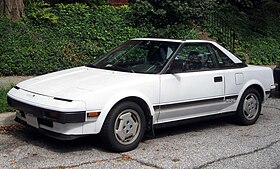
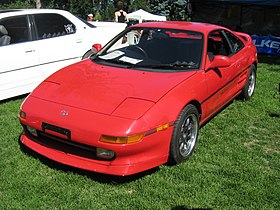

MR2 was conceived as a small, economical and sports car, its design used simple design elements, front and rear MacPherson struts , a transversely mounted in-line four-cylinder engine.
The name MR2 means either “mid-engined, small, two-seater” ( eng. M id-ship, r un-about, 2- seater ) [4] , or “mid-engined, rear-wheel drive, two-seater” ( eng. M id-engine, r ear-wheel-drive, 2 -seater ). [5] .
First Generation


Toyota introduced the first generation MR2 in 1984, assigning the model code “W10”. Cars with a 3A engine, 1.5-liter, were known as the AW10. Similarly, models with a 4A engine, 1.6-liter, were designated by the code "AW11".
In Japan, the MR2 was only sold through the Vista Stores dealer network, known since 1998 as the Toyota Netz Store . In the year of its appearance, in 1984, the MR2 became the car of the year of Japan .
Toyota designed a 2-liter engine [6] and a relatively light body (950 kg in Japan and 1,066 kg in the USA) for the MR2. The car was often referred to as AW11, referring to the chassis code of the most common 1.6-liter A-series models.
The car's suspension was developed by Toyota with the assistance of Lotus engineer Roger Becker [7] . Toyota’s collaboration with Lotus at the prototype stage can be traced back to AW11, which owes much to the technology of Lotus sports cars from the 1960s and 1970s. The car was equipped with an adjustable Toyota TEMS suspension. With five structural changes, the MR2 was heavy enough for a two-seater of its size [8] .
The car was also equipped with an atmospheric four-cylinder 4A-GE engine with a volume of 1587 cc, which had two camshafts and four valves per cylinder, adopted from the Corolla E80 series [9] . This engine was also equipped with DENSO electronic fuel injection and a variable intake geometry (“ T-VIS ”), which increased the engine's maximum power to 112 liters. with. (84 kW) on American models, and 128 liters. with. (95 kW) in the UK, 116 or 124 liters. with. (85 or 91 kW) in Europe (with and without a catalyst), [10] 118 l. with. (88 kW) in Australia and 130 liters. with. (96 kW) in Japan. The engine power of Japanese models was later reduced to 120 liters. with. (88 kW) [11] . The engine was previously installed on the Corolla AE86 , and had a positive reputation. A five-speed manual gearbox was installed on the base models and a four-speed automatic was optional.
Acceleration of MR2 to 100 km / h took 8 seconds, the time on the quarter was 16 seconds, which is much faster than the Pontiac Fiero or Fiat X1 / 9 with four-cylinder engines [12] [13] [14] . In the domestic market, the base model AW10 was available, on which a more economical 3A-U engine with a volume of 1452 cm³ and a capacity of 82 liters was installed. with. (61 kW).
In 1986, Toyota introduced the supercharged engine for the MR2. The 4A-GZE engine was equipped with a supercharger from Roots and an intermediate intercooler from Denso. The T-VIS system was no longer used, and the compression ratio was reduced to 8: 1. This allowed to develop a capacity of 145 liters. with. (108 kW) and a torque of 190 Nm. Acceleration to 100 km / h ranged from 6.5 to 7 seconds [15] [16] . The supercharger had a belt drive, but is driven by an electromagnetic clutch, in order to increase fuel economy. The curb weight increased to 1131 kg for supercharged models, due to the mass of equipment and a new, enhanced transmission [2] . In some car markets, a fuel select switch was installed in the car interior to allow the engine to run on regular unleaded fuel, if required. In addition to the new engine, the MR2 SC models were equipped with stiffer springs and received special aluminum tear-drop wheels. These cars differed from the atmospheric ones by another engine cover, a “Supercharged” nameplate on the rear and body moldings behind both doors. They were never officially offered in European and Australian markets, although some cars were imported privately.
Toyota 222D
While the Celica front-wheel rear-wheel drive rally car was a leader in the African Group B in the 1980s, these vehicles remained at a disadvantage in the European stages. Thus, in 1985, TTE began a rally car project codenamed "222D." Based on MR2, it was designed for performances in Group S, and potentially in Group B. Although the car looked like MR2 in appearance, it was noticeably different in content from the production car. Little is known about this project, because the car never participated in the races. Group B was banned in 1986, and the rules of Group S suffered the same fate, so the designed car remained a museum exhibit.
In 2006, at the Goodwood Festival of Speed, Toyota introduced the black 222D. The finished race car weighed about 750 kilograms and had a transverse four-cylinder turbocharged four-cylinder engine with a capacity of 750 liters. with. (560 kW) [17] [18] . The V6 engine mounted on this prototype was also designed specifically for it.
Second Generation
The MR2 was updated in 1989 (although new models appeared in North America in the late 1990s). The new car became larger, its mass ranged from 160 to 180 kg, and it received a more rounded, streamlined coupe and targa .
There were four trim levels on the Japanese market: the base G and maximum G-Limited naturally aspirated versions, as well as the GT-S and GT models with a turbocharged engine . Options on the European market included: Coupe , GT Coupe and GT T-Bar . Turbocharged models were not officially delivered to the European market. However, many Japanese models were sold here privately. Two trim levels were available in the US market, the MR2 with naturally aspirated engine and the MR2 Turbo with turbocharged engine .
Turbocharged models in the US market accelerated to 100 km / h in 6.1 seconds and passed quarter-time in 14.7 seconds. Japanese models passed the quarter in 14.227 seconds.
Changes in suspension geometry, tire sizes and power steering that occurred in January 1992 were made in response to journalist publications about the MR2's tendency to “oversteer.” However, some journalists noted that for most sports cars with a rear mid-engine layout, this behavior is characteristic, and in general on any car, when braking, the mass moves forward, and when accelerating backwards. When entering a turn at too high a speed, the mass of the car moves forward, as a result of which the rear wheels lose traction and oversteer occurs, which can lead to a U-turn. Toyota decided to change the suspension of the MR2 and change tires to reduce the likelihood of a similar situation [19] . Toyota claimed that these changes were made “for drivers whose reflexes are different from Formula 1 pilots” [20] .
SW20 Spider
Between 1996 and 1999, Toyota TechnoCraft (TTC) released 91 SW20 MR2 Spider cars. These cars in the back of a convertible received a retractable fabric roof, a trunk lid without a spoiler, and a unique engine cover. Most of these cars were equipped with an automatic transmission and naturally aspirated engine. Most models were painted Lucerne Silver with blue side molding and black and blue fabric upholstery [21] . Some of these vehicles have been imported to the UK.
Third Generation
The third generation was mass-produced from 1999 to 2007. In the Japanese version, the model was called Toyota MR-S , in the European Toyota MR2 Roadster and in the American Toyota MR2 Spyder .
The first prototype of the MR-S was introduced in 1997 at the Tokyo Motor Show . Chief Engineer Harunori Shiratori said: “Firstly, we wanted to get the true pleasure of the driver, mixing good dynamics, low inertia and light weight; then a long wheelbase was used to achieve high stability and a new style; mid-engine layout has created excellent steering in the absence of engine mass in front; the car body is quite simple, which makes it easy to reduce the cost of the car for the consumer ” [20] .
The only engine installed in the third generation was the all-aluminum 1ZZ-FED , an in-line four-cylinder engine with a displacement of 1794 cc. Like its predecessors, the engine has two overhead camshafts and 16 valves. The VVT-i system appeared in 1998 in some markets. However, unlike previous generations, the engine was placed on the contrary, with an exhaust manifold directed towards the rear of the car. Maximum engine power of 138 liters. with. (104 kW) was significantly reduced compared to the previous generation, but due to the lightness of the car, the engine allowed to accelerate to 100 km / h in a time of 6.8 to 8.7 seconds, depending on the installed transmission [22] [23] . For variants with a manual gearbox, the curb weight of the car was 996 kg.
In addition to a five-speed manual gearbox, a six-speed manual or five-speed sequential manual transmission (SMT) was also available. And since 2002, SMT has been standard for the Australian market, although, for example, air conditioning was an option. After 2003, a six-speed SMT gearbox appeared. The driver can shift gears by shifting the lever forward or backward or by pressing the buttons on the steering wheel. Also, cruise control was not available with a manual gearbox, although it was standard on vehicles with an SMT.
The MR2 Spyder had a heated rear window. An ordinary roof was also available in Japan and Europe.
Motorsport (Super GT)
Between 2000 and 2008, several teams performed on MR-S cars in the Super GT Championship (known as JGTC until the 2004 season) [24] .
- In 2002, Morio Nitta and Shinichi Takagi participated in the GT300 class at the Autobacs MR-S Championship Championship.
- Both drivers, Kota Sasaki and Tetsuya Yamano, won the Reckless team at the MR-S in 2005.
- In 2007, Kazuya Oshima and Hiroaki Isiura performed jointly at the Toy Story APR MR-S Championship, taking first place.
Spyder Production End
In July 2004, Toyota announced the end of sales of the MR2 (as well as Celica ) in the US at the end of the 2005 model year due to increasing competition and falling sales [25] . In the first year, 7233 third-generation cars were sold, in 2005 the number of sales was 901 units. In total, over six years of production in the United States, 27,941 vehicles were sold. The 2005 model year was the last for the MR2 in the USA. At the same time, the car was available in Japan, Mexico and Europe until 2007, when car production ceased completely.
Special Series
At the end of MR2 production, for Japan and the UK, Toyota released a limited edition of 1,000 units called the V-Edition . It is distinguished by wheels that are different in color, titanium interior elements, minor changes in the body, the presence of a limited slip differential, as well as steering wheel options [26] .
In addition, in the 2007 model year, the UK received 300 models of the special numbered TF300 series. A special, 182-horsepower (136 kW) turbocharged version was called the TTE Turbo (TTE is a reference to Toyota Team Europe) and is available as an optional dealer package. This package was also available for installation on regular MR2.
VM180 Zagato
Zagato's Toyota VM180 Zagato , developed by MR-S, was built by Toyota Modelista International for sale in Japan only through the Toyota Vista dealer network. The model was first shown on January 10, 2001 in Tokyo, and then, in February 2001, at the Geneva Motor Show . For her, the MR-S chassis was used [27] . Engine power for this model was 155 liters. with. (116 kW) [28] .
Notes
- ↑ 1 2 3 Affiliates (Toyota wholly-owned subsidiaries) -Toyota Motor East Japan, Inc. . Toyota (2012). Date of treatment January 8, 2017.
- ↑ 1 2 TOYOTA Service bulletin 1988 MR2 SPECIFICATIONS (PDF) (link not available) . toyotapart.com (1987). Date of treatment January 8, 2017. Archived July 17, 2011.
- ↑ TOYOTA Service bulletin 1991 MR2 SPECIFICATIONS (PDF) (link not available) . toyotapart.com (1990). Date of treatment January 8, 2017. Archived July 17, 2011.
- ↑ Toyota (2015-02-25). The Toyota MR2 - History . Press release . Retrieved 2017-01-08 .
- ↑ MR2 History . Date of treatment January 8, 2017. Archived on September 27, 2011.
- ↑ Hartley, John. Middle ground (unopened) // Car Magazine / Cropley, Steve. - London : FF Publishing, 1984. - September. - S. 85 .
- ↑ Mister Two: The Pocket Rocket (inaccessible link) . Date of treatment January 21, 2017. Archived September 24, 2012.
- ↑ Hartley , p. 86
- ↑ MR2 History (inaccessible link) . Date of treatment January 21, 2017. Archived July 3, 2015.
- ↑ Auto Katalog 1988: [ him. ] / Heitz, Rudolf. - Stuttgart : Vereinigte Motor-Verlage GmbH & Co. KG , 1987 .-- Vol. 31. - P. 276–277.
- ↑ Classic Cars Page . Autozine.org Date of treatment January 21, 2017. Archived June 15, 2010.
- ↑ Thompson, Jonathan. Japan's First Mid-Engine Sportscar, Road & Track Magazine, November 1984.
- ↑ Motor Trend Magazine, January 1985.
- ↑ Car and Driver Magazine, February 1985.
- ↑ Fiero Formula vs MR2 Supercharged Comparison Test, Road & Track , October 1987.
- ↑ “2x2 for the Road”, MotorWeek, February 20, 1988
- ↑ Sharpe, Martin Rallying | Group S | Rally car . Racecar Engineering (October 2, 2008). Date of treatment January 21, 2017. Archived November 21, 2010.
- ↑ Toyota . Group B Rally. Date of treatment January 21, 2017. Archived January 27, 2010.
- ↑ Toyota MR2 Performance, Heick, Terry, HP Trade, 2009
- ↑ 1 2 MR2 History (inaccessible link) . Date of treatment February 7, 2017. Archived April 1, 2012.
- ↑ Info / History of the TRD SW20 Spider . mr2.ie/. Date of treatment February 9, 2017. Archived November 13, 2011.
- ↑ 2002 Toyota MR2 Spyder SMT Road Test Review , Modified.com. Date of treatment February 9, 2017.
- ↑ Toyota MR2 Spyder SMT - Short Take Road Test - Auto Reviews . Archived on March 7, 2010. Date of treatment February 9, 2017.
- ↑ SUPER GT 2007 & JGTC Racing 1993–2006 - History of JGTC . Imca-slotracing.com (March 8, 2007). Date of treatment February 9, 2017.
- ↑ Toyota To Discontinue Production Of The Celica And MR2 . Date of treatment December 8, 2008. (unavailable link)
- ↑ Lavrinc, Damon Limited edition farewell to the MR2 - Autoblog . Autoblog.com (November 21, 2006). Date of treatment February 9, 2017.
- ↑ Markus, Frank. Toyota VM180 Zagato - Auto Shows (Eng.) // Car and Driver : magazine. - 2001. - No. February Archived on June 9, 2011.
- ↑ Toyota MR-S VM180 Zagato . Date of treatment February 9, 2017.