Odysseus Andrutzos ( Greek Οδυσσέας Ανδρούτσος ; 1788 - June 5, 1825 ) - Greek commander, leader of the Greek war for liberation . One of the most dynamic and at the same time tragic figures of the war of liberation.
| Odyssey Andrutzos | |
|---|---|
| Greek Οδυσσέας Ανδρούτσος | |
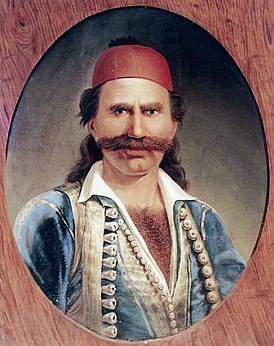 Odyssey Andrutosos | |
| Date of Birth | 1788 |
| Place of Birth | Ithaca |
| Date of death | June 5, 1825 |
| Place of death | Athens |
| Nationality |  Greece Greece |
| Occupation | |
| Father | Andreas Andrutzos |
| Mother | |
Content
Biography
Odysseus was born in 1790 on the island of Ithaca . His father, the famous Kleft Andreas Andrutzos, came from Fthiotis in Central Greece, his mother from Preveza in Epirus [1] .
After decades of hostilities against the Turks, Andreas Andrutzos joined his squad with the privateer fleet of Lambros Katsonis from Levadia , a Greek rebel and simultaneously an officer in the Russian service. Katsoni became the godfather of Odysseus. After Katsoni left for Russia and settled in Livadia in the Crimea , Andreas Andrutzos in 1792 went with his detachment through the Peloponnese to Central Greece. In 1793, Andreas Andrutzos decided to get into Russia and ask for help, but when he got to Venice he was arrested. The Venetians surrendered it to the Turks . Four years, from 1793 to 1797 , Andreas Andrutzos spent time in hard labor in Constantinople, repeatedly tortured until he was executed.
Odysseus became an orphan at 7 years old. He grew up at the court of Ali Pasha , an old friend of his father. Ali Pasha, hatched separatist plans, flirted with many Greek military leaders. Here in Ioannina , Odysseus was educated and became one of the most literate Greek military leaders. In particular, Odysseus fell in love with “history and antiquities” [2] . A model and level of his thinking can be a letter from Andrutzos dated April 23, 1823 to the Greek enlightener Adamantios Korais , who lived in France , whom Odysseus tried to convince that his place in rebellious Greece:
“- since you have been fighting for so many years, enlightening from afar your unfortunate compatriots, was your participation in the independence of Greece fair today? If in the remaining years you write the highest works, and Greece falls, then what is the use of this? If all subsequent centuries crown your labors with the highest praises, and Greece remains under the yoke, what glory is it? If you, in short, become your immortal letter, but your homeland falls into the hands of a wild tyrant, what did you win? ”
In descriptions of contemporaries
When the Greek Revolution broke out, Odysseus was 31 years old, but he already had a heroic background. Proud, adamant, impetuous and quick in his decisions - the Albanians and Turks were afraid of him, but the Greek landowners were most afraid of him.
Valetas writes that Andrutzos represented “the purest national and popular consciousness of the revolution of the 21st year, with its demands for democracy and rebirth” [3] . One of the main military leaders and war heroes, Georgios Karaiskakis said: “We have many warriors, but only one was a strategist - Odysseus. No one had his mind . ”
The Odyssey Image
His image “combined beautiful and heroic” [4] . Tall, fair-haired, with a wide forehead, Odysseus excelled everyone in running, jumping, throwing stones, and shooting. They say that he held one goat suspended in each hand while they were skinned. Here is how Odysseus was described in a folk song of those years:
Σα βραχος ειν οι πλατες του, σαν καστρο η κεφαλη του και ταπλατια τα στηθια του τοιχος χορταριασμενος
like the rocks of his shoulders and fortress head and chest broad with grass covered wall [5]
1821
Odysseus took part in a secret meeting before the uprising in January 1821 on the island of Lefkada . He was the first to launch hostilities in Middle (Western) Greece, destroying Hassan Bey and his 60 gendarmes. After that, Odysseus and his 116 associates wrote in Gravia one of the most glorious pages of the war .
In a web of political intrigue
By 1822, Odysseus was the most prominent military leader of Middle Greece, when landowners and politicians led by Alexander Mavrokordato began to weave their intrigues around him. Mavrokordato, who led the state, which had not yet been recreated, into the sphere of influence of Britain , disliked the illiterate military commanders from the people, but the military leaders who stood out, such as Odysseus, were already hostile.
On April 16, Andrutzos resigns from command of the units of Central Greece. On May 25, Odysseus kills in a cave where he was hiding two government envoys who came to arrest him. On June 3, the government announced a search and reward for the capture of Odyssey. But hiding from the government, Andrutzos does not forget about the war.
In July, having assembled a small detachment, he blocks the roads from Lamia to Corinth . On August 27, Odysseus enters Athens . On September 24, while still on the wanted list, Odysseus was proclaimed by the Athenian Assembly as the commander of the forces of (eastern) Middle Greece.
March 30, 1823 , in order to weaken the forces of military leaders, the Second National Congress abolishes the posts of commanders of the Peloponnese ( Theodore Kolokotroni ) and Central Greece (Andrutzos). On April 7, Odysseus calls on the democratic faction to get rid of the oligarchs. Demetrius Ipsilanti holds them back.
July 7 Andrutzos defeats the Turks near Livadia. November 23 - 25, 1823 he fights the Turks on the island of Euboea and defeats them. In February, Andrutzos met Colonel Stanhope and Edward Trelawney , both Englishmen encouraged by the acquaintance. After some time, Trelawney marries the half-sister of Andruzos. The friendship of Stanhope and Trelawney creates obstacles to English politics in Greece. In May, after the intrigues of Mavrokordato, Stanhope is called back by the British government.
In August 1824, Andrutzos arrives in Nafplion , the provisional capital of Greece, in order to stop the persecution of military leaders and is three times assassinated. February 20, 1825 Odysseus again put on the wanted list. The commander of the (eastern) Middle Greece is his former associate and adjutant, Yannis Guras .
Fall and death
On March 2, Andrutzos leaves for a cave on Mount Parnassus , from where, by blackmailing the government, he makes a mistake stating that he is imagining, so far, the transition to the Turks. On March 28, Guras besieges his former boss at St. Anne's Monastery. On March 31 and April 4, battles took place between the units of Guras and Andrutos, which is helped by the Turks. On April 5, Andrutzos leaves the Turks and surrenders to "his son" Guras, who promises not to touch him. Odysseus was imprisoned on the Acropolis of Athens, which served as a fortress.
On May 25, in the former cave of Andrutzos on Parnassus, the British Fenton and Whitcombe attempted to attempt Trelawney's life.
On the night of June 4-5, Odysseus Andrutzos was killed on the Acropolis of Athens. His corpse was thrown from the cliff of the Acropolis in order to pass off the murder as death when trying to escape. It is believed that he was buried near the Church of the Transfiguration of the Lord on Plaka [6] . The names of his three killers are known. But moral responsibility lies with Guras and politicians - Ioannis Coletis and Alexander Mavrokordato. Private Kaladzis was an unexpected witness to the murder and testified to lawyer Fortis several years later, but his testimony and written evidence appeared in the press only in 1898 . [7]
Memory
The last, dubious glory, months of the life of Odysseus did not diminish his glory. In the memory of the people, he remained a military commander, primarily for the battle of Gravel. Most Greek historians acknowledge his contribution to the liberation of Greece and consider him a victim of political intrigue. In all Greek cities there are streets and squares bearing the name Odysseus Andrutzos.
ESB Odyssey
In the Encyclopedic Dictionary of Brockhaus and Efron, the story of Odysseus is stated as follows:
- A famous figure in the Greek war for the liberation ( 1788 - 1825 ), the son of the kleft Andruzo [8] , originally from Ithaca ; He served at the court of Ali Pasha Yaninsky , with whom his father was also on good terms. There he went through a school of diplomatic art, learned to hide his thoughts and feelings and not to disassemble the means to achieve the goal. Natural courage, endurance, cunning and dexterity completed his resemblance to the hero of Odyssey , which he was much proud of. Ali Pasha appointed him an armolum , but this did not in the least prevent O. from being in constant friendly relations with the Clefts and supporting them. As soon as Kolokotroni revolted in the Peloponnese , O. went there, from there with a small detachment he hastened to the north and arrived in Gravia [9] immediately after the defeat of the Greeks at Thermopylae . Reinforced by the fugitives who left Thermopylae , he occupied a gorge near Gravia; First, he conducted peaceful negotiations with the Turkish military commander Omer Brioni [10] and supported in him the hope that he would go over to the Turks, but then with a skillfully prepared attack forced him to retreat, despite the enormous advantage of the Turkish forces. The first national assembly ( 1822 ) appointed O. the supreme command of the Greek forces in the northeast, who he had actually been before; but he resigned this title when he received a censure from the Areopagus for his unsuccessful expedition against Lamia [11] , and spent several months inactive. Yielding to the insistent requests of the government, he again assumed command and triumphantly defended Thermopylae against Bayram Pasha , the Acropolis of Athens against Reshid Pasha . At the public assembly of 1823 , O., together with Kolokotroni (see), was on the side of the military party. When the government of Condurioti was formed (see), O. refused to obey him (see Greece ). He tried hard to win Byron to his side, but to no avail; but he found sympathy and support in two friends of Byron, Stengope and Trelawni, who saw in him the only salvation of Greece. Meanwhile, O., who refused to comply with the government’s demand and relinquish command of the army, held secret negotiations with Omer Brioni , and then, with a bunch of supporters, fled to the Turkish camp. One of the captains subordinate to him, Guras, who took command of the insurgents, defeated the Turkish detachment under O. Daudis , and forced the latter to surrender (April 1825 ). O. was taken to Athens and imprisoned, where he soon died while trying to escape, as the government explained, or, rather, was strangled by his order or, at least, with his knowledge.
. See Παπαδόπουλος, «Άνασκενή τών είς τήν ίστοριαν τών Άθηνών άναφερομένων περί τοϋ στρατηγοϋ Όδυσσέως» (Athens, 1837) - Hot Protection OS in response to a hostile response to his book Σούρμελις «Ίστορία τών Άθηνών» (1884).
Odysseus, leader of the Greek war for liberation // Brockhaus and Efron Encyclopedic Dictionary : in 86 volumes (82 volumes and 4 additional). - SPb. , 1890-1907.
Links
- ↑ Γούδας, Αναστάσιος Ν. Βίοι Παράλληλοι των επί της αναγεννήσεως της Ελλάδος διαπρεψάντων ανδρών. - Αθήναι: Εκ του Τυπογραφείου Μ. Π. Περίδου, 1870-1875. - Vol. H '. - P. 122.
- ↑ Ιωάννης Φιλήμων . Ιστορικόν Δοκίμιον περί της Ελληνικής Επαναστάσεως. - Αθήνα: Ελεύθερη Σκέψις, 2003. - Vol. Γ΄. - P. 21. - ISBN 978-960-8352-16-2 .
- ↑ [Βαλετας, Ανθολογια Δημοτικης Πεζογραφιας, τομος Α, σελ. 564]
- ↑ [Φιλημων, ε.α., τομος Γ, σελ. 201]
- ↑ [translation by Anna Tanabash]
- ↑ Metamorfosis tou Sotiros // Athens24.com
- ↑ [Δημητρης Φωτιαδης, Ιστορια του 21, ΜΕΛΙΣΣΑ, τομος Β, σελ. 70-75]
- ↑ Ανδρέας Ανδρούτσος
- ↑ el: Μάχη στο Χάνι της Γραβιάς
- ↑ el: Ομέρ Βρυώνης
- ↑ possibly Lamia (city) - should be specified