Wild boar ( lat. Sus scrofa ), or a wild boar [3] , or a wild pig , is a mammal from the order of artiodactyls , the suborder of pig-like ( non-ruminant ), family of pigs , and the genus of wild boars . It is the ancestor of a domestic pig .
| Boar | |||||||||||||||||||||||||||||||||||||
 | |||||||||||||||||||||||||||||||||||||
| Scientific classification | |||||||||||||||||||||||||||||||||||||
|---|---|---|---|---|---|---|---|---|---|---|---|---|---|---|---|---|---|---|---|---|---|---|---|---|---|---|---|---|---|---|---|---|---|---|---|---|---|
| |||||||||||||||||||||||||||||||||||||
| International scientific name | |||||||||||||||||||||||||||||||||||||
Sus scrofa Linnaeus , 1758 | |||||||||||||||||||||||||||||||||||||
| Subspecies | |||||||||||||||||||||||||||||||||||||
| |||||||||||||||||||||||||||||||||||||
| Area | |||||||||||||||||||||||||||||||||||||
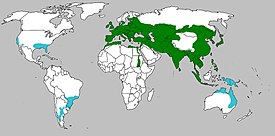 Reconstruction of the natural range of the wild boar. Human-acclimatized population (Small populations in South America, the Caribbean, Africa, and elsewhere not shown). [1] [2] | |||||||||||||||||||||||||||||||||||||
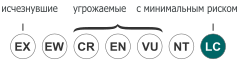
| Security status | |||||||||||||||||||||||||||||||||||||
General characteristics
Wild boar is an omnivorous artiodactyl non-ruminant mammal from the genus of wild boars ( Sus ). It differs from a domestic pig, which undoubtedly came from a wild boar (and other close species), has a shorter and denser body, thicker and higher legs; in addition, the head of a wild boar is longer and thinner, the ears are longer, sharper and moreover erect, sharp. Constantly growing upper and lower fangs protruding from the mouth upward in the male are much more developed than in the female .
The elastic bristles , in addition to the lower part of the neck and the back of the abdomen, form on the back something like a mane with a comb, which puffs when the animal is excited. In winter, under the bristles, a thick and soft downy grows. The bristles are black-brown in color with an admixture of yellowish, the undercoat is brownish-gray, due to this the general coloring is gray-black-brown, muzzle, tail, lower legs and hooves are black. Variegated and piebald specimens are rare and are considered descendants of feral domestic pigs. The color of the bristles may vary depending on age and habitat: if pure black boars are found in Belarus, then in the area of Lake Balkhash they are very light, almost whitish.
On a massive, thick and short neck there is a large wedge-shaped head with long wide ears, small eyes and a powerful forward-looking snout with a patch, well adapted for digging. An adult wild boar can dig through its snout with frozen soil to a depth of 15-17 cm. The tail is straight, 20-25 cm long, with a hair brush at the end. The digestive system is relatively simple in comparison with other artiodactyls. It makes the same sounds as a domestic pig (grunts and squeals); they can be divided into contact, alarm and combat.
The body length is up to 175 cm, the height at the withers is up to 1 m. The weight of an adult boar usually does not exceed 100 kg, although it can reach 150-200 kg [4] . Occasionally, individuals weighing up to 275 kg come across in Eastern Europe , and up to half a ton in Primorye and Manchuria . Sexual dimorphism is clearly manifested - the females are less: height at the withers up to 90 cm, weight within 60-180 kg. The life span of an animal can reach 14 years in nature and 20 years in captivity and protected areas [5] . Wild boar is capable of speeds up to 40 km / h [6] . Wild boars are good swimmers; in 2013, one boar sailed from France to the island of Alderney far to the north.
In the karyotype, 36–38 chromosomes [7] . A study of mitochondrial DNA showed that wild boars originated somewhere on the islands of Southeast Asia, for example, on the territory of modern Indonesia or the Philippines, from where they then spread throughout mainland Eurasia and North Africa [8] . The oldest fossils of this species belong to the Early Pleistocene [9] , gradually replacing the closely related species Sus strozzi - a large animal adapted to life in the swamp, from which, apparently, a Javanese pig [10] . The closest relative is a bearded pig found on the Malay Peninsula and a number of Indonesian islands.
Range
The range of wild boars is the widest among the entire family of pigs and one of the broadest among terrestrial mammals. Wild boars are found in broad-leaved ( beech and oak ) and mixed forests of mainland Central Europe (from the Atlantic to the Urals ); in the Mediterranean , including also parts of North Africa, including the Atlas and Cyrenaica mountains (in ancient times, its range extended along the Nile to Khartoum in the south); in the steppe regions of Eurasia, Central Asia, in the northeast of Western Asia; in the north, the range of wild boar reaches taiga and 50 ° C. w. (historically reached Lake Ladoga at 60 ° N, then passing along the diagonal line of Novgorod and Moscow , crossing the Ural Mountains at 52 ° N and leaving the West Siberian Plain at 56 ° N, before turn south on the Baraba lowland ); in the east - through the Tarim Depression , the mountains of Tannu-Ola and Transbaikalia to the Amur in the north and the Himalayas in the south, including the territories of China , Korea , Japan and the Great Sunda Islands in Southeast Asia. In addition to the mainland, there were island populations, including the British Isles , Corsica , Sardinia , several islands in the Aegean and Ionian Seas , Sri Lanka , Sumatra , Java and the small islands of the East Indies , Taiwan , Hainan , Ryukyu , the Japanese Islands and Sakhalin , where the fossil remains of wild boars are preserved.
Beyond these limits (in certain regions of South Asia, in South and Central Africa), it is replaced by related species ( large forest pig , African warthog , bearded pig , babirusa , dwarf pig , Javanese pig , etc.).
Range Changes
In ancient times, the range of the wild boar was much wider than the modern one. In Central Europe and the Middle East, it used to be almost everywhere, now in many places it has been exterminated due to uncontrolled hunting. So, in Libya, wild boars disappeared by the 1880s. The last boar in Egypt , where they were very common in the era of the pharaohs , died at the Giza Zoo in December 1912, while wild populations died out in 1894-1902. Prince Camille el-Din Hussein tried to re-populate Wadi Natrun with wild boars imported from Hungary, but they were soon exterminated by poachers . A similar situation prevailed in Scandinavia (there were no wild boars in Denmark in the 19th century), in large territories of the former USSR and northern Japan , as well as throughout Great Britain , where they disappeared in the 13th century, although William the Conqueror took care of them and decided in 1087 year for the illegal killing of a wild boar to blind the hunter, and Charles I in the XVII century made an attempt to reintroduction of wild boars, nullified by the civil war .
In the middle of the 20th century, partial restoration of wild boar populations began, especially in the USSR - by 1960 they were again found in the Leningrad and Moscow regions, and by 1975 they reached Astrakhan and even Arkhangelsk . In the 1970s, wild pigs reappeared in Denmark and Sweden , even in England in the 1990s, groups of wild boars introduced from the mainland, who escaped from specialized farms, appeared in the wild. The population of British boars was proposed to be eradicated; journalist and eco-activist George Monbio opposed and asked for a thorough study of the population [11] . Currently, the boar population is stable in most parts of Eurasia, where they are preserved. In certain regions of Mongolia, the population density was fixed at the level of 0.9 individuals per 1000 ha (in 1982 ) and even 1-2 individuals per 1000 ha (in 1989 in the Khangai mountains ).
At the same time, the area extended with the help of humans covers environments from semi-deserts to tropical rain forests , including reed jungle, mangrove forests , and agricultural land . However, human-created hybrids of European wild boars and domestic pigs, becoming homeless, in new habitats also become an environmental threat and harm agricultural crops (they are among the hundred most harmful animals). This is especially true for South America from Uruguay to the Brazilian states of Mato Grosso do Sul and São Paulo , where they are called [12] [13] [14] [15] [16] .
European boars were brought to North America by humans as a hunting object and spread in the wild along with reyzerbek - feral domestic pigs that have been found here since the beginning of European colonization. The first 13 wild boars purchased for the United States were purchased by Austin Corbin from German animal trader Karl Hagenbeck and released in Sullivan County in 1890. The most successful North American introduction of boars occurred in North Carolina in 1913. In Australia, feral pigs are similar to wild boars in their lifestyle.
In Russia, wild boar is found in large areas of the European part of Russia (except for the northeastern tundra and taiga regions), in the Caucasus , in southern Siberia ; in the Tien Shan, it rises to 3300 m (for comparison: in the Caucasus - up to 2600 m, in the Pyrenees - up to 2400 m, in the Carpathians - up to 1900 m).
Subspecies
Due to the variability of the habitat - from the zone of dark coniferous taiga to deserts, as well as all mountain zones up to the alpine - the geographical variability of wild boars is very large. There are 16 subspecies of Sus scrofa , which are combined into 4 regional groups [17] :
- Western
- S. scrofa scrofa , or Central European wild boar (common in Spain , Italy , France , Germany , Benelux , Denmark , Poland , Czech Republic , Slovakia and Albania )
- S. scrofa majori , or Maremian wild boar (common in Maremma , Italy)
- S. scrofa meridionalis , or Mediterranean boar (common in Andalusia , Corsica and Sardinia )
- S. scrofa algira , or North African boar (common in Tunisia , Algeria, and Morocco )
- S. scrofa attila , or Carpathian (Romanian, Caucasian) boar (common in the Carpathians , including Romania , Hungary and Ukraine , the Balkans , Transcaucasia , the Caucasus , the Asia Minor Peninsula, the Caspian Sea coast and northern Iran )
- S. scrofa lybicus , or Anatolian boar (common in the Caucasus , Turkey , Levant , Israel and the territory of the former Yugoslavia )
- S. scrofa nigripes , or Central Asian wild boar (common in Central Asia , Kazakhstan , eastern Tien Shan , western Mongolia , Kashgar and Afghanistan , and southern Iran )
- Indian
- S. scrofa davidi , or Central Asian boar (common in Pakistan , northwest India and southeast Iran )
- S. scrofa cristatus , or Indian boar (common in India , Nepal , Burma , Thailand, and western Sri Lanka )
- Eastern
- S. scrofa sibiricus , or Transbaikal boar (distributed on the shore of Lake Baikal , in Transbaikalia , northern and north-eastern Mongolia )
- S. scrofa ussuricus , or Ussuri boar (common in eastern China , on the shores of the Ussuri and Amur bays )
- S. scrofa leucomystax , or Japanese wild boar (common in Japan (excluding Hokkaido Island and the Ryukyu Islands )
- S. scrofa riukiuanus , or Ryukyu boar (common on the Ryukyu Islands )
- S. scrofa taivanus , or Taiwanese boar (common in Taiwan )
- S. scrofa moupinensis , or North Chinese boar (distributed on the coast of China , south to Vietnam and west to Sichuan )
- Indonesian
- S. scrofa vittatus , or Malaysian boar (common in peninsular Malaysia , Indonesia from Sumatra and Java east to Komodo )
Domestication
It is believed that the founders of modern domestic pigs are wild boars of Mesopotamia , Asia Minor, Europe and China, domesticated during the Neolithic revolution . Archaeological finds indicate that already 13,000 - 12,700 years ago, wild pigs began to domesticate in the Middle East in the areas of the Tigris Basin [18] . Initially, they were kept in a semi-wild state in the wild, similar to how pigs are kept now in New Guinea [19] . The remains of pigs dating back to more than 11,400 years ago were found in Cyprus . Pigs could get to the island only from the mainland, which implies movement together with humans and domestication [20] . A study of DNA from pig teeth and bones found in European Neolithic settlements shows that the first domestic pigs were brought to Europe from the Middle East . This stimulated the domestication of European wild pigs, which led to the crowding out of Middle Eastern breeds in Europe. Regardless of this, domestication of pigs took place in China, which took place about 8000 years ago [21] [22] (according to other sources, in the eighth millennium BC. [23] ).
The high adaptability and omnivorousness of wild pigs allowed the primitive man to domesticate them very quickly. Pigs were bred mainly for tasty meat, but skins (for shields), bones (for making tools and weapons) and bristles (for brushes) were also used [24] . In India, China, and some other places, wild boars were also domesticated to eat human waste - the so-called pig toilet .
Habits
The wild boar is kept in water-rich, swampy areas, both wooded and overgrown with reeds and shrubs, etc. This is a social animal that forms herds with matriarchal orders. Old males live mostly alone and join the herds only during mating. Females form usually small herds of 10-30 females, cubs, young and weak males. In Europe, sometimes there are large herds numbering up to 100 individuals. Herds can travel long distances, but only within their habitat and without migrating. According to studies conducted in the state of South Carolina and on the island of Santa Catalina (state of California ), the size of the wild boar habitat ranges from 1 to 4 km², moreover, males have much more territory than females. The population density in the studied areas was 1–34 individuals per km².
As a rule, wild boars are limitedly polygamous , since there are one to three females per male male boar. Typically, female wild pigs have been racing since the second year of life, and males only from the fourth to fifth year. The small river occurs from November to January (in regions with a temperate climate); between males fierce fights with sharp fangs occur at this time. Pregnancy lasts about 18 weeks (from 124 to 140 days).
The number of piglets (normally born once a year) is 4-6, and sometimes even 12 (the number of broods can fluctuate sharply 2-3 times). At the same time, the sow has 5 pairs of nipples, but in the first pair there is practically no milk. A newborn piglet weighs from 600 to 1650 g, usually weighs about 850 g. At first, piglets are painted with white, black-brown and yellow stripes that help mask in a forest litter ; after 4-5 months, the color gradually changes to the usual plain dark. The female carefully guards the cubs and furiously protects them from enemies; at first, the boar returns to them every 3-4 hours. The first week of life, the pigs do not leave their home (a kind of nest of branches, leaves and grass) and are closely pressed against each other. From a week old, they begin to go out with their mother for walks, by the age of 3 weeks they already learn the habits of adults. Mother feeds piglets up to 3.5 months. By autumn, the mass of piglets is 20-30 kg. The molars are fully formed by 1-2 years. Wild boars reach puberty at about 1.5 years of age, and become adults at 5-6 years.
Boar movements are clumsy, but fast, it floats excellently and can swim considerable distances. Vision is poorly developed: the boar does not distinguish colors and is not able to see a person standing 15 meters from him. But the smell, taste and hearing are very good. Wild boars are careful, but not cowardly; irritated, wounded, or protecting the cubs, they are very brave and dangerous in their strength and because of large fangs. In addition to man, wild boars, mainly young ones, are dangerous only to wolves (wild boars are their main prey) and lynxes , and in South Asia and the Far East - leopards and tigers , which, however, rarely attack old large males. On the Indonesian islands of Komodo , Flores and Rincha, Komodo lizard is a danger to wild boars. Small piglets can be attacked by large snakes, birds of prey, feline and other animals.
Since wild boars are susceptible to serious changes in temperature, they wallow a lot in the mud, which not only protects them from insects and burns, but also helps maintain an effective body temperature. Being active in the twilight time of the day, during the day the boars lie in a dug pit up to 30-40 cm deep, with the bottom lined with leaves; sometimes a common lair is arranged. By evening, go out to swim and find food.
In omnivorous boars can be compared with humans [25] . The diet consists mainly of vegetation - throughout the year these are tubers , roots, rhizomes, bulbs; in summer and autumn, the proportion of fruits, acorns , seeds, nuts, berries, mushrooms increases; finally, in winter, the animal is often forced to be content with tree bark, rags, shoots, etc., but including various small animals (worms, mollusks, frogs, lizards, snakes, rodents, insectivores, bird eggs, and insect larvae) and carrion. The ratio of plant and animal food varies depending on the season and environmental conditions. Boars of the Ujung Kulon National Park on Java live mainly on a vegetarian fruit-eating diet, which includes about 50 different types of fruits. Wild boars living in the Volga delta and near reservoirs in Kazakhstan consume quite a lot of fish, including carp and roach , as well as small birds and rodents.
A 50-pound boar requires about 4000-4500 kilocalories per day. A wild boar can consume from 3 to 6 kg of feed per day, on average extracting from the forest litter or soil about 2/3 of its food. Loosening large areas of land, wild boars contribute to the planting of seeds, and thereby the restoration of tree species; in addition, they eat forest pests, such as pine moths , as well as May beetles . Однако в голодные года они могут посещать поля картофеля, репы, зерновых, принося вред сельскому хозяйству, особенно тем, что разрывают и вытаптывают посевы. Они часто портят и молодые деревья. Изредка кабаны нападают на птиц и зайцеобразных, очень редко — и на довольно крупных животных, больных или раненых, например, ланей , косуль , даже оленей, убивают и поедают их.
Boars are resistant to a number of poisonous plants, and also have a nicotinic acetylcholine receptor mutation that protects them from snake venom. In addition to boars, modifications with a similar effect have only three groups of mammals - honey badger , real hedgehog and mongoose .
Wild Boar Hunt
Hunting a wild boar is fraught with considerable danger, since they often rush at hunters , and males - “bill hookers” inflict lacerations with their powerful fangs; females, whose fangs are less developed than males, knock down reckless hunters and beat them with their front hooves. Therefore, during driven hunting for wild boars, sometimes low platforms are arranged for hunters, from which wild boars, due to the immobility of their neck, cannot dump the hunter. When a boar rushes, it is best to bounce to the side of the animal itself, since the boar, having flown past, rarely returns back for a new attack. The most dangerous thing is the old wild boars, keeping alone, and therefore called loners. In old bill hooks, something like armor from subcutaneous cartilaginous tissue forms on the back and sides of the rut before the rut [26] . During the rut, this armor (kalkan) protects the sides of the animal from the blows of the fangs of another male during the fight for the female. In addition to the corral, wild boars are hunted with dogs etched on them (hounds and other breeds mixed with blood hounds). At night, the wild boar is kept in the sown fields where they go to feed. In the Asian part of the former USSR, where wild boars are found not only in forests, but also in reeds, they are hunted on horseback, chasing animals scared from reeds and shooting them at full gallop. They drive the wild boar with shouts: "Ah-ah!" Hunting from towers (storehouses) is also common, where animals are waiting when they come to the feeding platform.
In Heraldry
A wild boar, a wild boar - an emblem of courage and dauntless, is almost always depicted in black and in profile .
Sometimes one boar's head is presented ( fr. La hure ); moreover, the description separately indicates the color of the eyes and fangs of the animal ( fr. les defenses ).
The white boar was the breastplate of Richard III . At his coronation in 1483, 13,000 such badges were ordered. For this reason, opponents called Richard "boar" or "hog." After the defeat of the king at the Battle of Bosworth , hotel owners changed the emblem of the white boar to blue.
The boar also appears on the arms of many municipalities (communities and cities) of European countries.
In Culture and Mythology
- Erimanf Boar
- Hildiswini
- Sehrimnir
- Gullinbursti
- Varaha , Kalki
- Boar Y
See also
- Hogzilla is a giant mestizo of wild boar and domestic pig.
- Wild boar
- Boar Spear
Notes
- ↑ Oliver, W. & Leus, K. (2008). Sus scrofa . 2006. The Red Book . IUCN 2006. www.iucnredlist.org . Retrieved on 5 April 2009. Database entry includes a brief justification of why this species is of least concern.
- ↑ Kingdon, J. (1997). The Kingdon Guide to African Mammals. Academic Press Limited. ISBN 0-12-408355-2
- ↑ Boar // New Encyclopedic Dictionary : In 48 volumes (29 volumes were published). - SPb. , Pg. , 1911-1916.
- ↑ Flint V.E., Chugunov Yu.D., Smirin V.M. Mammals of the USSR. - M .: “Thought”, 1970. - S. 204. - 437 p.
- ↑ Fauna of the Bialowieza Forest. Boar
- ↑ Baskin, Leonid & Danell, Kjell. Ecology of Ungulates: A Handbook of Species in Eastern Europe and Northern and Central Asia. - Springer Science & Business Media, 2003. - P. 15-38. - ISBN 978-3540438045 .
- ↑ Massimo SCANDURA, Laura IACOLINA, Marco APOLLONIO. Genetic diversity in the European wild boar Sus scrofa: phylogeography, population structure and wild x domestic hybridization // Mammal Review. - 2011. - Vol. 41, no. 2. - P. 125-137. - DOI : 10.1111 / j.1365-2907.2010.00182.x .
- ↑ Chen, K. et al. "Genetic Resources, Genome Mapping and Evolutionary Genomics of the Pig ( Sus scrofa )." Int J Biol Sci 2007; 3 (3): 153-165. doi: 10.7150 / ijbs.3.153. Available from http://www.ijbs.com/v03p0153.htm
- ↑ Ruvinsky, A. et al. (2011). "Systematics and evolution of the pig." In: Ruvinsky A, Rothschild MF (eds), The Genetics of the Pig . 2nd ed. CAB International, Oxon. pp. 1-13. ISBN 978-1-84593-756-0
- ↑ Kurtén, Björn (1968). Pleistocene mammals of Europe. Weidenfeld and Nicolson. pp. 153-155
- ↑ Monbiot, George . How the UK's zoophobic legacy turned on wild boar , The Guardian (September 16, 2011). Date of appeal September 16, 2011.
- ↑ Authorization for the slaughter of the 'javaporco' reassures farmers in Assis, SP
- ↑ IBAMA authorizes capture and slaughter of 'javaporcos' - Folha do Sul Gaúcho (unavailable link) . Date of treatment April 29, 2016. Archived July 3, 2017.
- ↑ 'Javaporco' gives damage and scares farmers in Maracaí, SP - O Grito do Bicho }
- ↑ MS Rural - farmers are authorized to make populational control of exotic species, such as the European boar (link not available) . Date of treatment April 29, 2016. Archived October 12, 2014.
- ↑ Status and Distribution of wild boar in Rio Grande do Sul, Southern Brazil (2009). Archived May 25, 2013.
- ↑ Groves, CP et al. 1993. The Eurasian Suids Sus and Babyrousa. In Oliver, WLR, ed., Pigs, Peccaries, and Hippos - 1993 Status Survey and Conservation Action Plan, 107-108. IUCN / SSC Pigs and Peccaries Specialist Group
- ↑ Sarah M. Nelson Ancestors for the Pigs. Pigs in prehistory. (1998)
- ↑ Rosenberg M, Nesbitt R, Redding RW, Peasnall BL (1998). Hallan Cemi, pig husbandry, and post-Pleistocene adaptations along the Taurus-Zagros Arc (Turkey). Paleorient, 24 (1): 25-41.
- ↑ Vigne, JD; Zazzo, A; Saliège, JF; Poplin, F; Guilaine, J; Simmons, A. Pre-Neolithic wild boar management and introduction to Cyprus more than 11,400 years ago // Proceedings of the National Academy of Sciences : journal. - United States National Academy of Sciences , 2009. - Vol. 106 , no. 38 . - P. 16135-16138 . - DOI : 10.1073 / pnas.0905015106 . - PMID 19706455 .
- ↑ Giuffra, E; Kijas, JM; Amarger, V; Carlborg, O; Jeon, JT; Andersson, L. The origin of the domestic pig: independent domestication and subsequent introgression (Eng.) // Genetics: journal. - 2000. - Vol. 154 , no. 4 . - P. 1785-1791 . - PMID 10747069 .
- ↑ Jean-Denis Vigne, Anne Tresset and Jean-Pierre Digard. History of domestication (neopr.) . - 2012 .-- 3 July.
- ↑ “Swine in China: Empire of the pig”, The Economist, Dec 20th 2014
- ↑ Oral Care. Archived on September 16, 2007.
- ↑ Marsan, Mattioli, 2013 , p. 70–72.
- ↑ B. Kabelchuk, I. Lysenko. Biology and ecology of wild ungulates in the Stavropol Territory and their impact on the ecosystems of specially protected natural areas with free and semi-free keeping and breeding. - Litres, 2017 .-- ISBN 5457927814 , 9785457927810.
Literature
- Wild boar, wild pig // Brockhaus and Efron Encyclopedic Dictionary : in 86 volumes (82 volumes and 4 additional). - SPb. , 1890-1907.
- Vavilov M.P. Hunting in Russia in all its forms. - M.: Printing house F. Johanson, 1873 .-- 224 p.
- Cherkasov A. Notes of the hunter of Eastern Siberia (1856-1863). 1st edition. - St. Petersburg: Publishing House of S.V. Zvonarev, 1867. - 707 p. ( Cherkasov A. A. Notes of a hunter in eastern Siberia. - M.: Publisher: Physical Culture and Sports, 1990. - 575 p.)
- Prince A. Urusov, “Hunting for hoofed animals” (“Nature and Hunting”, 1883 IV), Vernensky Citizen (B. Karpov), “Mantyk - Tiger Slayer” (ibid., 1880 X)
- Marsan A., Mattioli S. Il Cinghiale. - Gavi: Il Piviere, 2013 .-- 146 p. - (Fauna selvatica. Biologia e gestione). - ISBN 978-88-96348-178 .