Vladimir Yulievich Wiese ( German: Waldemar Kurt Blass-Wiese ; 1886-1954) - polar explorer, oceanologist, corresponding member of the USSR Academy of Sciences ( 1933 ).
| Vladimir Yulievich Wiese | ||||||
|---|---|---|---|---|---|---|
| Waldemar kurt blass-wiese | ||||||
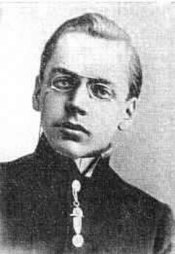 V. Yu. Wise - a graduate of the gymnasium. 1904 | ||||||
| Date of Birth | ||||||
| Place of Birth | Tsarskoye Selo , Russian Empire | |||||
| Date of death | February 19, 1954 | |||||
| Place of death | Leningrad , RSFSR , USSR | |||||
| A country | ||||||
| Place of work | ||||||
| Alma mater | ||||||
| Academic rank | Corresponding Member of the USSR Academy of Sciences | |||||
| Awards and prizes |
| |||||


Content
Biography
Born February 21 ( March 5 ), 1886 in Tsarskoye Selo in the family of Julius Friedrich Franz Wiese and Lydia Karolina Amalia Gertrud (Lydia Karoline Amalie Gertrud Blass) nee Blass. After the death of his mother (1893), his father married Cecilia Fyodorovna Vatershtraat (Caecilie Maria Anne Waterstraat). In 1891-1900, Julius Wiese was a member of the Ministry of Education , was a teacher of geography; then he was elected an honorary member of the Dvina serfdom guardianship of orphanages and took part in the work of the Committee for Assisting Pomors of the Russian North; later he took up insurance business and before 1917 was one of the directors and co-owners of the insurance company Help.
Vladimir in 1904 graduated from Tsarskoye Selo Grammar School and entered the natural department of the Physics and Mathematics Faculty of St. Petersburg University . In 1905 he went to Germany, where he studied at the Faculty of Chemistry of the University of Gottingen and at the University of Halle . In 1910 he returned to Russia. In the summer of 1910, Wiese took part in an expedition to the Kola Peninsula , which collected materials on geology and ethnography in the Lovozero tundra and in the area of the Khibiny ridge . The attention of the young scientist was attracted not only by minerals, in particular, apatity, but by folklore and rituals of the local population. In the fall, he recovered at St. Petersburg University. In 1910-1912, together with his fellow student at the gymnasium Mikhail Pavlov (1884-1938), he conducted field research in the tundra, discovered a number of lakes and described the life of the local population. After the expedition, V. Yu. Wise published his first scientific works “ Lopar music” and “Lopar seids ”.
From right to left: N. V. Pinegin, M. A. Pavlov, V. Yu. Wise, N. M. Sakharov , G. Ya. Sedov, M. A. Zander, P. G. Kushakov
In 1912, V. Yu. Wiese was credited with the post of geographer and head of meteorological observations on the expedition of George Sedov to the North Pole; his companion M. Pavlov was accepted to the post of geologist of the expedition. During the expedition in the spring of 1913, Wiese led a small sled expedition, which first crossed Novaya Zemlya along the glacier, reached the Kara Sea and safely returned to the ship. Departing on February 15, 1914, escorted by sailors G.V. Linnik and L.M. Pustoshny to the pole, Sedov transferred the scientific leadership of the expedition aboard the ship to Vise.
During the First World War, V. Yu. Wise served in the Naval General Staff and participated in the organization of military transport from the shores of Murman to the northern stations of the Finland Railway.
In 1918, he moved to the Main Geophysical Observatory , where he worked first as an adjunct , and then as a senior physicist, studying geophysics and oceanography.
In 1921, having entered the Hydrographic Directorate of the Navy , he went on the Taimyr ship to the Kara Sea, where he was engaged in oceanological work and took part in the construction of the first Soviet hydrometeorological observatory in the Matochkin Shar Strait [1] .
In 1922, V. Yu. Wise first worked as a meteorologist at the Central Administration of Maritime Transport, and then moved to the State Hydrological Institute . Since 1928, he became an employee of the Institute for the Study of the North and was immediately appointed head of the expedition on the icebreaker Malygin , aimed at saving the Italian expedition on the airship Italy . In 1929 and 1930, he directed scientific work on the icebreaker "George Sedov" in the north of the Barents and Kara Seas [1] .
In the fall of 1930, V. Yu. Wise became deputy director of the All-Union Arctic Institute (formerly Institute for the Study of the North) [2] [3] . Under his leadership, in the 1930s, the Institute launched work on the construction of a network of polar stations. In 1932 and 1934, Wiese sailed on the Northern Sea Route on the ships Sibiryakov and Litke [1] .
February 1, 1933 V. Yu. Wise was elected a corresponding member of the USSR Academy of Sciences in the Department of Mathematical and Natural Sciences (oceanography and meteorology), and in 1935 he was approved as a doctor of geographical sciences. In 1935, he also became a member of the International Meteorological Committee, an honorary member of the Norwegian Geographical Society, a member of the United States Geographic Society and the American Polar Society [1] .
Wiese took an active part in preparing the expedition of Ivan Papanin " North Pole-1 ." For health reasons, he was not included in this expedition, but in 1937 he was able to lead the scientific leadership of a high-latitude expedition on the icebreaking ship "Sadko" in the Laptev Sea and around the Novosibirsk Islands . This was the last expedition to the Arctic, in which Wise personally participated.
During World War II, he was in Krasnoyarsk , where the Arctic Research Institute was evacuated. There, he directed the compilation of long-term ice forecasts and prepared for publication the monograph “Fundamentals of Long-Range Ice Forecasts for the Arctic Seas” (1944), for which he was awarded the State Prize (1946). In 1945, V. Yu. Wise was invited as a professor at the Department of Oceanology at Leningrad State University [4] .
Theoretically, based on an extract from the logbook of the schooner "Saint Anna" rescued by V. I. Albanov , V. Yu. Wise predicted the existence of the island of Wiese and subsequently participated in the expedition that opened it [5] .
Laureate of the Stalin Prize ( 1946 ). He was awarded two Orders of Lenin , the Order of the Red Banner of Labor and medals. Vise is named after many geographical objects: Vise Island in the Kara Sea , a glacier , cape and bay on Novaya Zemlya Island , as well as the Professor Vize research vessel (1967) [6] . In 1950, President of the Geographical Society of the USSR L.S. Berg , nominating Professor V. Yu. Wiese for the Grand Gold Medal of the Geographical Society , said that there was no scientist in the Soviet Union who would make such a significant contribution to the study of the Arctic as V. Yu. Wiese did throughout his life.
He died on February 19, 1954 in Leningrad . He was buried on Literary bridges at the Volkovsky cemetery . [7]
Proceedings
- History of research of the Soviet Arctic. Kara and Barents Sea. - Arkhangelsk: Sevkraigiz, 1935
- Sea of the Soviet Arctic. - 3 ed. - M .; L., 1948;
- Basics of long-term ice forecasts for the Arctic seas. - M., 1944;
- On the "Sibiryakov" and "Litka" through the arctic seas. Two historical voyages of 1932 and 1934 - M .; L., 1946.
Notes
- ↑ 1 2 3 4 Northern Encyclopedia, 2004 , p. 147.
- ↑ The director of the institute in 1930-1932 was O. Yu. Schmidt.
- ↑ In the 1930s Wiese lived on the 20th line of Vasilyevsky Island (Building 11).
- ↑ Northern Encyclopedia, 2004 , p. 147-148.
- ↑ New Russian Encyclopedia : at 12 vol. / Editorial: A. D. Nekipelov, V. I. Danilov-Danilyan, V. M. Karev, etc. T. 2 A - Bayar - M .: Publishing House "Encyclopedia", 2005 .-- 960 p.: Ill.
- ↑ Northern Encyclopedia, 2004 , p. 148.
- ↑ Tomb of V. Yu. Wiese at the Volkovsky cemetery (Inaccessible link) . Date of treatment April 27, 2012. Archived March 4, 2016.
Publications
- Wiese V. Yu. Sea of the Russian Arctic. Essays on the history of the study: In 2 vols. - M .: Paulsen, 2016 .-- 344; 256 s. - ISBN 978-5-98797-128-4 ; ISBN 978-5-98797-130-7 .
Literature
- Wiese Vladimir Yulievich // Northern Encyclopedia = [Practical Dictionary of Siberia and North] / comp. E.R. Akbalyan . - [In Russian and English. lang.]. - M .: Paulsen: European Publications, 2004 .-- S. 147-148. - 5,000 copies. - ISBN 5-98797-001-6 .
- Buinitsky V. Kh. Losses of science. V. Yu. Wiese // Izv. All-Union Geographical Society. - 1954. - T. 8. - Issue. four;
- Buinitsky V.H. V. Yu. Wiese. - L., 1969;
- Treshnikov A.F. The ships of science are named after them: Prof. Wiese. Prof. Teeth. - M. Somov. (2nd ed. - L., 1984).
Links
- Profile of Vladimir Yulievich Wiese on the official website of the RAS
- Wiese V. Yu., (1886-1954), oceanologist, Arctic explorer. Encyclopedia St. Petersburg
- Vladimir Yulievich Wiese (1886-1954) on the site funeral-spb.narod.ru
- Vladimir Yulievich Wiese, 1886-1954, on the website qwercus.narod.ru
The materials of the Great Russian Encyclopedia and the Great Soviet Encyclopedia were used .