The Central European operation (the invasion of the Western allies in Germany , the Central European campaign ; March 22 - May 11, 1945 ) is the final strategic military operation of the Allied forces against the German army during World War II.
| Central European operation | |||
|---|---|---|---|
| Main Conflict: World War II | |||
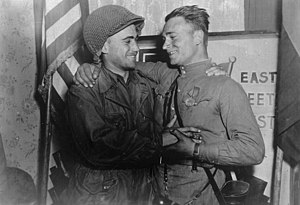 Happy 2nd Lieutenant W. Robertson and Lieutenant A. S. Silvashko on the background of the inscription “East meets West”, symbolizing the historic meeting of the Allies on the Elbe. | |||
| date of | March 22 - May 11, 1945 | ||
| A place | Germany , the western border of Czechoslovakia | ||
| Total | Allied victory | ||
| Opponents | |||
| |||
| Commanders | |||
| |||
| Forces of the parties | |||
| |||
| Losses | |||
| |||


Content
- 1 Background
- 2 The balance of power
- 2.1 Allies
- 2.2 Germany
- 3 Operation
- 4 Summary
- 5 Literature
Background
The offensive of the Allied forces from February 8 to March 21 ended in their exit to the Rhine . On the left bank of this river two large groups formed. South of the Ruhr , the 6th and 12th army groups entered the Rhine. They seized two bridgeheads on the right bank of the river, creating favorable conditions for bypassing the Ruhr from the south and advancing deep into Germany. To the west and north of the Ruhr was the 21st Army Group.
The situation that had developed by the end of March on the Western Front was extremely favorable for the Allies. The German troops, who suffered heavy defeats in the Ardennes and the Meuse-Rhine operations, who suffered heavy losses when moving away from the left bank of the Rhine, were very weakened. The morale and morale of German soldiers was undermined. US forces captured the Ruhr Industrial Area, Germany’s most important military industrial area, on which Germany’s ability to continue the war depended. The lack of manpower and resources did not allow the Wehrmacht command to create any kind of solid defense on the Western Front.
The alignment of forces
Allies
- 21st Army Group ( B. Montgomery )
- 1st Canadian Army
- 2nd British Army
- 12th Army Group ( O. Bradley )
- 1st american army
- 3rd american army
- 9th american army
- 15th american army
- 6th Army Group ( D. Divers )
- 7th american army
- 1st French Army
Germany
- Army Group "H"
- 25th Army
- Army Group B
- 15th army
- 6th SS Panzer Army
- 5th tank army
- 7th Army
- Army Group "G"
- 1st Army
- 19th army
Operation Progress
- March 22 - the beginning of the Central European operation
- March 23 - beginning of the Ruhr operation
- March 24 - crossing the Rhine by the 21st Army Group ( Operation "Plunder" ). Allied Airborne Landing on the Right Bank of the Rhine (Operation Varsity)
- March 25 - the capture of Darmstadt . Capture of bridges across the Rhine
- March 26 - formations of the 7th American and 1st French armies crossed the Rhine
- April 17 - surrender of the German group encircled in the Ruhr
- April 25 - meeting on the Elbe near Torgau (the first meeting of Soviet and American troops)
- May 8 - surrender of Germany
- May 10 - Allies reach Mauthausen
- May 11 - allies in Litsen and Karlovy Vary . End of operation
Summary
This operation ended the hostilities in the West European theater of operations of the Second World War.
Literature
- The history of the Second World War 1939-1945. Volume 10. - M .: Military Publishing, 1984. - S. 239—261.