KS-1 ( abbreviated as "Comet Projectile", product "B", GRAU index - 4К87 , according to the classification of the US Ministry of Defense and NATO - AS-1 "Kennel" ) is the first Soviet aircraft anti - ship cruise missile .
| KS-1 "Comet" | |
|---|---|
| NATO Code: AS-1 Kennel | |
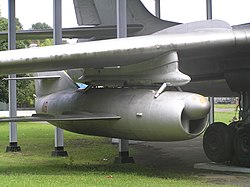 KS-1 under the wing of the Tu-16KS Indonesia Air Force at the Air Force Museum in Yogyakarta | |
| Type of | anti-ship missile |
| Status | withdrawn from service |
| Developer |  KB-1 KB-1 |
| Chief Designer | M. I. Gurevich |
| Years of development | R&D : From September 8, 1947 EP : March 25, 1949 - November 3, 1949 |
| Test start | January 4, 1951 |
| Adoption | 1953 |
| Manufacturer | Plant No. 256 ( Ivankovo ) |
| Years of operation | 1953-1969 |
| Main operators | |
| Other operators |   |
| Key Specifications | |
Max. launch range: 90 km Warhead: high-explosive fragmentation, 600 kg | |
| ↓ All specifications | |
Content
Creation History
On September 8, 1947, Decree of the Council of Ministers of the USSR No. 3140-1028 on R&D was issued, during which it was planned to create anti-ship aircraft-shells with a firing range of 100 km.
It was supposed to use the Tu-4 bomber as the carrier of these weapons. Specially for work on guided missiles, Special Bureau No. 1 (SB-1, since 1950 - KB-1) was created, with P. N. Kuksenko appointed as its director, and Sergo Beria as chief engineer. Design of the airframe was entrusted to OKB-155 , which was led by A.I. Mikoyan . Directly designing the rocket was engaged in M.I. Gurevich .
The preliminary design was started by government decree of March 25, 1949. During the development of the missile for testing the systems, backup aircraft based on the MiG-9 , MiG-15 and MiG-17 serial fighters were widely used. Weapons were removed from the fighters, a guidance system for KS-1 and other equipment were installed. Operated by test pilots, they simulated a rocket flight after being dropped from a carrier aircraft. Therefore, it is not surprising that when on November 3, 1949, the OKB-155 presented a new preliminary design of the projectile, it looked very much like a small copy of the MiG-15 . The main difference between a projectile and a fighter was a small-area wing with a very large sweep angle for that time - 57.5 °.
At the first stage of the flight, the onboard missile control system kept it inside the beam of the guidance station (taking into account the readings of the barometric altimeter). Typically, the flight altitude was 400 m above the surface of the water, and the speed was 1060–1200 km / h . When approaching the target at a distance of 10–20 km, the on-board radar of the K-2 rocket captured the beam of the K-1 guidance station reflected from the target, after which the Comet control switched to homing mode.
The first flight of the manned prototype “K” was performed on January 4, 1951 (test pilot - Amet Khan Sultan ). The first discharge of the prototype from under the Tu-4K carrier took place in May 1951. In total, four prototypes were made for testing the rocket: K-1, K-2, K-3 and K-4. After 150 manned flights in May 1952, unmanned launches of the KS-1 from the Tu-4K were launched. November 21, 1952 was the last test launch at the marine training ground in the region of Feodosia. The cruiser "Red Caucasus" was used as a target, which, after hitting the "Comet", broke in half and sank.
In 1953, the Comet was officially adopted, although the series was launched a year earlier.
Since August 1954, missiles were tested in conjunction with the Tu-16KS as a carrier. In 1955, this complex was adopted. In 1956-1957, measures were taken to improve the characteristics of the rocket.
In the first half of the 1960s, the replacement of the KS-1 with more advanced types of KSR-2 and KSR-11 missiles was launched, with the corresponding refinement of the Tu-16KS missile carriers to the Tu-16K-11-16 and Tu-16K-16 modifications ( Tu-16KSR, Tu-16KSR-2). The last KS-1 was decommissioned in 1969 [1] .
Modifications
KSS
KSS ( abbreviated from "Comet - Aircraft-Shell" [2] ) - anti-ship missile system, which was supposed to equip the cruiser project 67 . The missile is similar to the S-2 Sopka coastal complex, but with a shorter firing range of 40 km. It was not accepted into service, only the experimental cruiser Admiral Nakhimov , rebuilt according to the project 67-EP, was equipped with the complex. Work on the cruisers of project 67 was terminated by a resolution of the Council of Ministers of the USSR of July 4, 1957, the Admiral Nakhimov was disarmed on July 28, 1960. The main reasons: the "weakness" of the missile for cruisers with a displacement of 18,000 tons and the negative attitude of N. Khrushchev to heavy ships.
Arrow
"Strela" is a land-based stationary complex with a cruise missile, created on the basis of the "Comet" by installing the SPRD-15 solid-fuel jet accelerator on it. The development of the complex with launchers in stationary protected shelters [3] was started in 1954. In view of the identity of the missiles, in the 1960s the Strela was often called the Sopka stationary complex.
S-2 Sopka
S-2 “Sopka” (GRAU index: 4K87, NATO code: SSC-2B “Samlet” ) - a land-based mobile coastal anti-ship missile system with a cruise missile created on the basis of the “Comet” by installing the SPRD-15 solid-fuel rocket accelerator on it . Development was carried out by decree of the Council of Ministers of the USSR No. 2004-1073 of December 1, 1955. Adopted by order of the Commander-in-Chief of the Navy of the USSR of December 19, 1958. In August 1962, as part of Operation Anadyr, a separate coastal Black Sea Fleet Regiment was delivered to Cuba , a total of 4 divisions with 2 launchers (launchers) and 8-10 missiles in each division. In 1973, it was used during the fourth Arab-Israeli war .
FCR-1
FKR-1 (abbreviated from “front-line cruise missile”, also “KS-7 product” ) is a ground-based cruise missile, created by OKB-155 on the basis of the S-2 Sopka missile system and designed to launch strikes (including nuclear) on ground targets in tactical depths at distances of up to 125 km. The CVO was 500 meters. The development was set by the Decree of the Council of Ministers of the USSR No. 864–372 of May 11, 1954. Adopted by the Air Force by Resolution SM No. 320-154 of March 3, 1957. In service with one regiment of the Air Force were 20 missiles FKR-1. During the Caribbean crisis, in the fall of 1962, two regiments of FKR-1 were delivered to Cuba, each with 8 launchers and 80 combat units in nuclear missile equipment. Discontinued in the late 1960s.
Performance Specifications
- Length : 8.29 m
- Diameter : 0.92 m
- Rocket Height : 1.2 m
- Wing span : 4.77 m
- Starting weight : 2760 kg
- Flight speed : M = 0.9
- Firing Range : 90 km
- Application Height :
- Guidance System : Radar
- The mass of the warhead : up to 600 kg
- Engine : TRD RD-500K
- Fuel : TS, T-1 kerosene
- Aircraft : Tu-4K, Tu-16KS
Operation
In June 1953, in the Crimea at the airfield "Guards" was formed a special training unit for the development of missiles. The first launch by the combat crew was carried out already in December 1953 for the purpose - the Kursk transport. By the Directive of the General Staff of the Navy of 08.30.1955, 124 TBAP DD of the Black Sea Fleet aviation was formed on the basis of the unit (since 1957 - MTAP DD). The regiment included Tu-4KS aircraft and SKD-5 simulator aircraft based on the MiG-17. Simulator aircraft were widely used in crew training and allowed saving combat missiles. Subsequently, SKD-7 and SKD-15 aircraft were created, which, like the “Product K”, were widely used in crew training. For some time, at each aerodrome of missile carriers, squads of simulated aircraft existed.
Initially, two KS-1 shells were suspended on BD-KS beam holders under the wings of a Tu-4K bomber equipped with the K-1M Cobalt-M airborne radar . The radar of the carrier detected the target and switched to auto tracking mode. When approaching a target at a distance of up to 90 kilometers and a speed of not more than 360 km / h, a missile was launched. The rocket sank down, while accelerating and going forward, falling into the radio beam of guidance on the target. The carrier aircraft itself reduced its speed to 320 km / h and continued to illuminate the target until it was hit. GOS missiles captured the signal at a distance of 20-30 km from the target, and the missile was homing.
124 ITAP in 1955 conducted a trial combat duty as part of the Northern Fleet , completing a total of 40 launches.
The Comet missile system was not without flaws, but the weakest was, of course, the aging Tu-4 piston. Since 1953, the serial construction of Tu-16 jet bombers began, on the basis of which it was decided to create a Tu-16KS missile carrier with a modified control complex and Cobalt-2M radar. The first Tu-16KS No. 4200305 was ready for testing in August 1954. In total, Kazan Plant No. 22 built 107 copies of the Tu-16KS. In June 1957, the first missile carriers began to enter the aviation of the Black Sea Fleet (leader 124 ITAP). Next, the aircraft entered service with the five regiments of aviation of the Northern Fleet, Black Sea Fleet and Pacific Fleet.
In 1958, a number of improvements to the system were carried out: an increase in the fuel supply increased the range of the rocket, and changes in the launch system of the rocket engine increased its altitude. The rocket planes are made folding. Installed a radio altimeter . Since 1961, the complex has been finalized by the installation of noise-resistant guidance equipment.
Gradually, the Tu-16KS began to be converted to more advanced missiles. So, since 1962, 65 Tu-16 aircraft have been finalized for the K-11-16 system. By the end of the 1960s, “Comets” were completely replaced by more sophisticated anti- ship missiles .
At the beginning of the 1950s, during the Korean War , at a meeting of the Politburo of the CPSU Central Committee , the question of using the first 50 serial missiles on American aircraft carrier formations off the coast of Korea was considered, for which it was supposed to use 2 Tu-4 regiments . Technically, this was feasible, but the proposal was rejected due to fears of a local war developing into a world war with unpredictable consequences.
Operators
- - USSR Air Force
- - Egyptian Air Force
- - Indonesian Air Force
Notes
- ↑ Gordon, Yefim & Rigman, Vladimir. Tupolev Tu-16 Badger: Versatile Soviet Long-Range Bomber. - England: Midland Publishing, 2004 .-- ISBN 1-85780-177-6 .
- ↑ Skorodumov I. A. Shock anti-ship weapon "Altair". History of creation. - M .: Nautekhlitizdat, 2006 .-- S. 19 .-- 182 p. - 500 copies. - ISBN 5-93728-063-6 .
- ↑ Coordinates:
Literature
- Shirokorad, A. B. The history of aviation weapons. Short essay / Under the general ed. A.E. Taras . - Mn. : Harvest , 1999 .-- 560 s. - (Library of military history). - 11,000 copies. - ISBN 985-433-695-6 .
- Markovsky V., Perov K. Soviet air-to-ground aviation missiles. - M .: Exprint, 2006 .-- 50 p. - (Aviation Fund). - ISBN 5-94038-085-9 .
- Angelic R. The Supersonic Smokey. Anti-ship missile K-10 // Wings of the Motherland . - M. , 1997. - Vol. 802 . - No. 12 . - S. 24-26 . - ISSN 0130-2701 .
- Kazmin V. “Comet” is almost invisible // Wings of the Motherland. - M. , 1991. - No. 6 . - S. 22-23 . - ISSN 0130-2701 .
- Kazmin V. “Comet” is almost invisible // Wings of the Motherland. - M. , 1991. - No. 7 . - S. 17-18 . - ISSN 0130-2701 .
- Kazmin V. “Comet” is almost invisible // Wings of the Motherland. - M. , 1991. - No. 8 . - S. 18-19 . - ISSN 0130-2701 .
- Yakubovich N. ... And "Comet" ascended to the zenith // Wings of the Motherland. - M. , 1995. - No. 10 . - S. 8-9 . - ISSN 0130-2701 .
Links
- KS-1 (AS-1 KENNEL) . Domestic military equipment (after 1945). Date of treatment April 21, 2011. Archived March 29, 2012.
- Video of the launch of the Comet rocket rutube
- The first Soviet cruise missiles on Youtube.