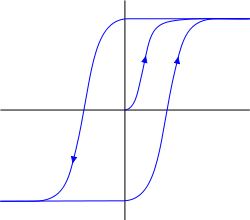
Hysteresis ( Greek ὑστέρησις - lag, lag) is a property of systems ( physical , biological, etc.), the instantaneous response of which to the effects applied to them depends on their current state, and the behavior of the system on the time interval is largely determined by its background. Hysteresis is characterized by the phenomenon of "saturation", as well as the variability of the trajectories between the extreme states (hence the presence of an acute-angled loop in the graphs). This concept should not be confused with the inertia of the behavior of systems, which denotes the monotonous resistance of a system to a change in its state.
In Physics
Of greatest interest are magnetic hysteresis, ferroelectric hysteresis, and elastic hysteresis.
Magnetic Hysteresis
Magnetic hysteresis is the phenomenon of the dependence of the magnetization vector and the vector of the magnetic field strength in a substance not only on the applied external field, but also on the history of this sample. Magnetic hysteresis is usually manifested in ferromagnets - Fe , Co , Ni and alloys based on them. Magnetic hysteresis explains the existence of permanent magnets .
The phenomenon of magnetic hysteresis is observed not only when the field H changes in magnitude and sign, but also during its rotation (magnetic rotation hysteresis), which corresponds to a lag (delay) in changing the direction of M with a change in the direction of H. Hysteresis of magnetic rotation also occurs when the sample rotates relative to a fixed direction H.
The theory of the hysteresis phenomenon takes into account the specific magnetic domain structure of the sample and its changes during magnetization and magnetization reversal. These changes are due to the shift of domain walls and the growth of some domains due to others, as well as the rotation of the magnetization vector in the domains under the influence of an external magnetic field. Everything that delays these processes and promotes the entry of magnets into metastable states can cause magnetic hysteresis.
In single-domain ferromagnetic particles (in particles of small sizes, in which the formation of domains is energetically unfavorable), only the processes of rotation M can proceed. These processes are hindered by magnetic anisotropy of various origins (anisotropy of the crystal itself, anisotropy of the shape of the particles, and anisotropy of elastic stresses). Due to anisotropy, M seems to be held by some internal field (an effective field of magnetic anisotropy ) along one of the axes of easy magnetization corresponding to a minimum of energy. Magnetic hysteresis arises due to the fact that two directions M (on and against) of this axis in a magnetically uniaxial sample or several equivalent (in energy) directions M in a magnetically uniaxial sample correspond to states separated by a potential barrier (proportional ) During the magnetization reversal of single-domain particles, the vector M rotates in the direction H by a series of successive irreversible jumps. Such turns can occur both uniformly and non-uniformly in volume. With a uniform rotation of M, the coercive force . More universal is the mechanism of inhomogeneous rotation of M. However the greatest impact on it exerts when the anisotropy of the shape of the particles plays the main role. Wherein may be significantly smaller than the effective field of the form anisotropy.
Ferroelectric hysteresis
Ferroelectric hysteresis is an ambiguous loop-like dependence of polarization ferroelectrics from an external electric field with its cyclical change. Ferroelectric crystals in a certain temperature range have spontaneous (spontaneous, that is, occurring in the absence of an external electric field) electric polarization . The direction of polarization can be changed by an electric field. In this case, the dependence ( ) in the polar phase is ambiguous, the value given depends on the prehistory, that is, on what the electric field was in the previous instants of time. The main parameters of ferroelectric hysteresis:
- residual polarization of the crystal at
- field value {\ displaystyle E_ {Kt}} (coercive field) at which repolarization occurs
Elastic hysteresis
In the theory of elasticity, the phenomenon of hysteresis is observed in the behavior of elastic materials, which under the influence of high pressures are able to maintain deformation and lose it when exposed to back pressure (for example, stretching a compressed rod). In many ways, this phenomenon explains the anisotropy of the mechanical characteristics of the forged products, as well as their high mechanical properties.
There are two types of elastic hysteresis - dynamic and static.
Dynamic hysteresis is observed at cyclically changing stresses, the maximum amplitude of which is significantly lower than the elastic limit. The reason for this type of hysteresis is inelasticity or viscoelasticity . With inelasticity, in addition to purely elastic deformation (corresponding to Hooke's law ), there is a component that completely disappears when stress is relieved, but with some delay, and with viscoelasticity this component does not completely disappear with time. In both inelastic and viscoelastic behavior, the quantity - energy of elastic deformation - does not depend on the amplitude of the deformation and varies with the frequency of the load. Dynamic hysteresis also arises as a result of thermoelasticity, magnetoelastic phenomena, and a change in the position of point defects and dissolved atoms in the crystal lattice of a body under the influence of applied stresses.
In Electronics and Electrical Engineering
In electronics and electrical engineering, devices are used that have magnetic hysteresis — various magnetic information carriers, or electric hysteresis, for example, a Schmitt trigger or a hysteresis motor .
Hysteresis is used to suppress noise (fast oscillations, contact bounce ) at the moment of switching the logic signals.
In electronic devices of all kinds, the phenomenon of thermal hysteresis is observed: after heating the device and its subsequent cooling to the initial temperature, its parameters do not return to the initial values. Due to the unequal thermal expansion of the crystals of semiconductors, crystal holders, microcircuit housings and printed circuit boards in the crystals, mechanical stresses arise that persist even after cooling. The phenomenon of thermal hysteresis is most noticeable in precision voltage sources used in measuring analog-to-digital converters . In modern microcircuits, the relative shift of the reference voltage due to thermal hysteresis is about 10-100 ppm [1] .
In Biology
Hysteretic properties are characteristic of skeletal muscle of mammals.
In the ecology of populations, the predator – prey system has hysteresis and / or a delay in the numerical response of a predator.
In soil science and geology
The main hydrophysical characteristic of the soil has hysteresis.
Of practical interest is also the delay in changes in soil temperature at various depths from fluctuations in air temperature. In autumn and early winter, when the air temperature drops below zero, the heat accumulated by the soil during the warm season still remains in the soil. This creates favorable conditions for the use of soil heat pumps for heating.
In hydrology
The dependence Q = f (H) - the relationship of flow rates and water levels in rivers - has a loop-like shape.
In economics
Some economic systems show signs of hysteresis: for example, considerable efforts may be required to start exporting to an industry, but to maintain them at a constant level, they are small.
In game theory, the hysteresis effect is manifested in the fact that small differences in one or several parameters lead the two systems to the opposite stable equilibrium, for example, “good” - trust, honesty and high well-being ; and “bad” - theft, mistrust, corruption and poverty. Despite the small initial differences, systems require tremendous effort to move from one equilibrium to another.
The hysteresis effect is a state of unemployment; Having reached a sufficiently high level, it can self-reproduce to a certain extent and hold on to it. The economic causes of hysteresis (long-term rigidity of the labor market) are ambiguous. Some institutional factors lead to hysteresis. For example, social insurance, especially unemployment insurance, can, through the tax system, reduce firms' demand for labor in the formal economy.
Unemployment can lead to the loss of human capital and to “tagging” those who remain unemployed for a long time. Unions can negotiate to maintain the welfare of their true members, ignoring the interests of outsiders who find themselves unemployed. Fixed costs associated with the change of position, place of work or industry, can also lead to hysteresis.
Finally, there may be difficulties in distinguishing between real and apparent hysteresis phenomena, when the final state of the system is determined by its current dynamics or its initial state. In the first case, hysteresis reflects our ignorance: by adding the missing variables and information, we can more fully describe the evolution of the system under study. Dr. the interpretation of the hysteresis phenomenon is the simple existence of several equilibrium states, when invisible influences move the economy from one equilibrium state to another.
In Sociology
The formation and management of public opinion is never carried out instantly. There is always some kind of delay. This is due to the complete or partial rejection of stereotypical traditional thinking and the need to "succumb" in certain cases to persuading and following new views that are formed by certain subjects. The subjects of the formation of public opinion and its management can be the state, parties, public organizations, their leaders, leaders and managers of various levels, etc.
In the nature of the formation of public opinion, it is important to consider two significant circumstances [2] .
One of them indicates the relationship of the efforts made by the subject of influence and the result achieved. The level of educational and propaganda work spent by the subject can be correlated with the level of “magnetization” (degree of involvement in the new idea) of the carrier object of public opinion, a social group, collective, social community, or society as a whole; in this case, some lag of the object from the subject may be detected. Persuasion, including with the alleged destructive consequences, is far from always successful. It depends on one’s own moral values, customs, traditions, the nature of previous upbringing, the ethical norms that dominate society, etc.
The second circumstance is connected with the fact that a new stage in the formation of public opinion can be correlated with the history of the object, its experience, its assessment by those who previously acted as the object of forming public opinion. At the same time, it can be found that the “reference point” of the time for the formation of public opinion shifts relative to the previous one, which is a characteristic of the system itself and its current state.
In Philosophy
Gilles Deleuze uses the concept of hysteresis to characterize Leibniz's monadology .
Mathematical Hysteresis Models
The appearance of mathematical models of hysteresis phenomena was caused by a rather rich set of applied problems (primarily in the theory of automatic control) in which hysteresis carriers cannot be considered in isolation, since they were part of a certain system. In the 1960s, a seminar began at Voronezh University under the guidance of M. A. Krasnoselsky , which created a rigorous mathematical theory of hysteresis [3] .
Later, in 1983, a monograph by M. A. Krasnoselsky and A. V. Pokrovsky appeared [4] , in which various hysteresis phenomena were formally described in the framework of system theory: hysteresis converters were treated as operators depending on their initial state as a parameter, defined on a sufficiently rich functional space (for example, in the space of continuous functions), acting in a certain functional space. A parametric description of the various hysteresis loops was proposed by R.V. Lapshin. [5] In addition to classical loops, replacing harmonic functions with trapezoidal or triangular pulses in this model allows one to obtain piecewise linear hysteresis loops, which are often found in discrete automation problems. There is an implementation of the hysteresis model in the programming language R (Hysteresis package [6] ).
Notes
- ↑ Harrison, L. Current Sources & Voltage References. - Newnes, 2005 .-- 569 p. - (Electronics & Electrical). - ISBN 9780750677523 . , p. 335
- ↑ Gorshkov M.K. Public opinion. Tutorial. - M .: Politizdat, 1989 .-- 384 p.
- ↑ Krasnoselsky M.A., Pokrovsky A.V. Systems with hysteresis. - M.: Science, 1983.
- ↑ Krasnoselsky M.A., Pokrovsky A.V. Systems with hysteresis. - M .: Nauka, 1983 .-- 271 p.
- ↑ RV Lapshin. Analytical model for the approximation of hysteresis loop and its application to the scanning tunneling microscope (English) // Review of Scientific Instruments : journal. - USA: AIP, 1995. - Vol. 66 , no. 9 . - P. 4718-4730 . - ISSN 0034-6748 . - DOI : 10.1063 / 1.1145314 . ( translation into Russian ).
- ↑ Package Hysteresis (Tools for Modeling Rate-Dependent Hysteretic Processes and Ellipses) . R-project (November 20, 2013). Date of treatment June 11, 2018.
Literature
- V. A. Kostitsyn, “Experience in the mathematical theory of hysteresis”, Matem. Sat, 32: 1 (1924), 192-202.
- Ruddai Reichlin. Civil war, terror and banditry. Systematization of sociology and social dynamics . Archived February 18, 2013 on Wayback Machine The Crowd Control Section
- Kapustin V. S. Introduction to the theory of social self-organization . Topic 11. The phenomenon of hysteresis in the formation of national forms and methods of self-organization. Modern paradoxes and puzzles of the "beginning"
Links
- What is hysteresis? - about magnetic hysteresis