The Murrumbidgee River is the main river in the Australian state of New South Wales and the Australian Capital Territory . The main tributary of the Murray River.
| Marrambigi | |
|---|---|
| English Murrumbidgee river | |
 Marrambigi River near Gandagai Marrambigi River near Gandagai | |
| Characteristic | |
| Length | 1485 km |
| Pool | 81 630 km² |
| Watercourse | |
| Source | |
| • Location | Australian Alps |
| • Coordinates | |
| Mouth | Murray |
| • Coordinates | |
| Location | |
| Water system | Murray → Alegzandrina → Indian Ocean |
| A country |
|
| Regions | Australian Capital Territory , New South Wales |



Geography
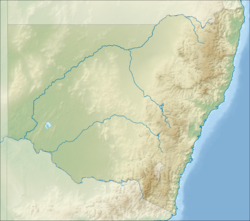
The source of the Marramby River is in the East Highlands of New South Wales in the Australian Alps , which are part of the Great Dividing Range . The river flow is regulated by the Tantangara dam and also by the system of reservoirs, which limit the natural annual drain of Marrambigi by almost 50% (especially in the spring months, when snowmelt begins in the mountains). The construction of the main dam in the upper river was completed in 1960. As a result, at present, up to 99% of the river flow in this place is transferred to the artificial lake Yukambin ( English Lake Eucumbene ). [one]
The main stream of the river system stretches for approximately 900 km. [2] The upper reaches of the Marrambigi are located at the foot of Pepperkorn Hill, in the area covered by moorlands and part of the Snow Mountains (which, in turn, are part of the Australian Alps). Subsequently, the river flows through the territory of New South Wales and the Australian Capital Territory (here the tributaries of the Molonglo and Kotter flow into it), being the main source of irrigation water, which is used to irrigate fields in the agricultural region of Riveraine , where grapes , citruses , wheat , cotton and rice are grown . [3] In the area between the cities of Mod and Balranald , the Loklan River flows into Marrambigi, after which the river continues to flow in a south-westerly direction. In the immediate vicinity of the border between the states of New South Wales and Victoria Marrambigi flows into the Murray River. The length of the river is 1485 km [4] , and the basin area is about 81 629.68 km². [five]
Marrambigi flows through several major cities, including Canberra , Iass , Wagga-Wagga , Hay and Balranald [3] .
History
The area along which the Marrambigi River flows is a historic place of resettlement of representatives of the Australian Aboriginal tribe of virajuri ( born Wiradjuri people ). The name of the river can be translated from the Virajuri language as “big water”, “a very good place” or “a path goes down here”. [6]
The first European colonialists guessed the existence of Marrambigi long before they discovered the river. In 1820, researcher Charles Throsby informed the Governor of New South Wales that he was awaiting the opening of a “large saltwater river (except for the rainy season), which the natives call Marrambigi . ” In an expeditionary journal, Trosby subsequently made a note: "The natives call this river or a large stream of water Yalambidzhi ( Eng. Yeal-am-bid-gie ) . " [7] In fact, the mentioned river turned out to be the Molonglo River, which is a tributary of Marrambigi. It was opened in April 1821.
In 1823, the headquarters of Marrambigi were reached by senior team officer John Ovens and captain Mark Currie , who conducted land surveys south of Lake George . In 1823, traveler Charles Sturt sailed down the river from Narrandera to the confluence with Murray, and then to the place where Murray entered the sea. [8] Active European colonization of the lands through which Marrambigi flows, began only in the 1830s.
Notes
- ↑ Lintermans, Mark The re-establishment of endangered Macquarie perch Macquaria australasica in the Queanbeyan River, New South Wales, with an examination of dietary overlap with alien trout (pdf) (link not available) . Environment ACT and Cooperative Research Center for Freshwater Ecology. Date of treatment April 3, 2009. Archived March 29, 2012.
- ↑ Murrumbidgee River Catchment (link not available) . Catchment Case Studies . NSW Department of Environment and Conservation (1995). Date of treatment April 3, 2009. Archived April 19, 2006.
- ↑ 1 2 Murrumbidgee River . Encyclopædia Britannica Online. Date of treatment April 3, 2009. Archived March 29, 2012.
- ↑ Longest Rivers (inaccessible link) . Geoscience Australia. Date of treatment April 3, 2009. Archived January 7, 2009.
- ↑ Economics - Murrumbidgee River (inaccessible link) . Australian Natural Resources Atlas. Department of the Environment, Water, Heritage and the Arts. Date of treatment April 3, 2009. Archived March 29, 2012.
- ↑ Murrumbidgee River (inaccessible link) . Geographical Names Board of New South Wales. Date of treatment April 3, 2009. Archived March 29, 2012.
- ↑ Official Year Book of the Commonwealth of Australia, 1931 (ABS cat. No. 1301.0)
- ↑ Sturt., Charles. Two Expeditions into the Interior of Southern Australia . - Project Gutenberg EBook, 2004.