The Battle of Brandy Station ( Battle of Brandy Station , or Battle of Fleetwood Hill ) is the largest cavalry battle of the American Civil War , as well as the largest cavalry battle on the American continent. It happened on June 9, 1863, at the very beginning of the Gettysburg campaign between the federal cavalry under the command of Alfred Pleasanton and the Confederate cavalry under the command of Jeb Stewart .
| Battle of Brandy Station | |||
|---|---|---|---|
| Main Conflict: US Civil War | |||
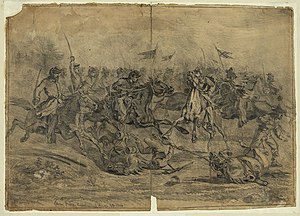 cavalry attack at Brandy station | |||
| date | June 9, 1863 | ||
| A place | Culpeper County, Virginia | ||
| Total | Draw | ||
| Opponents | |||
| |||
| Commanders | |||
| |||
| Forces of the parties | |||
| |||
| Losses | |||
| |||


Pleasanton managed to unexpectedly attack Stuart's cavalry near Brandy Station in Virginia . The battle lasted 10 hours with varying success, as a result, the feds retreated, and they could not find General Lee's army camp near Culpeper . However, from that day on, the federal cavalry began to exert some influence on the course of the war and the period of absolute impunity ended for the cavalry of the South [1] .
Content
Background
The North Virginia Army entered Culpeper County immediately after the Battle of Chancellorsville in May 1863. General Lee concentrated his army near the city of Culpeper and began preparations for the invasion of Pennsylvania. Supply problems grew day by day and Lee was forced to invade the north to capture horses, equipment, and food for his army. At the same time, the army could threaten Philadelphia and Washington , contributing to the growth of anti-war sentiment in the north. On June 5, two infantry corps ( Longstreet and Ewell) were deployed in and around Culpeper. Six miles north on the banks of the Rappahanock River, Stewart's cavalry camped, protecting Culpeper from surprise attacks and cavalry detachments of the enemy.
The South Cavalry was located mainly near Brandy Station. Stuart decided to arrange a large military review of his cavalry. This review took place on June 5, with 9,000 horsemen and 4 batteries of horse artillery participating in it. They depicted an attack on Inlet Station, located 3 kilometers southwest of Brandy station (the field where the view was held has been preserved untouched to this day).
General Lee could not attend the show, so the review was repeated in his presence on June 8 in the form of a regular parade without imitations of the battle. Lee ordered a real combat raid the next day towards enemy positions and, due to this raid, Stuart sent people to rest in a camp near Brandy Station.
Side Powers and Pleasanton Plan
At the Brandy station, Stewart had approximately 9,500 people in five cavalry brigades: 1. Wade Hampton's brigade, 2. Rooney Lee [2] 3. Beverly Robertson 's brigade, 4. William Jones's brigade 5. Thomas Manford's brigade (which replaced General Fitzhugh Lee , temporarily suffering from rheumatism). Stewart also had six batteries of horse artillery under the command of Major Robert Beckham.
No one in the camp knew that at that time 11,000 northerners had gathered on the north bank of the Rappahanok River. The Cavalry Corps of the Potomac Army was commanded by Major General Alfred Pleasanton , he brought his forces into two wings, entrusting one to General John Beauford and the other to General David Gregg. An infantry brigade from the V Corps was assigned to these forces.
Buford's wing included his own 1st Cavalry Division, a reserve brigade under the command of Major Charles Whiting, and an Edelbert Ames infantry brigade (3,000 men). Gregg's wing consisted of the 2nd Cavalry Division (regiment. Alfred Duffy), the 3rd Cavalry Division led by Gregg personally, and the infantry brigade of David Russell. The commander of the Potomac Army, Joseph Hooker, found out about the viewing of the southern cavalry and took him for preparing for a raid on the communications of his army. He immediately ordered Pleasanton to carry out a counter-raid in order to "disperse and destroy" the enemy.
Pleasanton's plan involved a double blow to the enemy. Beauford's wing was supposed to cross the river along the Beverly ford, 3 kilometers northeast of Brandy station. At the same time, Gregg must cross the Kelly ford 10 kilometers downstream and exit the station from the south. Pleasanton assumed that the southern cavalry would fall into a double environment and be defeated by superior forces. However, without sufficient intelligence information, he had a poor idea of the enemy’s position and made the wrong assumption that federal forces significantly outnumber Stuart’s cavalry.
Battle
On June 9 at 04:30 a column of Beauford in dense fog crossed the Rappahanok River and discarded the Confederate pickets from Beverly Ford. This was the first surprise for the southerners that day. The Jones brigade, awakened by the shooting, rushed into the battle practically naked and on bareback horses. They hit the head brigade (a regiment of Benjamin Davis) just on Beverly Ford Road and stopped their advance for a while, and Colonel Davis himself was killed in the battle. The federal brigade was stopped just in front of the positions of equestrian artillery, which was almost captured. The gunners managed to roll out two guns to the position and opened fire on the Beauford cavalry, allowing them to withdraw the remaining guns to their main forces. The artillery occupied two hills to the right and left of Beverly Ford Road, the Jones people gathered to the left of the batteries, and the Hampton brigade formed to the right.
The 6th Pennsylvania Cavalry Regiment launched an attack on the battery near the St. James Church, and in this unsuccessful attack suffered tremendous losses - the highest in that battle. Some southerners later described the attack of the 6th regiment as the most “brilliant and glorious” attack of that war. (In the battles of the Civil War, the cavalry usually dismounted and fought on foot, but near Brandy station, because of surprise and chaos, the cavalrymen remained in the saddle [3] .) Buford tried to attack the enemy’s left flank and destroy artillery that blocked the direct route to Brandy Station. However, Rooney Lee’s brigade appeared on his way, part of which dismounted and took up positions behind a stone wall. Having suffered heavy losses, the feds managed to repulse the stone wall. The southerners began to retreat and suddenly met face to face with the whole cavalry division of the northerners - 2,800 men - coming at them directly from the rear. It was Gregg's division, for which this meeting was also a surprise.
Gregg originally intended to cross Kelly's ford at dawn, at the same time as Beverly crossed the Beauford ferry. But he was delayed by the disappearance of the Duffy division, which went astray. In the end, Gregg lost two hours. When he moved along the road to Brandy Station, he discovered that the road was blocked by a Robertson brigade. Gregg found another, completely unguarded road, moved along it, and his head team (Colonel Percy Windham) at 11:00 left for Brandy station. He was not far from where the battle was already taking place, but between him and the battlefield was the Fleetwood Range, Stuart's headquarters last night. Stewart and his headquarters at this time went to the scene of the fighting, leaving only a 6-pound howitzer on the ridge without ammunition. Adjutant Stuart, Major Henry McClelan, summoned Lieutenant John Carter with the gunners and told him to occupy the top of the ridge. Carrying a few shells, Carter was supposed to detain the feds until Stuart sent any forces to the ridge. And Carter almost succeeded: a few accurate shots forced the people of Windham to stop [4] .
The northerners sent the riflemen forward to silence the gun, after which the brigade rushed to storm, climbed the western slope of the hill and almost climbed to the top when they suddenly ran into the retreating parts of the Jones brigade running straight from the top.
At this time, Gregg's second brigade, under the command of Judson Kilpatrick , was moving somewhat east and attacked the southeast slope of Fleetwood Hill. Then they discovered the Hampton Brigade. A chaotic battle ensued, and the hill changed hands several times. As a result, the Confederates cleared the hill of the enemy and captured three guns.
Colonel Duffy's small division (1,200) was detained by two enemy regiments near Stevensburg and eventually arrived on the battlefield too late.
Meanwhile, Rooney Lee also retreated to Fleetwood Hill, where he continued to restrain Buford's onslaught. At sunset, reinforced by the team of Fitzghu Lee, he launched a counterattack on Beauford's position, and at that very time, Pleasanton ordered a general retreat and the ten-hour battle ended [5] .
Consequences
In the battle, the federal cavalry lost 907 people (69 killed, 352 wounded, 486 missing, mostly captured.); Southerners lost a total of 523 people.
In total, about 20,500 people were involved in the battle. Among the casualties was General Robert Lee's son, William Henry Lee (known as Rooney Lee), who was seriously injured in the thigh. He was sent to Hickory Hill near Hanover Courthouse, where on June 26 he fell into the hands of the northerners and spent 8 months in captivity.
Stewart claimed that the battle ended with the victory of the Confederation, as he held the battlefield and repelled the attack of Pleasanton. However, the public opinion of the South took the news of this fight extremely negatively. The northerners also reacted negatively to the actions of their cavalry. Subordinates condemned Pleasanton for not acting actively against Stuart. Hooker ordered him to "scatter and destroy" the enemy cavalry near Culpeper, however, Pleasanton claimed that he was ordered to conduct "reconnaissance in the direction of Culpeper ."
John Mosby wrote: “Pleasanton repeated the maneuver of the Austrians at Rivoli , forming two battle lines, and Stuart did the same as Napoleon, when he was attacked from the front and flank and almost surrounded - hit and defeated the attackers before they united” [ 6] .
For the first time in an entire war, the federal cavalry caught up with the southerner cavalry in ability. Stewart suffered some humiliation, falling under two unexpected attacks, although the cavalry exists in order to prevent such attacks. Here he made his first mistake, later, in the Gettysburg campaign , he made the second.
Reaction in Russia
The study of American experience in general and the analysis of the battle at Brandy station in particular led to the controversial "dragoon reform" of 1882 in Russia. A. Kersnovsky wrote:
Station Brandy overshadowed both Shengraben, and Fer-Champenoise, and even the famous Strukov raid - a raid in front of which all the operations of Stuart and Sheridan turn pale. This psychosis of the "raids" on the American model, transplanted to Russian soil, then sadly affected during Yingkou. Fashion for American cowboys led to the abolition of the peaks left only in the Cossack units. [7]
Notes
- ↑ Coddington, Edwin B. The Gettysburg Campaign; a study in command. New York: Scribner's, 1968 pp. 64-65
- ↑ Second son of General Robert Lee
- ↑ Eicher, David J. The Longest Night: A Military History of the Civil War. New York: Simon & Schuster, 2001.S. 492
- ↑ Brandy // Military Encyclopedia : [in 18 vol.] / Ed. V.F. Novitsky [et al.]. - SPb. ; [ M. ]: Type. t-va I. D. Sytin , 1911-1915.
- ↑ Salmon, John S. The Official Virginia Civil War Battlefield Guide. Mechanicsburg, PA: Stackpole Books, 2001.S. 202
- ↑ Memoirs of John Mosby
- ↑ Kersnovsky A.A. History of the Russian Army. - M .:
Literature
- Coddington, Edwin B. The Gettysburg Campaign; a study in command. - New York: Scribner's, 1968 .-- 866 p. - ISBN 0-684-84569-5 .
- McClellan, Henry Brainerd. The life and campaigns of Major-General JEB Stuart: commander of the cavalry of the Army of northern Virginia. - New York: Houghton, Mifflin and Co., 1885. - 512 p.
- Thomas, Emory M. Bold Dragoon. The life of JEB Stuart. - New York: Harper & Row, publishers, 1986.- 354 p. - ISBN 0-06-015566-3 .
- Wert, Jefry D. Cavalryman of the Lost Cause. - New York: Simon & Shuster, 2008 .-- 496 p. - ISBN 0-7432-7819-4 .
Links
- Brandy // Military Encyclopedia : [18 vol.] / Ed. V.F. Novitsky [et al.]. - SPb. ; [ M. ]: Type. t-va I. D. Sytin , 1911-1915.
- Fighting for fleetwood hill
- Map of the battle at Brandy Station .