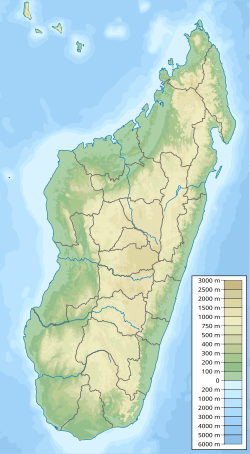
Betsibuka [1] or Betsibuka [2] (obsolete. Betsiboka [3] and Betsiboka [4] ; malag. Betsiboka ) is a river in the northwestern part of the island of Madagascar . It has a length of 525 km, is the largest river of the island. Known for its red-brown color, which is explained by the huge amount of sediment washed by the river in the sea.
| Bezibuk | |
|---|---|
| Malaga Betsiboka | |
 | |
| Characteristic | |
| Length | 525 km |
| Watercourse | |
| Source | river confluence: Dzabu and Amparihibe |
| • Height | > 860 m |
| • Coordinates | |
| Mouth | Strait of mozambique |
| • Height | 0 m |
| • Coordinates | |
| Location | |
| Water system | Strait of mozambique |
| A country |
|
| Regions | Bueni , Betsibuka , Analamanga |
 - source - source  - mouth - mouth | |



Geography and economic use
Betsibuka originates in the mountains of the central part of the island, in the north of the province of Antananarivo . The river is formed at the confluence of the Amparihibe and Dzabu rivers , then flows in a northerly direction. Not far from the village of Maevatanan, Betsibuka goes to the plain and receives (on the left) the water of its largest tributary, the Ikupa River. A 40-km section from this place to the confluence (on the right) with the Kamuru River near the Ambatubueni settlement along the river bed contains a large number of small lakes. Near the settlement of Maruvuay, Betsibuka flows into the Bumbetuka Bay of the Mozambique Strait , forming a delta. At the exit of the bay is the port city of Mahajanga .
The river is navigable 130 km from the mouth, in its lower reaches are vast rice fields . [five]
Ecology
The red-brown color of the waters of Betsibuki is a sign of environmental disaster . Large-scale deforestation of the tropical forest , which was the natural cover of the island, significantly accelerated the process of soil erosion in its northwestern part. [5] The development of land for arable land and pasture over the past 50 years has led to the fact that the volume of leached soils, most of which are red laterite soils (having a laterite horizon in profile), in some areas of the island approaches 250 tons per hectare . This is the maximum recorded value of this indicator worldwide.
Sediments carried by the river settle in the estuary of the river, causing the process of siltation of Bumbetuk Bay. In 1947, the port facilities of the city of Mahajanga had to be moved to the outer shore to prevent the stranded ocean vessels. [6]
In January 2009, two successive tropical cyclones caused flooding on Betsibuk. The river spilled heavily, located along the shores of the lake filled with mud. [7]
Notes
- ↑ IV. Accent // Instruction for the transfer on geographical maps of the Malagasy Republic / Comp. I.V. Popov ; Ed. V.S. Shirokova . - Moscow, 1967. - S. 9. - 200 copies.
- ↑ Betsibuka // Dictionary of geographical names of foreign countries / resp. ed. A.M. Komkov . - 3rd ed., Revised. and add. - M .: Nedra , 1986.- S. 48.
- ↑ Betsiboka // Small Encyclopedic Dictionary of Brockhaus and Efron : in 4 volumes - St. Petersburg. 1907-1909.
- ↑ Betzibock // Brockhaus and Efron Encyclopedic Dictionary : in 86 volumes (82 volumes and 4 additional). - SPb. , 1890-1907.
- ↑ 1 2 Sediment Laden Drainages . Moon and Planet Research Institute , USRA . Date of treatment March 31, 2009. Archived March 29, 2012.
- ↑ Earth from Space (inaccessible link) . NASA Date of treatment March 31, 2009. Archived March 29, 2012.
- ↑ Betsiboka River Floods, Madagascar-January 2009 . NASA Image of the Day (March 30, 2009). Date of treatment March 31, 2009.