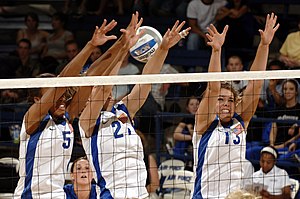
Blocking is a technical element of a volleyball game used to counteract an opponent’s attacking blows, which consists in blocking the ball’s flight path by jumping and putting hands above the net.
The block is considered the most difficult technical element of volleyball, because in the confrontation over the net the attacker is the active side, and the blocker must determine the direction of the strike in a split second and respond to, as a rule, a well-organized attack by the opponent.
Content
Types of Blocking
The rules distinguish between a block attempt (without touching the ball) and an held block (when the ball is hit by a blocker). Only the front line players, that is, located in the 2nd, 3rd and 4th zones of the court, are allowed to participate in the block.
Blocking made by one player is called single ; a block put by two or three players - group , or collective (double and triple, respectively).
Blocking Technique
When setting up a block, the choice of a place for a jump, its height and timeliness is of decisive importance. In attacks from high and medium gears, the blocker jumps after the attacker, in attacks from low gears - at the same time as him, in attacks on takeoff - earlier than the attacker.
When staging a block, a player who is in close proximity to the net jumps up, extends his arms at the elbows and raises them above the net. The fingers with the fingers apart after reaching the upper edge of the grid produce an up-forward movement through the grid. At the time of hitting the ball, the hands are bent in the wrist joints to counteract the attack and direct the ball forward-downward to the opponent’s side. When blocking attacking blows at the edges of the net and when an opponent tries to strike a block in order to bounce the ball into out, the palm of the hand closest to the edge is turned inward so that when it hits the block, the ball bounces onto the opponent’s court.
Blocking can be performed both from a place and after movement. With a single motionless zone block, the player closes a certain zone of his half of the court; with a mobile catching one, he tries to close the true direction of the attacking strike. Reflection of attacks from high gears and attacks with translation is carried out, as a rule, with a group unit. At the same time, the player who blocks the running direction chooses a place to jump, while others “attach” to it [1] [2] .
A History of Changing Rules, Techniques, and Tactics
The attacking strike and blocking as a counter to it began to be used from the second half of the 1920s and significantly diversified the game tactics that existed up to that time, which, as a rule, came down to transfer to the 3rd zone, then to the 4th, from where the volleyball player made a throw through the grid. Later, a group block appeared, but for a long time in volleyball the tendency of a fairly significant superiority of the attack over defense continued, the effectiveness of the volleyball players on the block was low - in the 1950s it was 8% for single blocking with a share of errors of 46% and 13% for group with an error rate of 34%.
In 1965, shortly after the completion of the first Olympic tournament in the history of volleyball, the International Federation (FIVB) introduced an amendment to the rules to balance the possibilities of attack and defense, allowing the players of the defending team to touch the ball on the opponent’s side when setting a block (after they made attack hit) and re-touch the ball after blocking. Since 1976, the block ceased to be one of three hits: after the blocking, the players of one team got the opportunity to touch the ball 3 more times before transferring it to half of the opponent’s court. Even earlier, since 1970, it was allowed to block the opponent’s supply, but in 1984 this rule was canceled.
Changes in the rules of blocking not only increased the effectiveness of this element of the game, but also contributed to the development of attack tactics, the appearance of more diverse attacks, and increased game dynamics. According to the prominent Japanese coach Yasutaki Matsudaira , who considered the block an ornament of volleyball, “the search for methods to combat a powerful block led to the creation of a modern high-speed game” [3] .
Blocking tactics also continued to improve; in different years, team coaches developed special options for playing on the block. For example, Vyacheslav Platonov is the author of the idea of the “ledge” block - this is when the 4th zone player is a meter away from the net and is responsible for the defense on the entire net, helping partners block the attack in all directions [4] . This scheme was first tested in 1976 by Avtomobilist players , and later became a powerful weapon in the performance of the USSR national team.
Block in modern volleyball
In modern volleyball, the double block is most often used (up to 70%), less often - single and triple [5] . High-class teams gain 12-15% of the points in a match in a block, because after a well-placed block, opponents can find it very difficult, and sometimes impossible, to leave the ball in the game. In cases where the opponent’s attack is not stopped by the block, favorable conditions are still created for playing on the back line, the players and the libero have the opportunity to more definitely choose a place to receive the ball, while the opponent’s attack becomes less strong and prepared.
Playing on the block is the main function of the two central blockers (also called the first tempo attackers), who are usually the highest and most mobile players in the team, capable of jumping to a height of about 3.4-3.5 meters. Due to the fact that the game process is associated with transitions of players, and players who are able to play effectively on the block are not always on the net, in modern volleyball conditions, compositional variation through substitutions plays a particularly important role.
A number of teams are trying to strengthen the game on the block, using the services of higher than usual binders . A striking example of such a case is the Dutchman Peter Blanche (height 206 cm), who replaced the “small” Avital Selinger (175) in the team in 1993 - the triple block with Blange became an insurmountable obstacle for rivals, which was one of the factors for the successful performance of the Netherlands team in mid 1990s [6] . Based on this, the zone block today is more common than the catching one - male players about 210 cm tall and women above 200 cm close the net simply physically; in addition, this blocking option is easier to execute [7] .
A successful team game on the block can have a strong impact on the emotional background of the team, its mood. There are frequent cases when the “sheathing” of the best attacking opponent, who previously played correctly, catches courage and sows nervousness in the camp of his opponent, which can lead to a sharp change in the course of a difficult game and match.
Blocking in other ball games
In beach volleyball , unlike the classic, the block is one of three touches, but the player is allowed to touch the ball again after blocking. Based on the specifics of the 2x2 game, a group block is encountered in exceptional cases. The zone version of the block, the direction of execution of which one partner negotiates with another using tactical signals, is the main one. The fishing block, regardless of the prior agreement of the partners, is used in cases where the ball is pointed at the net [8] .
Blocking as a tactical method of active defense, when it is difficult for the opponent in possession of the ball to inflict a final blow, takes place in other sports - handball , water polo , basketball ( block shots ), American football .
Notes
- ↑ Basics of setting up a block . fivb.narod.ru. Date of treatment January 1, 2014.
- ↑ Block setting technique . fivb.narod.ru. Date of treatment January 1, 2014.
- ↑ Matsudaira J. and others. Volleyball: the path to victory. - M., 1983.
- ↑ Platonov V.A. Equation with six known. - M., 1983.
- ↑ Zheleznyak Yu. D., Shipulin G. Ya. , Serdyukov O. E. Trends in the development of classical volleyball at the present stage // Theory and Practice of Physical Culture. - 2004. - No. 4 . Archived August 23, 2011.
- ↑ It's time to put Yao Ming on the net . " Sport Express " (December 1, 2003). Date of treatment January 1, 2014.
- ↑ Chesnokov Yu. B. “Airspace” at the castle // Volleyball Time. - 2007. - No. 3 . - S. 80-82 .
- ↑ Kostyukov V.V. Development of beach volleyball in Russia: problems, prospects // Theory and practice of physical culture. - 1999. - No. 3 . Archived July 12, 2009.
Literature
- Sports games: Technics, tactics, teaching methods / Ed. Yu. D. Zheleznyak, Yu. M. Portnova. - 2nd ed .. - M .: Academy, 2004 .-- 520 p. - ISBN 5-7695-1749-2 .
- Sports Games: Improving Sportsmanship / Ed. Yu. D. Zheleznyak, Yu. M. Portnova. - M .: Academy, 2004 .-- 396 p. - ISBN 5-7695-1411-6 .
- Volleyball / Under the General Ed. A.V. Belyaev, M.V.Savina. - 4th ed .. - M .: TVT Division, 2009. - 360 p. - ISBN 978-5-98724-059-5 .