Helm Molotoruky , son of Gram ( Eng. Helm The Hammerhand , incl . Translation options - Helm Iron Hand , Helm Zheleznoruky ; 2691 - 2759 T.E.) - in the legendary J.R. R. Tolkien the ninth King Rohan , famous for his extraordinary physical strength.
| Helm | |
|---|---|
| Helm the hammerhand | |
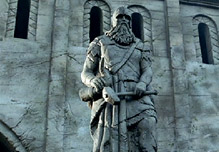 Helm Statue in Hornburg | |
| Race | person |
| Floor | male |
| Habitat | Rohan (until 2759 T.E. ) |
| Years of life | 2691 T.E. - 2759 T.E. |
Biography
Helm Molotoruky was born in 2691 of the Third Age . After the death of his father, the king of Gram, in 2741 of the Third Age, he became king. Helm received his nickname for his tremendous physical strength and severity.
The ruler of Adorn, Freka, came to Helm to ask for the hands of his daughter for his son, Wolfe, but Helm rudely refused him, which angered Freck and began to threaten Helm. And then Helm killed him.
When the Vastaki attacked Rohan in 2758 of the Third Age, Wolfe, the son of Freka, gathered the Dunland warriors under his command and decided to fulfill his revenge for his father, also went to war on Rohan. The battle between the Dunlanders of Wolfe and the squad of Helm at the Isen River was accomplished. In the end, Wolfe captured Edoras and took the throne in the Golden Hall. During the defense of the Gate of Meduseld, Helm's eldest son, Halet, died.
When almost all of Rohan was lost, Helm was forced into the Hornburg Citadel, located in the gorge, later named after him by the Helm Pad and entrenched there with his army. It was then that the Long Winter began. Having lost all his sons in defensive battles, Helm became distraught with grief and began to attack alone at night the camps of the besieging Hornburg Dunlandites, leaving no one alive and, with his appearance, scared the enemy.
Before each sortie, Helm blew his battle horn, so that already having heard his sounds, the Dunland warriors, in fear, were in a hurry to get out of the way of the mad king. Thanks to the fact that Helm attacked his enemies unarmed and killed them with his bare hands, it was believed that when the king was unarmed he could not be killed. After one of such attacks, Helm got lost in a storm and only in the morning was found frozen to death near the walls of the fortress. He was later buried in one of the mounds in front of Edoras .
Helm in Rohan mythology
There is a strong belief in Rohan that the spirit of Helm wanders among the enemies of Rohan, killing them with invisible horror. The signal of his horn in Helm's Paddy marks the beginning of the attack: the Rohirrim believe that Helm rises from the dead and rushes into battle with the living.
... The siege army froze - they listened and looked around. And then from the top of the tower suddenly and menacingly blew Helm's big horn.
A shiver ran through the ranks of the besiegers. Many threw themselves prone to the ground and muffled their ears. The gorge echoed with a booming echo, as if invisible trumpeters on each cliff picked up a military call. The defenders of Gornburg with joyful amazement listened to the silent echoes. Thunder roll call announced the mountains, and there seemed to be no end to the menacing and sonorous singing of horns.
- Helm! Helm! - exclaimed the people of Riga. - Helm rose from the dead and rides to the battle! Helm and King Theoden!( Quoted from: “The Lord of the Rings. Two Fortresses,” Chapter 7 // Translation by V.S. Muravyov. )
Literature
- Gary Russell. The Art Of The Lord Of The Rings . - Houghton Mifflin Harcourt, 2004 .-- P. 28. - 223 p. - ISBN 9780618510832 .