The Chinese Soviet Republic ( Chinese trade. 中華 蘇維埃 共和國 , exercise. 中华 苏维埃 共和国 , pinyin : Zhōnghuá Sūwéi'āi Gònghéguó ) - the Soviet republic under the leadership of the Chinese Communist Party , which existed in 1931-1934 in the south of Central China. According to Chinese historiography, the republic existed until September 22, 1937 , when it was transformed into the Special District .
| de facto independent unrecognized state | |||||
| Republic of China | |||||
|---|---|---|---|---|---|
| 中華 蘇維埃 共和國 中华 苏维埃 共和国 | |||||
| |||||
| Anthem : International (國際歌) | |||||
 | |||||
←   → →November 7, 1931 - September 22, 1937 | |||||
| Capital | Ruijin | ||||
| Largest cities | Hoichang, Dingzhou, Ningdu, Nanfin, Lichuan | ||||
| Languages) | Chinese | ||||
| Currency unit | Yuan [1] | ||||
| Ethno-burial | Chinese, Chinese, Chinese | ||||
| Square | 150,000 km² | ||||
| Form of government | Soviet republic | ||||
| Diplomatic recognition | was absent | ||||
| Official language | |||||
| Actual country leaders | |||||
| • 1931-1937 | Zhang Wentian | ||||

Content
Creation Background
The Soviet movement in China gained wide scope after the conduct of the National Revolutionary Army of the Northern Campaign as a result of its victory over local militarists and propaganda by the Communists, both local and KPA. After the defeat of the Soviet movement in large cities (the largest of these defeats was the Guangzhou rebellion of 1927 ), the councils were established almost exclusively in rural areas.
In 1931, there were about 10 Soviet districts in China with a population of several million people. The Red Army of China served as an armed support against the Kuomintang troops and local militarists.
The Chinese Soviet Republic, 1931-1934
On the recommendation of the ECCI and the decision of the 4th plenum of the Central Committee on September 11, 1931, the Chinese Soviet Republic and the Provisional Soviet Government were formally established. [2]
On November 7, 1931, in the city of Ruijin (Jiangxi Province), the 1st All-China Congress of Soviets was held. The congress adopted draft constitution of the Chinese Soviet Republic, land law, labor law, economic policy, the construction of the Chinese Red Army, Soviet construction and others; was elected by the Central Executive Committee of the Chinese Soviet Republic, which formed the Provisional Central Soviet Government (Council of People's Commissars) led by Mao Zedong . The revolutionary military council of the republic was led by Zhu De .
An important role in the political and military leadership of the Chinese Soviet Republic was played by such members of the Political Bureau of the Central Committee of the CPC as Xiang Ying and Zhou Enlai , sent to the Central Soviet Region, and Zhang Gotao , sent to the base of the 4th Corps.
The Central Army Group became the military support of the Republic, the basis of which was the troops of Zhu De and Mao Zedong, parts of Xu Xiangqian in the Anhui - Henan - Hubei region, the He Lun corps in the Hubei - Hunan region, and other parts of the Chinese Red Army. In 1931-1932, the reorganization of the Red Army was completed, which began in 1929-1930. The discrepancy in the names and numbers of military units was eliminated, the rear service was created, and the support and supply services, medical services and combat training were streamlined. Under the Revolutionary Military Council, the General Staff was created, headed by Liu Bocheng , as well as the Political Administration, which was headed by Politburo member Wang Jiaxiang ; in military units, the institution of commissars was strengthened.
The largest Soviet region in the republic was the Central region (southeastern Jiangxi - western Fujian ). Other major Soviet regions were the region in Northeast Jiangxi, the Hunan-Jiangxi region, the Hunan-Hubei-Jiangxi region, the Hunan-West Hubei region, the Hunan-Hubei region (west of Wuhan), the Sichuan-Guizhou region, the Shaanxi-Gansu region, Hubei - Henan - Anhui District, Honhu District. The remoteness, mountain location and lack of modern communications - these basic geographical features of the Chinese Soviet Republic perfectly protected it from external enemies in the military sense. On the other hand, the republic was located in mountainous, sparsely populated border areas of the provinces far from the main highways, these areas were badly damaged during the years of the civil war and as a result of enemy campaigns, and the increasing military and economic blockade caused its political and economic isolation. In 1932, the connection of the Central Region with other bases and formations of the Red Army was absent or unstable.
By the beginning of the 4 punitive campaign, the area of the Central Soviet District, located in East Jiangxi and West Fujian, was 50-60 thousand square meters. km., population - 4-5 million people. The Central Army Group included 1, 3 and 5 corps with a total number of about 25 thousand people. In addition, there were a number of local independent regiments and divisions, numbering 30-40 thousand people, as well as almost unarmed units of peasant self-defense - the Red Guard, the Young Guard and others.
The second largest Soviet region with an area of 40 thousand square meters. km and with a population of about 3 million people, it was located at the junction of the provinces of Henan, Hubei, Anhui, north of the Yangtze River and east of the Beijing-Wuhan railway. The regular armed forces of the region were the 4th Corps, numbering 12-15 thousand people. In addition, there were independent and local units of 5-6 thousand soldiers. Political, and later military leadership of the area was carried out by Zhang Gotao.
At the junction of the provinces of Jiangxi, Zhejiang and Anhui was a powerful partisan region with an area of about 15 thousand square meters. km with a population of 1 million people. There was an 10th army under the command of Fan Zhimin, numbering 5-6 thousand people.
At the southern junction of the provinces of Hunan and Jiangxi, there was a base of the 17th and 18th independent divisions with a total number of 10 thousand people, later reduced to the 6th corps under the command of Xiao Ke , an area of 15 thousand square meters. km with a population of 1-2 million people.
In the partisan region of a separate 16th division at the junction of the provinces of Hunan, Jiangxi, Hubei with an area of up to 12 thousand square meters. km with a population of up to 500 thousand and 3-4 thousand fighters, the Soviet district was lost due to unsteady leadership and conflicts with the local population.
At the junction of the Hubei and Hunan provinces, in the middle reaches of the Yangtze, there was a Soviet district of the 2nd building. Its area was about 20 thousand square meters. km., the population was 1-2 million people, and the armed forces more than 10 thousand soldiers.
In total, in six large Soviet regions with a total area of about 150 thousand square meters. km These areas were defended by regular armed forces of 65-72 thousand people.
Between 1931 and early 1934, the number of Soviet districts decreased, but some of them expanded their territory. By the fall of 1933, the Chinese Red Army successfully repelled four punitive campaigns of the Kuomintang army against the Soviet regions.
On April 5, 1932, the Chinese Soviet Republic declared war on Japan. [3]
In January 1934, the 2nd All-China Congress of Soviets was held in the Central Soviet Region, which adopted a number of decisions aimed at strengthening the Red Army and improving the work of the Soviets, and finally adopted the Constitution. Democratic freedoms for workers, equality of men and women, equality of nationalities and the right of all peoples of China to self-determination up to the state branch and the creation of independent states were proclaimed. The independence of the Mongolian People’s Republic was unconditionally recognized.
| In accordance with the Basic Constitutional Program, the Regulation and the Provisional Law on Elections to the Soviets (1931 and 1933, respectively), “only workers” enjoyed active and passive suffrage. Workers in the Soviet elections were given special advantages. The elections of deputies were held at special meetings according to the production and territorial principle: workers - at enterprises, and peasants, artisans, etc. - at the place of residence. The principles of work of the Soviets were established by special acts adopted at the I and II congresses of the Soviets (Regulation and resolution on Soviet construction). [four] |
However, by this time, the situation in the Soviet districts began to deteriorate in connection with the 5th punitive expedition of the Kuomintang that began in the autumn of 1933.
Great Campaign
In October 1934, a group of the Chinese Red Army, defending the Central Soviet District, was forced to leave it and begin the Great Campaign (Northwest Campaign). Between the fall of 1935 and the fall of 1936, the surviving detachments of the Red Army concentrated in the area at the junction of Shaanxi and Gansu, which after the end of the Northwest campaign remained the only Soviet region.
In connection with the expansion of the Japanese aggression against China and the transformation of Japanese troops into a threat to the Red Army, no less dangerous than the Kuomintang army, the CPC, contrary to the previous position of Mao Zedong, began to revise the policies of the Soviets based on the decisions of the 7th Congress of the Comintern . Since 1936, the main slogan has been the creation of a united anti-Japanese front with all the armed and political forces of China, including the Kuomintang. Immediately before the outbreak of war with Japan in the spring of 1937, the slogans of the Soviets and the confiscation of landowner land were removed. The Soviet district of Shaanxi - Gansu - Ningxia was renamed the "Special District" , and the local Red Army units were transformed into the 8th Army .
See also
- Xi'an incident
- Sino-Japanese War (1937-1945)
Notes
- ↑ World Coins. China . coins20c.narod.ru. Date of treatment November 11, 2018.
- ↑ Harold Isaacs. The tragedy of the Chinese revolution . VuzLib.net . Date of treatment November 11, 2018.
- ↑ Yuri Zhukov. Another Stalin . Nikolai Ivanovich Kozlov . Date of treatment November 11, 2018.
- ↑ Chapter 15 (inaccessible link) . Date of treatment March 29, 2009. Archived on April 8, 2008.
Links
- Great Soviet Encyclopedia / Tips in China
- Brown O., Chinese Notes. 1932-1939, M., 1974.
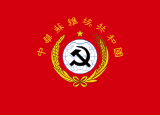
- Flags of the Chinese Soviet Republic and the Chinese Red Army