Clever Geek Handbook
📜 ⬆️ ⬇️

Linear differential equation with constant coefficients

A linear differential equation with constant coefficients is an ordinary differential equation of the form:

∑k=0naky(k)(t)=any(n)+an-oney(n-one)+⋯+aoney′+a0y=f(t){\ displaystyle \ sum _ {k = 0} ^ {n} {a_ {k} y ^ {(k)} (t)} = a_ {n} y ^ {(n)} + a_ {n-1} y ^ {(n-1)} + \ dots + a_ {1} y '+ a_ {0} y = f (t)} {\ displaystyle \ sum _ {k = 0} ^ {n} {a_ {k} y ^ {(k)} (t)} = a_ {n} y ^ {(n)} + a_ {n-1} y ^ {(n-1)} + \ dots + a_ {1} y '+ a_ {0} y = f (t)}

Where

  • y=y(t){\ displaystyle y = y (t)} {\ displaystyle y = y (t)} - desired function
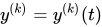
  • y(k)=y(k)(t){\ displaystyle y ^ {(k)} = y ^ {(k)} (t)} {\ displaystyle y ^ {(k)} = y ^ {(k)} (t)} - herk {\ displaystyle k} k derivative
  • a0,aone,a2,...an{\ displaystyle a_ {0}, a_ {1}, a_ {2}, \ dots a_ {n}} {\ displaystyle a_ {0}, a_ {1}, a_ {2}, \ dots a_ {n}} - fixed numbers
  • f(t){\ displaystyle f (t)} f (t) - given function (whenf(t)≡0 {\ displaystyle f (t) \ equiv 0} {\ displaystyle f (t) \ equiv 0} , we have a linear homogeneous equation, otherwise - a linear inhomogeneous equation).

Homogeneous equation

Definition

Multiplicity rootk {\ displaystyle k} k polynomiala0xn+aonexn-one+...+an {\ displaystyle a_ {0} x ^ {n} + a_ {1} x ^ {n-1} + \ ldots + a_ {n}} {\displaystyle a_{0}x^{n}+a_{1}x^{n-1}+\ldots +a_{n}} this numberc {\ displaystyle c} c such that this polynomial is divisible without remainder by(x-c)k {\ displaystyle (xc) ^ {k}} {\displaystyle (x-c)^{k}} but not on(x-c)k+one {\ displaystyle (xc) ^ {k + 1}} {\displaystyle (x-c)^{k+1}} .

The equation of order n

Homogeneous equation:

any(n)+an-oney(n-one)+⋯+aoney′+a0y=0{\ displaystyle a_ {n} y ^ {(n)} + a_ {n-1} y ^ {(n-1)} + \ dots + a_ {1} y '+ a_ {0} y = 0} {\displaystyle a_{n}y^{(n)}+a_{n-1}y^{(n-1)}+\dots +a_{1}y'+a_{0}y=0}

integrates as follows:

Let beλone,...,λk {\ displaystyle \ lambda _ {1}, \ dots, \ lambda _ {k}} {\displaystyle \lambda _{1},\dots ,\lambda _{k}} - all the different roots of the characteristic polynomial , which is the left side of the characteristic equation

anλn+an-oneλn-one+⋯+aoneλ+a0=0{\ displaystyle a_ {n} \ lambda ^ {n} + a_ {n-1} \ lambda ^ {n-1} + \ dots + a_ {1} \ lambda + a_ {0} = 0}  

multiplicitiesmone,m2,...,mk {\ displaystyle m_ {1}, m_ {2}, \ dots, m_ {k}}   accordinglymone+m2+⋯+mk=n {\ displaystyle m_ {1} + m_ {2} + \ dots + m_ {k} = n}   .

Then the functions

tνeλjt,one≤j≤k,0≤ν≤mj-one{\ displaystyle t ^ {\ nu} e ^ {\ lambda _ {j} t}, \ \ 1 \ leq j \ leq k, \ \ 0 \ leq \ nu \ leq m_ {j} -1}  

are linearly independent (generally speaking, complex) solutions of a homogeneous equation, they form a fundamental system of solutions .

The general solution of the equation is a linear combination with arbitrary constants (generally speaking, complex) coefficients of the fundamental system of solutions.

Using the Euler formula for pairs of complex conjugate rootsλj=αj±iβj,one≤j≤k {\ displaystyle \ lambda _ {j} = \ alpha _ {j} \ pm i \ beta _ {j}, \ \ 1 \ leq j \ leq k}   we can replace the corresponding pairs of complex functions in the fundamental system of solutions with pairs of real functions of the form

tνeαjtcos⁡(βjt),tνeαjtsin⁡(βjt),j∈one...k¯,0≤ν≤mj-one{\ displaystyle t ^ {\ nu} e ^ {\ alpha _ {j} t} \ cos (\ beta _ {j} t), \ \ t ^ {\ nu} e ^ {\ alpha _ {j} t } \ sin (\ beta _ {j} t), \ \ j \ in {\ overline {1 \ dots k}}, \ \ 0 \ leq \ nu \ leq m_ {j} -1}  

and construct a general solution of the equation in the form of a linear combination with arbitrary real constant coefficients.

Second Order Equation

Homogeneous second order equation:

a2y″+aoney′+a0y=0{\ displaystyle a_ {2} y '' + a_ {1} y '+ a_ {0} y = 0}  

integrates as follows:

Let beλone,λ2 {\ displaystyle \ lambda _ {1}, \ lambda _ {2}}   Are the roots of the characteristic equation

a2λ2+aoneλ+a0=0{\ displaystyle a_ {2} \ lambda ^ {2} + a_ {1} \ lambda + a_ {0} = 0}   ,

being a quadratic equation .

The form of the general solution of the homogeneous equation depends on the value of the discriminantΔ=aone2-foura2a0 {\ displaystyle \ Delta = a_ {1} ^ {2} -4a_ {2} a_ {0}}   :

  • atΔ>0 {\ displaystyle \ Delta> 0}   the equation has two different real roots
λone,2=αone,2=-aone±Δ2a2.{\ displaystyle \ lambda _ {1,2} = \ alpha _ {1,2} = {\ frac {-a_ {1} \ pm {\ sqrt {\ Delta}}} {2a_ {2}}}.}  

The general solution is:

y(t)=coneeαonet+c2eα2t{\ displaystyle y (t) = c_ {1} e ^ {\ alpha _ {1} t} + c_ {2} e ^ {\ alpha _ {2} t}}  
  • atΔ=0 {\ displaystyle \ Delta = 0}   - two matching real roots
λone=λ2=α=-aone2a2.{\ displaystyle \ lambda _ {1} = \ lambda _ {2} = \ alpha = {\ frac {-a_ {1}} {2a_ {2}}}.}  

The general solution is:

y(t)=coneeαt+c2teαt{\ displaystyle y (t) = c_ {1} e ^ {\ alpha t} + c_ {2} te ^ {\ alpha t}}  
  • atΔ<0 {\ displaystyle \ Delta <0}   there are two complex conjugate roots
λone,2=α±iβ=-aone2a2±i|Δ|2a2.{\ displaystyle \ lambda _ {1,2} = \ alpha \ pm i \ beta = {\ frac {-a_ {1}} {2a_ {2}}} pm pm {\ frac {\ sqrt {| \ Delta |}} {2a_ {2}}}.}  

The general solution is:

y(t)=coneeαtcos⁡(βt)+c2eαtsin⁡(βt){\ displaystyle y (t) = c_ {1} e ^ {\ alpha t} \ cos (\ beta t) + c_ {2} e ^ {\ alpha t} \ sin (\ beta t)}  

Inhomogeneous equation

The inhomogeneous equation is integrated by the method of variation of arbitrary constants ( Lagrange Method ).

The form of a general solution of an inhomogeneous equation

If a particular solution of the inhomogeneous equation is giveny0(t) {\ displaystyle y_ {0} (t)}   , andyone(t),...,yn(t) {\ displaystyle y_ {1} (t), \ ldots, y_ {n} (t)}   Is the fundamental system of solutions of the corresponding homogeneous equation, then the general solution of the equation is given by the formula

y(t)=coneyone(t)+...+cnyn(t)+y0(t),{\ displaystyle y (t) = c_ {1} y_ {1} (t) + \ ldots + c_ {n} y_ {n} (t) + y_ {0} (t),}  

Wherecone,...,cn {\ displaystyle c_ {1}, \ dots, c_ {n}}   - arbitrary constants.

Superposition Principle

As in the general case of linear equations , the principle of superposition takes place, which is used in different formulations of the principle of superposition in physics.

In the case when the function on the right-hand side consists of the sum of two functions

f(t)=fone(t)+f2(t){\ displaystyle f (t) = f_ {1} (t) + f_ {2} (t)}   ,

a particular solution of an inhomogeneous equation also consists of the sum of two functions

y0(t)=y01(t)+y02(t){\ displaystyle y_ {0} (t) = y_ {01} (t) + y_ {02} (t)}   ,

Wherey0j(t),j∈one,2¯ {\ displaystyle y_ {0j} (t), \ \ j \ in {\ overline {1,2}}}   are solutions of an inhomogeneous equation with right-hand sidesfj(t),j∈one,2¯ {\ displaystyle f_ {j} (t), \ \ j \ in {\ overline {1,2}}}   , respectively.

Special Case: Quasimolecular

In the case whenf(t) {\ displaystyle f (t)}   - quasi-polynomial, i.e.

f(t)=p(t)eαtcos⁡(βt)+q(t)eαtsin⁡(βt){\ displaystyle f (t) = p (t) e ^ {\ alpha t} \ cos (\ beta t) + q (t) e ^ {\ alpha t} \ sin (\ beta t)}  

Wherep(t),q(t) {\ displaystyle p (t), \ q (t)}   - polynomials , a particular solution to the equation is sought in the form

y0(t)=(P(t)eαtcos⁡(βt)+Q(t)eαtsin⁡(βt))ts{\ displaystyle y_ {0} (t) = (P (t) e ^ {\ alpha t} \ cos (\ beta t) + Q (t) e ^ {\ alpha t} \ sin (\ beta t)) t ^ {s}}  

Where

  • P(t),Q(t){\ displaystyle P (t), \ Q (t)}   polynomialsdeg(P)=deg(Q)=Max(deg(p),deg(q)) {\ displaystyle deg (P) = deg (Q) = Max (deg (p), \ deg (q))}   whose coefficients are a substitutiony0(t) {\ displaystyle y_ {0} (t)}   into the equation and calculation by the method of uncertain coefficients .
  • s{\ displaystyle s}   is the multiplicity of a complex numberw=α+iβ {\ displaystyle w = \ alpha + i \ beta}   as the root of the characteristic equation of a homogeneous equation.

In particular, when

f(t)=p(t)eαt{\ displaystyle f (t) = p (t) e ^ {\ alpha t}}  

Wherep(t) {\ displaystyle p (t)}   Is a polynomial, a particular solution to the equation is sought in the form

y0(t)=P(t)eαtts{\ displaystyle y_ {0} (t) = P (t) e ^ {\ alpha t} t ^ {s}}  

HereP(t) {\ displaystyle P (t)}   - polynomialdeg(P)=deg(p) {\ displaystyle deg (P) = deg (p)}   , with indeterminate coefficients that are a substitutiony0(t) {\ displaystyle y_ {0} (t)}   into the equation.s {\ displaystyle s}   is a multiplicityα {\ displaystyle \ alpha}   as the root of the characteristic equation of a homogeneous equation.

When

f(t)=p(t){\ displaystyle f (t) = p (t)}  

Wherep(t) {\ displaystyle p (t)}   Is a polynomial, a particular solution to the equation is sought in the form

y0(t)=P(t)ts{\ displaystyle y_ {0} (t) = P (t) t ^ {s}}  

HereP(t) {\ displaystyle P (t)}   - polynomialdeg(P)=deg(p) {\ displaystyle deg (P) = deg (p)}   , buts {\ displaystyle s}   is the multiplicity of zero, as the root of the characteristic equation of a homogeneous equation.

The Cauchy - Euler Equation

The Cauchy - Euler equation is a special case of a linear differential equation of the form:

∑k=onenak(αx+β)ky(k)(x)=an(αx+β)ny(n)(x)+...+a2(αx+β)2y″(x)+aone(αx+β)y′(x)+a0y(x)=f(x){\ displaystyle \ sum _ {k = 1} ^ {n} {a_ {k} (\ alpha x + \ beta) ^ {k} y ^ {(k)} (x)} = a_ {n} (\ alpha x + \ beta) ^ {n} y ^ {(n)} (x) + ... + a_ {2} (\ alpha x + \ beta) ^ {2} y '' (x) + a_ {1} ( \ alpha x + \ beta) y '(x) + a_ {0} y (x) = f (x)}   ,

reducible to a linear differential equation with constant coefficients by substitution of the form(αx+β)=et {\ displaystyle (\ alpha x + \ beta) = e ^ {t}}   .

Application

Differential equations are the most commonly used and classical form of mathematical description of processes. Different forms of mathematical descriptions are a tool for analytical analysis and synthesis of dynamic systems and automatic control systems. Differential equations whose parameters depend on variables are called non-linear and do not have common solutions. At present, the mathematical apparatus of the Laplace and Fourier integral transforms is widely used in the theory of automatic control. From mathematics, it is known that the DU is compactly transformed into the frequency domain with constant coefficients and with zero initial conditions. And in control theory, such an equation is linear. [one]

If a dynamic system is represented by nonlinear differential equations of mathematical physics, then the application of classical methods of analysis of these systems requires their linearization .

See also

  • A linear recurrence sequence is a discrete analogue of a linear differential equation with constant coefficients.
  1. ↑ A.V. Andryushin, V.R.Sabanin, N.I.Smirnov. Management and innovation in the power system. - M: MPEI, 2011 .-- S. 41 .-- 392 p. - ISBN 978-5-38300539-2 .
Source - https://ru.wikipedia.org/w/index.php?title= Linear_differential_equation_with_constant_ coefficients&oldid = 101377183


More articles:

  • Luther, Karl Theodore Robert
  • The guy from our city (film, 1942)
  • Apache CXF
  • Boychenko, Valery Viktorovich
  • Tarsien
  • Medical Law
  • Economy of the Third Reich
  • Krasnovorotsky passage
  • Pacarana
  • Kolganov, Vladimir Nikolaevich

All articles

Clever Geek | 2019