Biržai Palace Castle ( lit. Biržų pilis ) is the former residence of the Radziwills in the city of Birzai in northern Lithuania . Destroyed in 1704; recreated in the alleged forms of the XVII century in 1978-1986. It is included in the Register of Cultural Property of the Republic of Lithuania and is protected by the state (code 1905 [1] ). Since 1988, the Birzhaisk Public Library has been located in the palace, and since 1989 - the Birzhaisk Museum of Local Lore, Sela .
| Castle | |
| Birzai castle | |
|---|---|
| lit. Biržų pilis | |
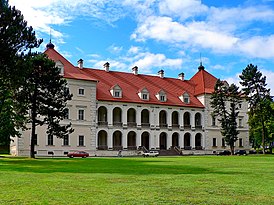 The part of the castle reconstructed at the end of the 20th century | |
| A country |  Lithuania Lithuania |
| Location | Exchange |
| Architectural style | Renaissance |
| Founder | Krzysztof Radziwill |
| Building | 1589 |
| Key dates | |
| 1586-1589, 1637-1682, 1978-1986 | |
Content
History
In 1575, on the initiative of Prince Krzysztof , the construction of the second, northern castle of the Dubin Ordination began from the Dubin branch of the Radziwills. The work began with the construction of a dam at the confluence of the Apascia and Agluon rivers and the formation of the artificial lake Shirvenas with an area of about 400 hectares. In 1586-1589 a castle was built, surrounded by a protective embankment and ditches with water according to the system of Italian Renaissance theorists. Shafts with prominent corners and bastions were important; deep moats surrounded them. The upper part of the stone wall formed a parapet. In the bastions were two- and three-story casemates. An important artistic component of the castle was a two-story gate crowned with a spire [2] . Among the courtyard buildings stood the three-story palace of the prince, located in the middle of the fortress, and the church [3] . At the time of completion, it was the most perfect and largest bastion fortress of the Italian type [1] .
During the Polish-Swedish war in 1625, the castle was captured by the Swedish army, led by the Swedish king Gustav II Adolf . The palace, church, gate building and arsenal were destroyed [1] .
In 1627, Christopher Radziwill returned almost completely destroyed castle. On his initiative, in 1637 the construction of the second Birzai castle began according to the Dutch model of bastion castles. The castle reconstruction project was prepared by engineer, military architect Georg Pirkas ( lit. Georgas Pirkas ). For some time, fortification was led by military engineer and architect Amandus Jostas [1] [4] . New bastions were built, embankments, a dam were repaired, the palace, barracks, arsenal, fortress gates and a bridge were reconstructed. The fortified two-story gates with open loggias were decorated with decorative sculpture, wooden carvings and paintings [2] . The castle included more than 20 buildings for various purposes, forming a huge defensive complex.
In the years 1662-1669. according to the project of architects J. Ulrich and Teofil Spinovskis a new palace was built [1] . The building was rectangular in shape, 24.9 m wide and 71.1 m long, symmetrical in plan. The outer walls of the palace were 1.3 m thick, the inner ones were 1.2 m [5] . The palace was two-story with three-story risalits at the ends. The predominant element of the architectural composition of the palace was a two-tiered arcade gallery located in the center of the facade. The risalits were crowned with a gable roof and turrets with spiers [2] . The architecture of the palace was characteristic of the late Renaissance with some features of Baroque [3] . The interior of the palace was richly decorated: the ceilings were decorated with stucco molding and picturesque shades. The rooms were equipped with glazed tiles with ornamental motifs and heraldic signs of the Radziwills. There were many (about 1000) paintings and sculptures in the palace [4] .
In 1701, during the Northern War in the Birzhaisk Castle, Russian Tsar Peter I and the King of the Polish-Lithuanian Commonwealth and Elector of Saxony August II signed the Birzha Treaty against Sweden. In August 1704, the castle was besieged by a Swedish detachment of 15,000 thousand soldiers led by General A.L. Levengaupt . On August 14 of the same year, the fortress garrison surrendered, the palace and other fortifications were blown up. After that, the castle was not restored. Only the ruins of the palace with the southern wall, fragments of the gate building, the foundations of the arsenal and other buildings have survived.
In 1811, the castle passed into the possession of the counts Tyszkiewicz . In 1818, during a visit to Birzai, Alexander I ordered the ruins of the fortress to be preserved. At the end of the 19th century, the castle was planted with fruit trees and turned into a garden. In the 1920s the embankments and the courtyard became a place for walking and recreation: gravel paths and trees were planted. In 1931, a monument to Janusz Radziwill (sculptor Juozas Zikaras ) was erected in front of the ruins [1] . In the courtyard of the fortress there was a tennis court and a cinema. In Soviet times, there was a city park [4] .
The first project to preserve Birzai Castle was developed in 1953 by architect S. Ramunis. In 1955-1957 A similar project was prepared by A. Umbrasas. The goal of both projects was to put an end to the emergency state of the ruins of the palace [4] . In 1978-1986, after the creation of the Birzhaisk restoration workshop, designed by architect Evaldas Purlis reconstruction of the castle was carried out [6] . To adapt the building to accommodate the local history museum and library in some places, the layout of the premises was changed. In 2006, a 17th-century furnace was restored in one of the halls of the palace [4] . In 2013, the arsenal building was restored [1] .
Since 1988, the Birzhaisk Public Library has been located in the palace, and since 1989 - the Birzhaisk Museum of Local Lore, Sela .
Birzai Castle and the city on the plan of Tomasz Makovsky , 1600s.
The ruins of the palace, 1954
Western facade of the palace
Arsenal
Fortress bridge
Notes
- ↑ 1 2 3 4 5 6 7 Biržų piliavietė (lit.) . Kultūrosvertybių registras . Kultūros paveldo departamentas prie Kultūros ministerijos.
- ↑ 1 2 3 History of the art of the peoples of the USSR: Art of the XIV-XVII centuries / Ed. N.A. Yezerskaya and O.I. Sopocinsky. - M .: Fine Arts, 1974. - T. 3. - S. 202. - 439 p.
- ↑ 1 2 General History of Architecture: Western Europe and Latin America. XVII - the first half of the XIX centuries. - Publishing House of the Academy of Architecture of the USSR, 1969. - T. 7. - S. 394. - 620 p.
- ↑ 1 2 3 4 5 Biržai (lit.) . Gynybiniai įtvirtinimai (XIII-XVIII a.) .
- ↑ Minkevičius J. Lietuvos architektūros istorija: Nuo seniausių laikų iki XVII a vidurio. - Vilnius: vidurio, 1987. - T. 1. - S. 223. (lit.)
- ↑ Zhemaitite, 1984 , p. 131.
Literature
- Daugudis V., Mardosa J., Zhemaitite Z. et al. 300 cultural monuments / Comp. Z. Zhemaitite. - Vilnius: Mintis, 1984. - 270 p.
- Yčas J. Biržai fortress, city and duchy: an outline of history = Biržai: tvirtovė, miestas ir kunigaikšystė: istorijos eskizas. - Kaunas: Candela, 2009 .-- 191 p. (lit.)
- Pinkus S. Biržų pilis. - Vilnius: Mintis, 1986. (lit.)
- Pinkus S. Biržų pilis // Lietuvos pilys. - Vilnius, 1971. - S. 245—276. (lit.)
- Kviklys B. Mūsų Lietuva. - 1991. - T. 2. - S. 668-681. (lit.)
- Glemža J. Biržų pilis // Mokslas ir gyvenimas. - 1969. - No. 7 . - S. 19–22 . (lit.)
Links
- Biržų piliavietė // Kultūros vertybių registras (lit.)
- Birzhaisk Museum of Local Lore “Sela” (inaccessible link) (Russian)