American Siskin [2] ( lat. Carduelis tristis ) is a species of migratory North American passerine birds from the family finch . Birds nest in the territory from the middle of Alberta to Northern California ; in winter they migrate south through the Canadian border to the USA and Mexico .
| American siskin |
|---|
 |
|
| No rank : | Bilateral symmetrical |
| Infrastructure : | Passerida |
|
|
Carduelis tristis ( Linnaeus , 1758 ) |
|
- Fringilla tristis Linnaeus, 1758 [1]
|
|
- Carduelis tristis jewetti (van Rossem, 1943)
- Carduelis tristis pallida (Mearns, 1890)
- Carduelis tristis salicamans (Grinnell, 1897)
- Carduelis tristis tristis (Linnaeus, 1758)
|
|
 Nesting range All year round Migrations |
|
Least ConcernedIUCN 3.1 Least Concern : 22720407 |
|
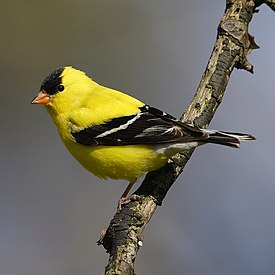
Birds of this species are the only ones in the Carduelinae subfamily that completely change summer plumage to winter plumage. Sexual dimorphism is the color of the plumage - males are mostly clearly yellow in summer, olive in winter, and females pale yellow-brown, only lighter in summer. Males display their bright plumage in the mating season to attract females.
Fruit-eating birds, adapted for quick extraction and consumption of seeds from mature inflorescences with a conical beak. Social animals that adjoin large flocks of birds during the search for food and migration. They may be territorial during the construction of the nest , although this behavior is short-lived among American siskins. Mostly monogamous . One brood per year.
Human activity is beneficial for American siskins. Siskins often find areas rich in food resources that are rich in seed plants, which helps birds survive easier in the area. Deforestation is also favorable for siskins, as new open areas appear that are preferable for them.
Phylogenetic relationships were determined by Antonio Arnaiz-Villena and coauthors [3] .
The American siskin was first described by the Swedish naturalist Carl Linnaeus in 1758 in the tenth edition of the book " Systems of Nature ", originally placed in the genus Fringilla [1] .
There are four subspecies [4] [1] :
- Carduelis tristis tristis is the nominative subspecies most common. In summer, it occurs from southern Canada to Colorado and east to North and South Carolina . In winter, from southern Canada south to Florida and central Mexico ;
- Carduelis tristis pallida - differs from other subspecies by a paler plumage, brighter white patterns and, in males, a black “cap”, which occupy a larger surface of the head than other subspecies. Larger than the nominative subspecies. It occurs in summer from British Columbia to western Ontario, south to Colorado and west to Oregon. In winter - from southern Canada and northern California, south to Mexico;
- Carduelis tristis jewetti is the smallest and darkest among subspecies. It occurs on the coastal slopes of the Cascade Mountains from southern British Columbia to central California, partially merging with the range of C. t. pallidus .
- Carduelis tristis salicamans - found in the summer in the west of Sierra Nevada , in the winter - in the south and central part of Upper California to the Mojave and Colorado deserts. In winter, the plumage of birds of both sexes is browner than that of the representatives of the remaining subspecies; in winter, males have a smaller “cap” than other subspecies.
American siskins are small birds, 11–13 cm long, with a wingspan of 19–22 cm, and a mass of 11–20 grams [5] . The beak is small, conical and pink from summer to winter, and in spring, during the change of plumage to summer orange [6] . The shape and size of the beak is suitable for the isolation of seeds from inflorescences of a thistle, sunflower and other plants [7] .