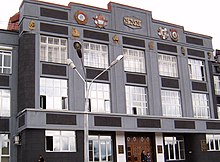
Novokuznetsk Metallurgical Plant (until 2003 - the Kuznetsk Metallurgical Plant ) (since 2011 the ZSMK rail rolling site) - a metallurgical plant in the city of Novokuznetsk, Kemerovo Region . The plant was founded on May 5, 2003 on the basis of the production facilities of the legendary KMK, which for over 70 years has been supplying its products to different parts of Russia and abroad.
| NKMK | |
|---|---|
 | |
| Type of | Public corporation |
| Year of foundation | 2003 , based on KVM (1931) |
| Location |  Russia : Novokuznetsk , 1 Victory Square Russia : Novokuznetsk , 1 Victory Square |
| Key figures | Golovatenko Alexey - Director of Rail Production |
| Industry | ferrous metallurgy |
| Products | railway rails |
| Turnover | ▼ 26 366.9 million rubles ( 2009 ) [1] |
| Net profit | ▼ −2 071.4 million rubles (2009) |
| Number of employees | more than 10,000 (2011) |
| Awards |     |
| Site | web.archive.org/web/2007... |
A controlling stake in the enterprise belonged to the Russian metallurgical company Evraz Group .
History
In April 1918, the Supreme Council of the National Economy announced a competition for "a project to create a single economic organization covering the mining and metallurgical industry of the Kuznetsk coal basin ."
KMK Construction (Kuznetsk Iron and Steel Works)
The plant was created in the period 1929-1936. near the city of Kuznetsk . [2]
At the end of the 1920s, a decision was made to create in the East of the USSR a second powerful coal and metallurgical base operating on iron ores of the Urals and coking coal of Siberia. In the autumn of 1927, the recruitment of workers began, which was to build the largest metallurgical plant.
In 1929, I.P. Bardin was summoned to Moscow. He is entrusted with the technical management of the construction of the Kuznetsk Metallurgical Plant, the first-born of the industrial development of Siberia’s natural resources.
Construction of the plant began in the short winter days of the end of 1929, when air temperature rarely rose above 30 degrees below zero. Bonfires burned day and night at the construction site, warming the frozen ground. Thousands of Komsomol members who arrived here from different parts of the country dug trenches in frozen ground, erected foundations for metallurgical furnaces, and created giant workshops. Bardin was the soul of this great construction site. You could meet him here both in the early morning and in the dead of night, when work was carried out in the bright light of many hundreds of spotlights.
The enthusiasm of the builders of the metallurgical plant was very impressed by the poet Vladimir Mayakovsky , who knew some of them personally, and who dedicated his famous poem, “There will be a garden city here in four years”, which was part of the compulsory school curriculum in the USSR.
Bardin during the construction was able to change the technical conditions of the project. Knowing the site well, he noted that the workshops could be located better than the American company Freyn Enginering had proposed . The fact is that the Americans limited the area of the plant to the river Konobenikha . In the summer it was a trickle, and in the spring - a fierce river. Ivan Pavlovich found that if you build a dam and divert water through a canal, the plant area can be significantly expanded, and it’s more appropriate to arrange workshops.
All this made it possible to significantly increase the capacity of the future plant. From 400 thousand tons of pig iron per year, it rose to 1.5 million tons.
No difficulties could stop Bardin; on the contrary, they inspired him; Apparently, the practice of previous years inspired him with confidence that any difficulties could and should be overcome. He knew how to maintain self-control at any difficult moment, he hated whiners, whom he was drawn to a quiet life.
| Construction, - said Bardin, - we need people who are disciplined, selfless, persistent in the pursuit of achieving the intended goal. |
The chief engineer boldly gave permission and drawings for blasting, which were to prepare the construction of foundations for blast furnaces and open-hearth furnaces.
Builders ahead of schedule laid all the foundations of the main workshops, except for rolling. This scope of work unfolding on the site was unexpected for the central department in charge of construction. Telegrams flew to Bardin from Moscow. "On what basis, according to whom is the approved plan the construction of the main workshops of the plant carried out?" The construction manager drew the attention of the chief engineer to the fact that there is no approved work plan yet and he, Bardin, has no right to erect the main structures.
To all telegrams and inquiries, Ivan Pavlovich replied that he had already discussed and finally approved a plan drawn up by Frein, and that he considered it to be a sufficient basis for work.
Representatives of several dozens of design organizations worked at the construction site [3]
At the end of February 1930, a commission unexpectedly arrived at the construction site, by the decision of which the construction management was transferred to the Stalstroy construction organization. Construction slowed down. After Bardin’s stubborn struggle with the builders, the decision of the Supreme Economic Council, signed by V.V. Kuybyshev, the structure of Stalstroy was liquidated. The builders were again subordinated to the leadership of Kuznetskstroy . All the reins of the technical management - both design, and technical supervision, and direct management of the organization and the progress of work - again passed to Ivan Pavlovich.
In the second half of 1930, equipment ordered abroad began to arrive - excavators, cranes, tractors, cars, mobile power plants, and machine tools. By January 1, 46,827 people were working at the construction site [4]
On May 1, 1930, the foundation of the blast furnace was laid in a festive atmosphere, and on April 1, 1932 at 3 hours 55 minutes the first Kuznetsk blast furnace was blown out. April 3, 1932 the first cast iron was obtained.
The metal given out by the first blast furnace was poured by a casting machine and sent to Moscow. The participants of the celebration received the tiles of the first Siberian cast iron.
The newspaper of the Kuznetsk construction then wrote:
| Listen, great proletarian country: there is Kuznetsk cast iron! |
Following the first furnace, a second went a month later. And soon steel marten was issued, then the rolling shop was launched - the existing blooming and rail rolling mill were commissioned.
In 1932, the plant went into operation. It was built in 1000 days. This is a great merit of Ivan Pavlovich, who managed to mobilize people to overcome difficulties associated with construction. I.P. Bardin worked for eight years as a technical director of KMK. During this time, the construction of the plant was completely completed and it became the country's foremost metallurgical enterprise.
In April 1932, I.P. Bardin became an academician of the USSR Academy of Sciences.
KVM activities in the Soviet years
At first, the plant worked poorly. In the winter of 1932/33, water pipelines froze, ore in bunkers froze into stone, paths covered with ice. The Americans even proposed stopping the plant for the winter months. But the dedication and enthusiasm of the Soviet people did what the foreign experts thought was impossible. The plant began to pick up pace, giving the country more and more metal.
By 1936, the Kuznetsk Metallurgical Plant was already in full swing. Both local coals and local ores were developed. The blast furnaces - Bardin's main concern - worked quietly. Mines expanded, and the plant continued to be built.
In the 1930s, the KMK included Osinnikov mines, and in the 1930-1970 mines of Mountain Shoria.
The brainchild of I.P. Bardin was the central factory laboratory, in which he had his second office and spent a whole week in it weekly.
Also at the initiative of I.P. Bardin, a technical museum of the plant was created at KMK. [5] A memorial museum of the academician was created at the scientific and technical museum of the plant - its home office and library were donated to the plant by his wife L. V. Bardina.
I.P. Bardin attached particular importance to the technical library, created already in 1933.
In 1938, the prototype of a continuous casting machine was first used in the world by KMK, producing a small section, but suitable for further redistribution, of a profile.
During the period from 1941 to 1945, KMK produced defense products. The director of the plant was Roman Vasilievich Belan. KMK’s armor produced: tanks - 50 thousand out of 108 thousand in the USSR, aircraft - 45 thousand out of 95 thousand in the USSR, shells - 100 million out of 220 million in the USSR.
In 1944, the Kuznetsk Metallurgical Plant was renamed the Kuznetsk Metallurgical Plant.
On May 9, 1985, in memory of the heroic contribution of the Kuznetsk Metallurgical Plant to the defeat of Nazi troops, the Memorial Museum of the military and labor glory of Kuznetsk metallurgists was inaugurated. [6]
In the post-Soviet era
In October 1993, OJSC KMK was established. In 1997, KMK OJSC included mining enterprises of Mountain Shoria.
From 1996 to 1997, management companies very often replaced KMK. [7] There were 32,488 people working.
With the participation of specialists from SibGIU and KemSU, a program was presented to overcome KMK from the crisis. [eight]
In 2001, KMK OJSC was liquidated, in its place KMK Rails OJSC, KMK Design OJSC, Steel-NK OJSC, Siberian Goods OJSC, Kuznetsk GOK OJSC, metallurgical equipment repair plant (after NKVZ) were established. [9]
In 2003, the Novokuznetsk Metallurgical Plant was created, which partly included these enterprises.
Composition in 2004
- TPP, workshop of networks and substations - 2500 employees (including TPP - 1125)
- Department for the preparation of production and the workshop for social and economic services - 860 employees
- Abagurov sinter plant - 2063 employees
- Motor transport enterprise, beautification workshop and office equipment laboratory - 1,500 employees
- Railway Administration - 1,600 employees
- Coke shop, capture shop, coal preparation shop, coke equipment repair shop and department of the main power engineer-1100 employees
- Blast furnace shop, repair shop for metallurgical furnaces, gas workshop, technological dispatching workshop, technical control department - 1600 people
- Foundry, heat-power workshop, water supply workshop, metrology and automation department, central automation and mechanization laboratory - 1216 employees
- workshops "Marten-1", "Marten-2", electric steel-smelting shop No. 1 and the workshop for the preparation of trains - 990 people
- ESPTS-2 - 840 employees
- copier workshop - 360 employees,
- metallurgical equipment repair shop - 128 employees
- slag processing workshop - 223 employees
- Rolling shops - 3200 employees
- Rail and beam shop - 1645 employees
- mechanical repair shop, metal construction workshop, third mechanical workshop - 1800 employees
- Siberian Products LLC - 3,000 employees
- PL10 - 780 students
- PU11 - 711 students
- State Farm Metallurg - 420 employees
KMK polyclinic data on serviced sites.
NKMK Activities from 2004 to 2011
In 2004, a new rolling shop was commissioned, equipped with a modern calibration machine from the German company Herkules.
In 2005, a gas cleaning system was put into operation in the electric steelmaking shop. This project was implemented jointly with Tecoaer ( Italy ) and Badische Stahl Engineering ( Germany ).
In February 2006, a Techint walking-beam heating furnace was put into operation at the head of the rail and beam workshop.
In 2006, an air separation unit was put into operation. It allowed to fully satisfy the oxygen demand of the technological complexes of the plant. First of all, an electric steelmaking shop.
In January 2007, an air separation workshop was put into operation, which made it possible to fully supply the plant with oxygen and nitrogen of its own production.
In March 2008, a ladle vacuum degasser began operation at the ESPC, the commissioning of which will significantly improve the quality of NKMK rail steel.
Steel NK LLC was established during bankruptcy proceedings at OJSC Kuznetsk Metallurgical Plant (KMK). Its composition included open-hearth and electric steel-smelting shop No. 1, a crimping workshop, slag processing, a foundry and a workshop for repairing metallurgical furnaces, and a unit for the preparation of compositions. In 2005, Steel NK produced 1.2 million tons of liquid steel, including open-hearth steel - 1 million tons, electric steel - 190 thousand tons, rolled steel, mainly steel billets, 1.4 million tons. The enterprise employed about 2.5 thousand people. In 2007, it stopped producing steel. [ten]
Since 2011
In 2010, blast furnace production was eliminated. ESPC and rolling production remained. July 1, 2011 became part of ZSMK. The joint venture was named: Open Joint-Stock Company EVRAZ United West Siberian Metallurgical Plant.
Nowadays, it is an industrial site for rail rolling of EVRAZ ZSMK OJSC. In 2014, the first Russian hundred-meter rails made in the RBC were laid on the October Railway.
In 2017, 9606 KMK veterans lived on the territory of Novokuznetsk. There were 52 primary organizations of KVM veterans [11] .
KVM Territory
There are three EVRAZ ZSMK workshops on the territory of the rail rental site: ESPTs-2, a rail beam and a grinding ball production workshop. The last rolling mill was put out of operation. There are also production facilities of other companies: car repair, waste processing, railway, energy. A significant part of the employees of the units is in the primary trade union organization, the Kemerovo Territorial Trade Union Organization of the Mining and Metallurgical Union of Russia : Evraz-Service , Siberian MMC , TPP of the Kuznetsk Metallurgical Plant , Novokuznetsk Carriage Works .
The total volume of emissions on the KMK rail site for 2015 is 2989 t / year [12]
On the industrial site (November 7, 2014) there are also Secondary Resource Processing, ZSEMZ, SGMK-Ferroalloys, Novokuznetsk steel-enamel branch, Evrazenergotrans OJSC, Roteks OJSC, Kedr-NK OJSC, MK Cleaning LLC [13] , Recycling Technologies LLC, Kuznetskiy Industrial College, Power Plant for Metallurgists, ChOP Interloklok-N, LLC Friendly Information Technologies [14] . There were checkpoints on Rudokoprova, on Victory Square, 8th checkpoint, at Doza.
There is a part of the Ministry of Emergencies [15] .
It is planned to build shopping centers on part of the industrial site, create various small and medium-sized enterprises; measures are currently being taken to improve the environmental situation in the former workshops of KVM.
A retail park is being built [16] [17] .
Rewards
- Order of the Red Banner of Labor 1943
- Order of Lenin 1943
- Order of Kutuzov I degree 1945
- Order of the October Revolution of 1971
Production
- Coke production (liquidated);
- blast furnace (on April 22, 2009 the production was put into conservation mode, the last furnace No. 5 was stopped, the complete liquidation of the blast furnace production was started on August 27, 2009, the last furnace was dismantled);
- electric steel production: ESPC-1 (liquidated), ESPC-2;
- rolling: mill 500 (eliminated), mill 1100 (blooming) (eliminated), mill 450 (eliminated);
- open-hearth production (liquidated);
- in 1990 it was planned to build an oxygen-converter shop;
- TPP;
- Railway;
- manufacture of other goods, bed workshop and mechanical 3 (defense) (liquidated);
- foundry (liquidated);
The NKMK structure previously included agro-enterprises Abagurovskaya sinter factory , Mundybash sinter factory , mines Temirsky , Kaz , Sheregesh , construction companies.
NKMK's share in domestic rail production is about 70%, and in the world - about 9%. According to the research of the All-Russian Scientific Research Institute of Market Studies ( Moscow ), NKMK is one of the five largest producers along with Chinese enterprises (in the cities of Anshan , Dalian , Baotou ) and Russia ( Nizhny Tagil ) in terms of rail output. [18]
In 1991, the plant produced 25 742 thousand tons of coke, 45 071 thousand tons of pig iron, 59 583 thousand tons of steel, 44 094 thousand tons of finished steel (including 18 790 tons of sheet metal) [19] .
Being the only producer in the country of the whole range of rail gauges and a monopolist in the market of tram rails, NKMK acts as a general supplier of rail products for Russian Railways .
In addition, KMK produces long products (circles, plow blanks), a blank for rolling, a channel, a corner, steel grinding balls, a hot-rolled sheet, coke and chemical products, a tube stock, and also a ship for the needs of river shipbuilding.
Abroad, the products go to the countries of Southeast Asia, China, Mongolia, the DPRK, the CIS countries and the Baltic states.
The main ore base is the mines of Temirtau (until 1999), Kaz , Sheregesh , Tashtagol .
The territory of KVM in the 1990s was several square kilometers. Access to the territory was from Victory Square, from the Lower Colony, from the village of DOZ.
Financial Performance
| 2008 | 2009 | |
|---|---|---|
| Revenue, billion rubles | 42,276 [20] | 26,367 [21] |
| Net profit, billion rubles | 1,594 | −2.071 |
Railroad rental in 2016
Rails - P43, P50, P60, P65, OP 65, UR 43, OP50, OP 65, RK 50, RK 65. Rails for the subway - P50, P65. Tram rails - T62. Rails crane P80, P100, P120. Rail profile; stripe for staple stubborn; PC terminal. Strip for terminals for separate rail fastening of the railway track. Cover plate P50 and P65. Core blank for insulating rail joint.
Persons
KVM Management
F.T. Kolgushkin first director (1887-1937).
- Bardin, Ivan Pavlovich - chief engineer in 1929-1937 , Hero of Socialist Labor, full member of the USSR Academy of Sciences.
- Frankfurt, Sergey Mironovich - second director.
- Butenko, Konstantin Ivanovich - director from July 1934 to January 1938, arrested in May, executed on July 28, 1938. On December 14, 1954 he was posthumously rehabilitated and reinstated in the party.
- Shklyar, Timofey Ivanovich - Director from 1938 to 1939, sentenced to 10 years.
- Belan, Roman Vasilievich - Director from 1939 to 1953.
- Ermolaev, Grigory Ivanovich - Director from 1953 to 1956.
- Zherebin, Boris Nikolaevich - Director from 1957 to 1965, Hero of Socialist Labor.
- Salov, Evgeny Mikhailovich - Director from 1965 to 1976, Hero of Socialist Labor.
- Kritinin, Ivan Andreevich - Director from 1976 to 1981.
- Kuznetsov, Alexei Fedorovich - Director from 1980 to 1990, from 1993 to 1994, Hero of Socialist Labor.
- Braunstein, Evgeni Rudolfovich - General Director of KMK from 1995 to 1997.
- Yunin, Gennady Nikolaevich - external manager in 1998.
- Kuznetsov, Sergey Alekseevich - General Director in 1999.
- Samoilov Vadim Pavlovich - General Director from 1999 to 2000.
- Litvin Sergey Grigoryevich - General Director in 2000.
- Pavlov, Vyacheslav Vladimirovich - Managing Director from 1999 to 2001.
- Nosov, Sergey Konstantinovich - Managing Director from 2001 to 2004.
- Yuryev, Alexey Borisovich - Managing Director of NKMK from 2004 to 2007.
- Mokhov Gleb Vladimirovich - Managing Director of NKMK from 2007 to 2011.
- Volkov, Konstantin Vladimirovich - Deputy Director of Evraz ZSMK for rail rental from 2011 to 2018.
Famous employees
- Weisberg, Leonid Emmanuilovich - chief engineer in 1941-1945.
- Kazarnovsky, Grigory Efimovich - head of the technical department in 1929-1955.
- Chersky, Nikolai Vasilievich - an employee of the machine shop in 1933-1934, later a geologist, academician of the USSR Academy of Sciences.
- Dykhne, Alexander Mikhailovich - employee of the Central Laboratory in 1955-1956, academician of the Russian Academy of Sciences
Heroes of Socialist Labor
- Bedareva, Nadezhda Prokopyevna - a subsidiary farm , 1949
- Gavryushchenko, Maria Stepanovna - subsidiary farming , 1949
- Ponomareva, Ksenia Nikitichna - a subsidiary farm , 1949
- Ananenko, Ivan Prokopyevich - Senior Roller, 1958
- Borisov, Kuzma Alekseevich - senior welder of the KMK rail and beam workshop, 1958
- Burkatsky, Mikhail Vasilievich - steelworker, 1958
- Efimov, Alexander Borisovich - mason TsRMP, 1958
- Gudkov, Stepan Fedorovich - senior hatch KHP, 1958
- Inyutin, Pavel Efimovich - mason TsRMP, 1958
- Zherebin, Boris Nikolaevich - Director, 1958
- Kartavykh, Alexander Grigoryevich - shift supervisor of the sheet rolling shop, 1958
- Klimasenko, Leonid Sergeevich - ch. steelmaker, 1958
- Konyakhin, Nikolai Vasilievich - steelworker, 1958
- Lyulenkov, Ivan Samsonovich - ch. mechanic, 1958
- Mogilevtsev, Ivan Georgievich - Art. master of the open-hearth workshop, 1958
- Privalov, Mikhail Moiseevich - steelworker, 1958
- Somov, Ivan Alekseevich - Senior Roller, 1958
- Ustinov, Andrei Grigoryevich - a sinker at the Tashtagol mine , 1959
- Makurina, Olga Andreyevna - operator-operator, 1966
- Shabalov, Kuzma Fedorovich - steelmaker, 1966
- Samoshonkov, Vasily Yegorovich - a sinker of the Tashtagol mine , 1966
- Moskalev, Dmitry Nikandrovich - sinker of the Sheregesh mine , 1971
- Zholbin, Anatoly Alexandrovich - steelworker, 1971
- Pribytkov, Ivan Aleksandrovich - senior rolling operator, 1971
- Salov, Evgeny Mikhailovich - Director, 1971
- Shevchenko, Olga Dmitrievna - senior metal planner, 1971
- Skrylyov, Vasily Romanovich - Senior Roller, 1973
- Kotenko, Alexei Mikhailovich - gasman, 1976
- Krivobokov, Alexander Nikolaevich - steelworker, 1982
- Sorokin, Anatoly Mikhailovich - steelworker, 1982
- Kuznetsov, Alexey Fedorovich - Director, 1988
- Sviridov, Vitaly Artemievich - steelworker, 1988
[22]
Laureates of the Stalin Prize and USSR State Prize
- 1942 - For achieving high performance in the smelting of high-quality steel - Leonid Vaysberg Emanuilovich
- 1942 - For the development and implementation of a new high-performance technology for metal rolling - Liberman, Solomon Evseevich
- 1943 - For the development of a new high-performance technology for metal rolling - Monid, Anatoly Grigoryevich
- 1943 - For the creation of a refueling machine for blast furnaces - Dmitrienko, Ivan Ivanovich , Uralsky, Leon Yakovlevich
- 1943 - For the development of steel production technology in heavy open-hearth martens - Chalkov, Alexander Yakovlevich
- 1946 - For the development and implementation of a high-speed method for the reconstruction of blast furnaces - Belan, Roman Vasilyevich , Berezkin, Boris Sergeevich , Domnitsky, Ivan Filippovich , Zherebin, Boris Nikolaevich , Kazarnovsky, Grigory Efimovich , Lyulenkov, Ivan Samsonovich , Maslovsky Peter Modestovich , Rybochkin, Gennady Gennady
- 1946 - For the development and implementation of devices for automatic control of open-hearth and domain processes - Gudovshchikov, Sergey Sergeevich , Koshtyal, Yuri Fedotovich
- 1949 - For radical improvements in technology and production management at KMK - Belan, Roman Vasilievich , Zeltser, Grigory Shmulevich , Kosolapov, Vladimir Ivanovich , Makarov, Alexander Grigorievich , Sakharov, Alexei Alekseevich , Smirnov, Victor Dmitrievich , Stepanenko, Leonid Ivanovich , Frolov, Alexander Evseevich
- 1950 - For the introduction of high-speed methods of steelmaking - Bayev, Stepan Sergeevich , Lutov, Nikolai Ivanovich
- 1950 - For the introduction of new methods of smelting electric steel - Biryukov, Vasily Ignatievich , Lakhno, Vladimir Alekseevich , Morgunov, Nikolai Nikolaevich
- 1950 - For developing the speed of improving the quality of rolling rolls - Borovkov, Anton Nikiforovich , Volkov, Nikolai Vasilievich
- 1950 - For the development of new steel-making technologies - Privalov, Mikhail Moiseevich
- 1950 - Somov, Ivan Alekseevich
- 1951 - For the development and implementation of the production of special steel (double layer) - Goncharov, Georgy Ivanovich , Gorelkina-Zhmurova, Antonina Evseevna , Zavarykin, Peter Vasilievich , Zenkov, Trofim Fedotovich , Lenivtsev, Mikhail Semenovich , Pavlovsky, Sergey Iosifovich , Potapov, Alexander Ilyich , Troshchin, Nikolai Fedorovich , Chernyaev, Mitrofan Anisimovich
- 1951 - For the development and organization of the production of special steel - Sharov, Gennady Vasilyevich
- 1978 - For outstanding success in labor, a significant increase in the productivity of metallurgical and mining industries through improved production capacities - Rolev, Dmitry Rudolfovich
[23]
See also
- TPP of the Kuznetsk Metallurgical Plant
- Siberian metallurgical base
- Kuznetskstroy
- Kemerovo Territorial Trade Union Organization of the Mining and Metallurgical Union of Russia
- Palace of Sports of Kuznetsk Metallurgists
- KMK Palace of Culture
- Опорная научно-техническая библиотека имени Бардина ЕВРАЗ ЗСМК
Считается, что в стене технологического тоннеля КМК покоится тело прораба А. Заева, который завещал похоронить себя на месте своей работы, чтобы не разлучаться с делом всей своей жизни даже после смерти. В тоннеле можно найти памятную доску .
Notes
- ↑ Рейтинг крупнейших компаний Сибири по объёму реализации в 2009 году//Эксперт-Сибирь. 22 ноября — 5 декабря 2010. № 45-46. 2010
- ↑ Бюллетень Кузнецкстроя
- ↑ И.П.Бардин в воспоминаниях современников
- ↑ Кузнецкий металлургический комбинат. 1934
- ↑ НАУЧНО-ТЕХНИЧЕСКИЙ МУЗЕЙ ИМЕНИ И. П. БАРДИНА (недоступная ссылка) . Дата обращения 31 мая 2008. Архивировано 21 июля 2011 года.
- ↑ Мемориальный музей боевой и трудовой славы кузнецких металлургов
- ↑ ДЕЯТЕЛЬНОСТЬ ПРОФСОЮЗНЫХ СТРУКТУР В СОВРЕМЕННОЙ РОССИИ: ГОРНО-МЕТАЛЛУРГИЧЕСКИЙ ПРОФСОЮЗ
- ↑ http://www.keup.sibsiu.ru/science/1999.pdf Организационно-экономические проблемы повышения эффективности металлургического производства. Материалы 1 международной научно-практической конференции.
- ↑ https://web.archive.org/web/20040902083106/http://www.nkmk.ru/press1.pl 5 компаний комбината. Интервью внешнего управляющего НКМК Зверева. Интернет-архив официального сайта комбината. Перепечатка из журнала -Металлы Евразии
- ↑ http://www.nk-info.ru/nvkz/2833.html Сталь-НК перестало выпускать сталь
- ↑ Новокузнецкий городской совет ветеранов
- ↑ Водохозяйственная обстановка
- ↑ Первичные организации
- ↑ Эхо Кузбасса. N 261
- ↑ 23 отряд МЧС
- ↑ http://nk-tv.net/2015/03/26/v-novokuznetskom-ritejl-parke-raboty-idut-polnym-hodom.html Новокузнецкое интернет-телевидение
- ↑ http://rus.evraz.com/enterprise/steel/zsmk/history/ История предприятия на сайте Евраза
- ↑ Рыночные позиции (недоступная ссылка) . Дата обращения 31 мая 2008. Архивировано 8 сентября 2007 года.
- ↑ http://www.lin.ru/db/emitent/EE12AE3BC2FA67A5C3256D3C0047DC62/section/common/section_index/1/discl_doc.html Отчёт за 2000 год
- ↑ 400 крупнейших компаний Сибири//Эксперт-Сибирь. — № 40-41. — 26 октября — 8 ноября 2009 года
- ↑ Рейтинг крупнейших компаний Сибири по объёму реализации в 2009 году//Эксперт-Сибирь. — № 45-46. — 22 ноября — 5 декабря 2010.
- ↑ http://f.kemrsl.ru:8081/iap/Nandigram/sovr_kr/201410/Novokuzneck/Kuzneckie_metallurgi_Geroi_Soc_Truda_Ukazatel.pdf Кузнецкие металлурги- Герои соцтруда
- ↑ Кузнецкие металлурги - лауреаты Госпремии
Links
- Сайт НКМК на 2007 год
- Сайт КМК на 2001 год
- История Кузнецкого металлургического комбината
- Первичная профсоюзная организация Кузнецкие металлурги
- НКМК в научной электронной библиотеке
- Кузнецкий металлургический завод (Тельбесский) в Сибирской советской энциклопедии
- Газета Металлург в интернент-архиве Кемеровской областной научной библиотеки
- 20 years of KVM. Magazine Spark
- Kuznetskstroy collection
- Evrazholding. Novokuznetsk Metallurgical Plant. 2008 year
- Kuznetsk Metallurgical Plant. 1934