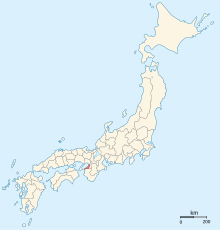
Izumi Province ( 和 泉 国 - Izumi no Kuni, "the country of Izumi"; 泉州 - Senshu, "Izumi Province") is a historical province of Japan in the Kinki region of Honshu Island. Corresponds to the southwestern part of Osaka Prefecture .
Izumi Province was founded in 716 , as a result of the division of Kawati Province. In 740, Izumi was included in the latter, and in 757 - re-allocated to the administrative unit. The center of Izumi province was located on the territory of the modern city of the same name Izumi.
Since the province was located on the important trade sea route that connected Western Japan with the capital, Izumi was constantly in the hands of the most influential Japanese rulers. Over the course of the 13-14th century, it was ruled by the Hojo clan , whose representatives were the actual rulers of the Kamakur shogunate . From the end of the fourteenth to the sixteenth centuries the province was controlled by the regency family Hosokawa .
In the XV - XVI centuries, the center of Izumi became one of the largest trading cities in Japan at that time - mito Sakai . Christian missionaries called it "Eastern Venice ."
During the Edo period ( 1603 - 1867 ), there were two principalities on the lands of Izumi ( Kishiwada Khan and Hataka Khan ), vassals of the Tokugawa shogunate . Kishiwada Khan was ruled by the clans of Koide , Matsudaira and Okabe , and Hataka Khan was ruled by the Watanabe clan.
In 1871, as a result of administrative reform, Izumi Province was transformed into Sakai Prefecture, which was subsequently integrated into Osaka Prefecture .
Izumi counties
- Izumi 和 泉 郡
- Ootori 大鸟 郡
- Hine 日 根 郡
Literature
- 『角 川 日本 地名 大 辞典』 全 50 巻 、 東京 : 角 川 書店 、 1987-1990 (“The Great Dictionary of Locality Names of Japan by Kadokawa Publishing House” In 50 volumes, Tokyo: Kadokawa shôten, 1987-1990)