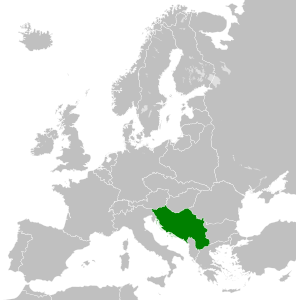
The Kingdom of Serbs, Croats and Slovenes ( KSKhS ; Serbohor. Krajevina Srba, Khrvat and Slovenets / Kraljevina Srba, Hrvata i Slovenaca , Sloven . Kraljevina Srbov, Hrvatov in Slovencev , KSHS -). It was founded on December 1, 1918 as a result of the unification of Serbia , Montenegro and the State of Slovenes, Croats and Serbs . January 6, 1929 was officially renamed the " Kingdom of Yugoslavia " (unofficially this name was used since 1918 ).
| Independent kingdom | |||||
| Kingdom Serbs, Croats and Slovenes | |||||
|---|---|---|---|---|---|
| serbohorv. Kraljevina Srba, Hrvata i Slovenaca Slovene. Kraljevina Srbov, Hrvatov in Slovencev Maced. The Kingdom of Srbi, Hrvati and Slovenzi | |||||
| |||||
| Motto : “ Serbohorv. Cyrus. Јedan people, јedan kraљ, јedna dzhava serbohorv. lat Jedan narod, jedan kralj, jedna država Maced. One nation, one king, one yezhava Slovene. En narod, en kralj, ena država ( Rus. One people, one king, one power ) " | |||||
| Anthem : “ Khimna KSHS ” Anthem KSHS | |||||
 | |||||
←  ←  ←  ←   → →December 1, 1918 - January 6, 1929 | |||||
| Capital | Belgrade | ||||
| Largest cities | Ljubljana , Zagreb , Sarajevo , Banja Luka , Dubrovnik , etc. | ||||
| Languages) | Serbo-Croatian , Slovenian | ||||
| Religion | Orthodoxy , Catholicism , Islam , Protestantism , Judaism | ||||
| Currency unit | dinar KSHS | ||||
| Square | 247,542 km² | ||||
| Population | 11 984 911 people (1921) | ||||
| Form of government | dualistic monarchy | ||||
| Dynasty | Karageorgievichi | ||||
| Government structure | unitary | ||||
| Heads of state | |||||
| King of Serbs, Croats and Slovenes | |||||
| • 1918 - 1921 | Peter I | ||||
| • 1921—1929 | Alexander I | ||||
| Regent | |||||
| • 1918-1921 | Alexander Karageorgievich | ||||


Content
Background
The idea of creating a single South Slavic state arose at the turn of the XIX — XX centuries. As a result of World War I, Austria-Hungary was defeated and disintegrated . On the territory of the South Slavic lands of Austria-Hungary, the State of Slovenes, Croats and Serbs was formed . Under the threat of an invasion of Italian troops, it turned to Serbia for help. [1] [2]
History
On December 1, 1918, a single state was created. His king was the Serbian monarch Peter I Karageorgievich , and the capital was moved to Belgrade . The ideological basis of the state was “ Yugoslavism ”, which grew out of Illyrism : within the framework of a single state, Serbs, Croats and Slovenes had to form a single Yugoslav people over time. This caused discontent among the Croatian bourgeoisie and intelligentsia. Integration processes based on Serbian political culture came across a rebuff from the Croats. The number of adherents of "Yugoslavism" in Croatia was rapidly declining, and the popularity of nationalist ideas was growing [3] [4] [5] . In the spring of 1920, during a strike by the railway workers of Yugoslavia in Ljubljana, clashes between demonstrators and the military resulted in the death of 13 people. The Vidovdan Constitution of 1921 proclaimed the Slovenes, Serbs and Croats the three tribes of a single Yugoslav people [6] .
Several Slovenian parties emerged as part of the KSXC, the largest of which was the Slovene People’s Party, which condemned the 1921 Constitution as “authorizing the hegemony of Serbia, which is detrimental to a state in which three peoples live” [7] . It was she who won the elections in the People’s Assembly in March 1923 in Slovenia. In Yugoslavia, Slovenes achieved some autonomy. [8] In the political system of the Kingdom of Serbs, Croats and Slovenes, the leading role was played by two Serbian parties: the People's Radical Party Nicola Pasic , who moved to conservative, panserb positions, and the more liberal Yugoslav Democratic Party Lyubomir Davidovich , who defended the idea of a single Yugoslav people. None of these parties managed to win any significant support from the non-Serb peoples of the country, however, the relative numerical majority of the Serbs in the ethnic composition of the kingdom's population (out of the twelve-millionth population of Yugoslavia, the Serbs were 4.7 million, that is 39% [9] ) allowed the radicals and Democrats alternately in power throughout the 1920s . Their main political opponent was the Croatian peasant party led by Stepan Radic , demanding the federalization of the state [10] . In 1921, under pressure from Serbian parties, the Constituent Assembly of the Kingdom of Serbs, Croats and Slovenes adopted the constitution (“ Vidovdan Statute ”), which fixed the unitary structure of the country. The constitution also gave democratic rights and freedoms to the population. For the 1920s, there was a sharp political struggle between radicals and democrats, as well as between Serb and non-Serb parties, a chronic political crisis, intrigues, and a mess of governments. Attempts to compromise between the Serbian and Croatian elites invariably failed, tension in Serbo-Croatian relations grew, turning into clashes on ethnic grounds in areas with a mixed population. Economic and social issues were pushed into the background and remained unresolved [3] . By the end of the 1920s, both major Serbian parties were in deep crisis, while the king’s influence was growing steadily. The culmination was the killing of two representatives of the Croatian Peasant Party by a Serbian deputy at a parliament meeting on June 20, 1928 .
State Transformation
In 1928, Croatian politician Stepan Radic was killed right in the parliament building. As a result, on January 6, 1929, the king dissolved the parliament, repealed the constitution and established the royal dictatorship “ January 6 dictatorship ”) until 1931 , and the state was transformed into the Kingdom of Yugoslavia .
Economics
The socio-economic situation of the Kingdom of Serbs, Croats and Slovenes in the early years of its existence was extremely difficult: post-war disruption, inflation , high unemployment , the unresolved agrarian question led to unrest in the countryside and frequent mass strikes of workers. Throughout the entire interwar period, in Serbia, the dominance of agriculture in the economy remained, and its modernization was proceeding at an extremely slow pace due to small-scale land [11] and lack of capital.
The unification of the South Slavic lands around Serbia did not give any significant impetus to the development of Serbian industry: negative factors such as competition from Slovenian and Croatian enterprises, extremely low purchasing power of the population of Serbia and more backward regions, lack of labor and financial resources affected it. However, in the interwar period, industrialization processes began in Serbia, primarily in the mining , food and tobacco sectors. Belgrade was completely rebuilt and turned into a major European metropolitan center [3] .
Human Rights
In 1921, the Constituent Assembly of the Kingdom of Serbs, Croats and Slovenes adopted a constitution called “ Vidovdan ”, which provided for a number of democratic freedoms.
Political Rights
However, after the accession of Alexander I, a number of measures were taken to limit the activities of political parties. The Law on the Protection of the State, adopted on August 1, 1921, banned the activities of the Communist Party and annulled 58 mandates of Communist deputies [12] . In the summer of 1923, the People's Assembly brought the leadership of the Croatian Republican Peasant Party to court in accordance with this law, and the party itself was banned [13] . The authorities pursued a reactionary policy , causing increasing discontent among the population.
Social Inequality and Discrimination
The ideological basis of the state was " Yugoslavism ", which grew out of Illyrism . This concept, however, did not recognize the national identity of the other Slavic peoples of the country ( Muslim Slavs , Macedonian Slavs and Montenegrins ), who were officially considered Serbs. Non-Slavic peoples ( Kosovo and Macedonian Albanians , Bosnian and Sanjak Turks , Hungarians and Germans of Vojvodina) found themselves in the position of undesirable ethnic minorities, while state policy was relatively tolerant towards Hungarians and Germans, then Turks and Albanians were exposed to open discrimination aimed at extruding these nationalities from the country [3] [14] . At the same time, the resettlement of Serbian colonists in Macedonia and Kosovo was encouraged [15] , and the use of the Macedonian language in educational institutions and authorities is prohibited . The actions of the Macedonian Slavs and Albanians against Serbization were brutally suppressed [16] . Nevertheless, the Macedonian and Albanian issues in their acuteness in the political life of the state were much inferior to the main internal problem: the Serbo-Croatian contradictions. Serbia was the unconditional core of the new state, and the Serbian elite took dominant positions in the political system of the country.
Culture
The only area in which progress has been made in uniting the Yugoslav peoples. The dialects of Croats, Serbs and Muslims continued to converge until the formation of a single Serbo-Croatian language , the Latin alphabet became the second script for the Serbs, Belgrade and Zagreb turned into international cultural and scientific centers [3] . Belgrade, in addition, has become one of the most important European centers of Russian emigration, which has had a significant impact on the development of Yugoslav culture. In literature and art, ethnic characteristics faded into the background, and the confrontation of the avant-garde and traditional art came to the fore. The dominant role in the 1920s was played by expressionism , the most significant representatives of which in Serbia were, first of all, the writer Milos Tsrnyansky and the poet Rastko Petrovich , as well as, in literature, Stanislav Vinaver and Dragisa Vasić , in the fine arts - Zora Petrovich and Milan Konevich . In sculpture, the absolute leadership belonged to the Croatian Ivan Mestrovich , the author of the “Victory” monument, which became one of the symbols of Belgrade. [17] At the same time, the Bulgarian language and culture were severely discriminated against and oppressed, since the authorities did not recognize the very fact of the existence of Bulgarians in the country, all the South Slavic dialects of the country were officially classified as “Serbo-Croatian-Slovenian”.
Administrative divisions
District 1918-1922
Provinces (units of the first level) 1920-1922
Regions of 1922-1929
See also
- List of Prime Ministers of Yugoslavia
Notes
- ↑ "State of Slovenes, Croats and Serbs"
- ↑ Ivo Banac: The National Question in Yugoslavia: Origins, History, Politics "published by Cornell University Press, 1984 pages 129-31
- ↑ 1 2 3 4 5 Error in footnotes ? : Invalid
<ref>; no text forDSfootnotes - ↑ Error in footnotes ? : Invalid
<ref>; no text forOYfootnotes - ↑ Rudić V. The Yugoslav idea, the former Yugoslavia and its Social and Geographical Features Archived June 4, 2008 on Wayback Machine .
- ↑ History of Slovenia, 2011 , p. 296, 299, 300.
- ↑ Pilko N. S. Slovenes in Yugoslav political life in the 20s - 30s. XX century // Slavic almanac. - 2015. - No. 1-2. - S. 72
- ↑ Error in footnotes ? : Invalid
<ref>; no text forkkifootnotes - ↑ Petranovic B. Istorija Jugoslaviji 1918-1988. Prince 1. - Beograd, 1988.
- ↑ Error in footnotes ? : Invalid
<ref>; no text forISNfootnotes - ↑ In 1930, in Serbia there were only 135 households with an area of more than 100 hectares.
- ↑ Yugoslavia in the 20th century: essays on political history / K.V. Nikiforov (ed.), A.I. Filimonov, A.L. Shemyakin, etc. - M .: Indrik, 2011. - P. 251. Regime Access: http://www.inslav.ru/resursy/elektronnaya-biblioteka/2372-2011-jugoslavija-v-xx-veke
- ↑ Yugoslavia in the 20th century: essays on political history / K.V. Nikiforov (ed.), A.I. Filimonova, A.L. Shemyakin, etc. - M .: Indrik, 2011. - P. 252. Regime Access: http://www.inslav.ru/resursy/elektronnaya-biblioteka/2372-2011-jugoslavija-v-xx-veke
- ↑ Kosik V. Experience of the history of a country that was not: Serbia in 1918-1941 Archived copy of December 13, 2010 on the Wayback Machine .
- ↑ After the First World War, about 60 thousand Serbs migrated to Macedonia and Kosovo, mainly from Croatia, Bosnia and Montenegro.
- ↑ Rychlík J., Kouba M. Dějiny Makedonie. - Praha, 2003 .-- ISBN 80-7106-642-7 .
- ↑ Protiћ M. Slickarism and Vaharism of the 20th Century Archival copy of June 7, 2008 on the Wayback Machine .