Edward Braddock ( English Edward Braddock ) ( January 1695 - July 13, 1755 ) - British military leader, commander of the British troops in North America at the beginning of the Seven Years War .
| Edward Braddock | |
|---|---|
| English Edward braddock | |
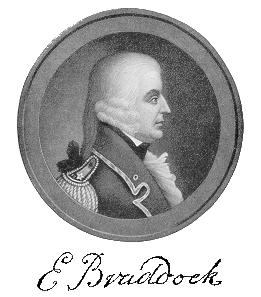 | |
| Date of Birth | 1695 |
| Place of Birth | Scotland |
| Date of death | July 13, 1755 |
| Place of death | Pennsylvania , USA |
| Affiliation |  Great Britain Great Britain |
| Type of army | |
| Rank | Major general |
| Commanded | British troops in North America |
| Battles / wars | |
Content
Biography
Born in the city of Perthshire in Scotland in 1695 . Father, Major General Edward Braddock, died in 1725 . He joined the Coldstream Guards on foot regiment in 1710. In 1747 , he served as lieutenant colonel under the command of Prince William IV of Orange in Holland . In 1753 he was promoted to the rank of Colonel of the Own Prince of the Oran Pedestrian Regiment (now the West York Regiment, Eng . West Yorkshire Regiment ). Since 1754 - Major General . Soon after, he was appointed commander of the British forces in North America .
February 19, 1755 arrived in Virginia . He took part in the Congress in Alexandria (Virginia), where he met with the governors of several British colonies. According to Congress decisions, Braddock was assigned a decisive role in conducting military operations against the French troops. Braddock was to lead an expeditionary detachment of British troops whose purpose was to capture the French fort Duchenne and other territories in the Ohio River Valley .
After several months of preparations, a two-thousand-strong convoy of British troops, consisting of George Washington as adjutant to Braddock, marched along a forest road toward the fort. On July 9, 1755, the advance detachment of the convoy led by Braddock crossed the Monongahela River and was attacked almost immediately by the Allied Franco-Indian forces. [1] In a bloody battle, a British column was surrounded, fired and defeated, the soldiers stampeded. Braddock rode forward to try to cheer on his people, who had lost all sense of solidarity and were retreating in a formless crowd. He, in a state close to rage, and practically growling, rushed between the groups of his soldiers and tried to force him to restore the system. No matter how fantastic this sounds, four horses were killed under him, but he moved to the fifth and tried hard to implement his plan. When all the officers, except for the miraculously surviving Washington, were injured or killed, and less than a third of the army remained unharmed, Braddock nevertheless ordered a signal to withdraw. By the end of this difficult battle, Braddock was mortally wounded in the lungs and the resistance of the few English who managed to maintain courage collapsed. The general fell off his horse, and he was quickly carried back to the rearguard, which was attacked by the enemy less intensely. However, it was not so easy to take out the general. Most of the soldiers had already fled, Washington commanded a cover detachment, and in fact, only Captain Robert Orme and several local militiamen were nearby. They also rushed to run and all persuasions and promises of Orm (60 gold guineas) did not give anything. Braddock persuaded the captain to leave him and save his life. “ Where I buried my honor, I want to bury my shame ,” said the general. However, Orm did not obey the general. Together with the Virginian Stuart, the captain of the light cavalry, who broke through with battle to the captain and the general, they loaded Braddock onto a fresh horse, and Stuart Orme led her away while Stuart was covering their retreat from a dozen Indians. Stuart himself received seven wounds, but still survived and was able to retreat. The general was dying and weakening every minute. He gave up all hope of continuing the campaign. Fully understanding what had happened, Braddock endlessly told his officers that he was taking the blame on himself and that he and only he was responsible for the rout.
On the evening of July 12, Sunday, the army marched toward Great Meadows. All the way to the Great Meadows, the dying general was silent, breaking the silence only to give orders.
At about 8 pm on July 13, 1755, with the words: “ Next time we will know what to do with them ... ” or, according to another version, “ who would have thought ... ”, Braddock passed away. [2]
By order of George Washington, he was buried in the middle of the road near Fort Nessecity. On the road, carts drove specially to hide the traces of burial from abuse by hostile Indians.
See also
- Battle of Monongahel
- Braddock Expedition
Notes
- ↑ Battle of Monongahel . World Digital Library (1755). Date of treatment August 4, 2013. Archived on August 13, 2013.
- ↑ BATTLE unopened . mybiblioteka.su. Date of treatment March 18, 2019.