
Gross domestic product ( Gross Domestic Product ), generally accepted reduction - GDP ( English GDP ) is a macroeconomic indicator reflecting the market value of all final goods and services (that is, intended for direct consumption, use or use) produced in a year in all sectors of the economy on the territory of the state for consumption, export and accumulation, regardless of the nationality of the factors of production used . This concept was first proposed in 1934 by Simon Kuznets .
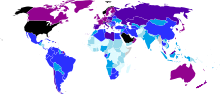
The country's GDP can be expressed both in national currency and, if necessary, reference converted to the exchange rate in foreign currency, and can be presented at purchasing power parity (PPP) (for more accurate international comparisons).
Content
Origin history
Work on measuring the volume of national production began in the 30s of the XX century by economist Simon Kuznets in the US Department of Commerce . The first estimates of national income were made by Kuznets in 1934 . In this work, accounts of national income and product first appeared. The blacksmith recounted US national income accounts until 1869 . For the first time, a report on national income and production for the period 1929-1935 was presented to the US Congress in 1937 . Before that, no one had detailed ideas about the country's economic activity. The term macroeconomics until 1939 was not used in print. In 1971, Simon Kuznets received the Nobel Prize .
Until 1991, the gross national product was the benchmark in macroeconomic research. GDP has become a key indicator for compatibility with the United Nations system of national accounts .
Definition
According to K. R. McConnell and S. L. Bru, the gross domestic product is the total market value of all finished goods and services produced in the country during the year [1] . GDP can be calculated as the sum of the gross value added of all sectors (or institutional sectors) plus net taxes on products (taxes on products minus subsidies on products) [2] .
Nominal and real GDP
Allocate nominal and real GDP ( English nominal and real GDP ).
Nominal GDP - the value of all final goods and services of the region or state in question, expressed in current market prices. As a result, nominal GDP depends on changes in the price and income index of the economy in question. Nominal GDP grows with inflation due to rising prices for products and services. Conversely, it falls during deflation due to falling prices. So, the inflation rate of 5%, with a constant level of production of goods, also leads to an increase in GDP by 5%.
Real GDP takes into account the extent to which GDP growth is determined by real production growth, rather than price increases [3] . The basis for real GDP can be taken as the prices of the previous or any other year. The ratio of nominal GDP to real GDP is called a deflator [4] .
- .
Where - the volume of release of the current year;
- - price of the current year;
- - the price of the base year.
Gross national product
Gross national product ( Eng. Gross-National Product , Eng. Gross-National Income ). Abbreviated GNP ( English GNP or GNI ).
Unlike GDP, which reflects the total value of all goods created in the country, gross national product (GNP) reflects the total value of goods created only by its residents, regardless of their geographical location.
GDP per capita
GDP per capita is an important economic indicator of material wealth in a country or region. It is calculated as follows:
For a more objective comparison of different countries for this indicator, GDP per capita calculated according to PPP is used.
Other definitions
Net national product - gross national product after deduction of depreciation.
Actual GDP is part-time GDP that reflects the realized opportunities of the economy.
Potential GDP is the GDP at full employment, it reflects the potential of the economy. The latter can be much higher than the real ones. The difference between actual and potential GDP is called the GDP gap .
Exception from GDP calculation
All non-production transactions are excluded from the calculation of GDP [1] :
- financial transactions:
- government transfer payments , including social insurance payments, unemployment benefits, pensions and payments that the state provides to individual households;
- private transfer payments , including material assistance, student scholarships, one-time gifts from wealthy relatives, are not related to production, but simply represent the transfer of funds from one private person to another;
- transactions with securities, including all transactions for the sale of shares and bonds.
- sale of used goods, the value of which was included in the calculation in previous periods.
Calculation methods
There are 3 methods for calculating GDP:
- by income
- on expenses
- value added .
GDP by income
- GDP = National income + depreciation + indirect taxes - subsidies - net factor income from abroad (BHF) (or + net factor income of foreigners working in the country (BHF)) , where:
- National income = salary + rent + interest payments + corporate profit .
This formula characterizes GDP by income in the UN system of national accounts ( 2008 version). An operating difference measures the surplus or deficit received from production to the payment of any interest, annuity or similar payments paid on financial or tangible non-produced assets borrowed or leased by an enterprise, as well as before any interest or rent received on financial or tangible non-produced assets, owned by the enterprise (for unincorporated enterprises owned by households, this indicator is called “mixed income”).
GDP by expenditure
- where
- GDP = final consumption + gross capital formation (investment in a firm, that is, the purchase of machinery, equipment, stocks, a place of production) + government spending + net exports (exports - imports; can be either positive or negative) .
Final consumption includes the costs of meeting the final needs of individuals or societies made by the following institutional sectors: household sector, government sector (public sector), private non-profit organizations serving households. Gross capital formation is measured by the total value of gross fixed capital formation, changes in inventories and net acquisition of values by unit or sector.
GDP by value added (production method)
- GDP = amount of value added .
- Added value of the company = income of the company - the intermediate cost of production of goods or services .
- Total value added = total output - the total value of intermediate products [5] .
The volume of GDP is currently calculated in accordance with the recommendations of the neoclassical theory - as the amount of value added created in the country under the assumption that it is created both in the production and in the service sector . Moreover, the value added is estimated as the difference between the income of the enterprise and material costs and does not include indirect taxes paid on products (services). As a result, the total volume of GDP differs from the total value added recorded in the spheres of production and services by the amount of net indirect taxes (indirect taxes minus subsidies provided by the state to business).
Criticism
Since the start of using GDP, many reputable economists have warned that GDP is a “specialized tool” and that using it as an indicator of overall well-being can lead to dangerous misconceptions. Simon Kuznets , one of the architects of the US national accounting system, warned against identifying GDP growth with increased economic or social well-being (Kuznets, 1934; Kuznets et al., 1941).
Since GDP takes into account only monetary transactions related to the production and sale of goods and services, this indicator is based on a fundamentally incomplete picture of the social and natural systems within which people and the economy exist. GDP does not take into account the nature of products and long-term prospects - the growth of natural resource extraction and the growth of high-tech products have the same effect on the indicator. The GDP calculation methodology encourages the depletion of natural resources by counting the decrease in natural capital as income, although this undermines the basis of similar incomes in the future and leads to degradation of ecosystems associated with the maintenance of life on the planet.
When calculating GDP, the shadow economy is not taken into account, as a result of which economic growth indicators can be significantly underestimated.
Despite this, the economic policy of most countries of the world is largely determined by the goal of increasing GDP [6] . Leading economists, politicians, entrepreneurs and the media regularly talk about GDP growth as if it represents progress in general or the growth of social welfare. According to critics, GDP growth in the modern world has become a kind of “magic formula” to solve all problems. Van den Berg (2009) [7] concludes that “support for this indicator does not have good justification; rather, it is based on dogma , or, at best, on habit.”
A number of alternative indicators are proposed to eliminate the deficiencies inherent in GDP. Some of them, in particular the True Progress Indicator and Net Savings [8] are also based on the system of national accounts and are expressed in cash.
In France, in 2008, to develop such criteria, an international Commission was created on the main indicators of economic activity and social progress .
GDP of Russia and other countries
In terms of PPP GDP, Russia occupied (in 2017) 6th place, being after the PRC (1st place), the USA (2nd), India (3rd), Japan (4th) and Germany ( 5th) [9] .
| Dynamics of GDP (PPP) of Russia and Germany. Source: World Bank. Note: Source file is interactive |
GDP per capita of Russia and other countries
| The dynamics of GDP (PPP) per capita of Russia and other major states formed as a result of the collapse of the USSR . Source: World Bank |
see also
- Gross national product
- Pure national product
- National income
- Gross regional product
- True progress indicator
- List of countries by GDP (PPP)
- List of countries by GDP (nominal)
- List of countries per capita GDP (PPP)
- List of countries by GDP (nominal) per capita
- The economic growth
- Monetization of the economy
- External debt
- Productivity
Notes
- ↑ 1 2 McConnell K.R., Bru S.L. Economics : principles, problems and politics. - M .: Republic , 1992. - T. 2. - S. 384. - 400 p. - ISBN 5-250-01486-0 . Archived September 6, 2017 on Wayback Machine
- ↑ BRIEF METHODOLOGICAL EXPLANATIONS . www.cisstat.com. Date of treatment January 10, 2019. Archived on June 28, 2018.
- ↑ Nominal and real GDP Archival copy of January 29, 2010 on the Wayback Machine
- ↑ Gross domestic product . www.gks.ru. Date of treatment January 10, 2019. Archived March 25, 2018.
- ↑ Matveeva T. Yu. “Introduction to Macroeconomics”, HSE Publishing House, 2008
- ↑ Nordhaus and Tobin, 1973
- ↑ JCJM van den Bergh (2009). The GDP paradox. Journal of Economic Psychology. 30 (2): 117-135
- ↑ Adjusted savings: net national savings (current US $) | Data | Table . Date of treatment August 28, 2014. Archived on September 4, 2014.
- ↑ GDP of Russia and the countries of the world for 2019 . Date of treatment January 22, 2019. Archived January 22, 2019.
- ↑ Gross domestic product based on purchasing-power-parity (PPP) valuation of country GDP . The World Bank (1 July 2015). Date of treatment July 19, 2015. Archived July 4, 2015.
- ↑ GDP based on purchasing-power-parity (PPP) per capita . World Bank (1 July 2015). - PPP GDP per capita. Date of treatment July 19, 2015. Archived July 30, 2015.