Eocaecilia micropodia (lat.) Is a species of extinct amphibians from the legless order, typical and unique in the genus Eocaecilia . It is the earliest known representative of the legless amphibian detachment that lived during the Lower Jurassic era ( 199.3–182.7 million years ago) in North America on the territory of the modern state of Arizona ( USA ) [1] .
| † Eocaecilia micropodia |
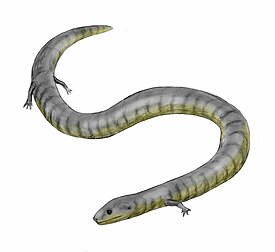
Reconstruction |
| Scientific classification |
|---|
| No rank : | Bilateral symmetrical |
| Gender: | † Eocaecilia Jenkins & Walsh, 1993 |
| View: | † Eocaecilia micropodia |
|
| International scientific name |
|---|
Eocaecilia micropodia
Jenkins & Walsh, 1993 |
Geochronology199.3-182.7 Ma | million years | Period | Era | Aeon |
|---|
| 2,588 | Even | | | Ka | F
but
n
e
R
about
s
about
th | | 23.03 | Neogene | | 66.0 | Paleogen | | 145.5 | a piece of chalk | M
e
s
about
s
about
th | | 199.6 | Yura | | 251 | Triassic | | 299 | Permian | P
but
l
e
about
s
about
th | | 359.2 | Carbon | | 416 | Devonian | | 443.7 | Silur | | 488.3 | Ordovician | | 542 | Cambrian | | 4570 | Precambrian |
◄ Nowadays◄ Cretaceous-Paleogene extinction◄ Triassic extinction◄ Mass Permian Extinction◄ Devonian extinction◄ Ordovician-Silurian extinction◄ Cambrian explosion |
|---|
|
Content
A new species and genus were described in 1993 by the MNA V8066 holotype - the skull and body imprint [1] .
In general, the animal is very similar to modern legless amphibians, but the limbs remained in Eocaecilia micropodia . There was a large well-developed eye socket . The orbit was surrounded by a lacrimal, prefrontal, zygomatic, posterior frontal and postorbital bone. There was a channel for tactile tentacles. Two rows of teeth on the upper jaw.
