Badan thick-leaved , or saxifrage thick-leaved , or Mongolian tea ( Latin Bergénia crassifólia ) - perennial herbaceous plants, a typical species of the genus Badan ( Bergenia ) of the family Saxifragaceae .
| Badan | |||||||||||||||||||
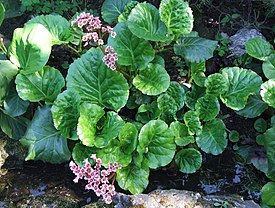 General view of the plant. | |||||||||||||||||||
| Scientific classification | |||||||||||||||||||
|---|---|---|---|---|---|---|---|---|---|---|---|---|---|---|---|---|---|---|---|
| |||||||||||||||||||
| International scientific name | |||||||||||||||||||
Bergenia crassifolia ( L. ) Fritsch , 1889 | |||||||||||||||||||
| Synonyms | |||||||||||||||||||
| |||||||||||||||||||
Content
Distribution and Ecology
The plant is distributed in Siberia ( Altai , Buryatia , Chita , Irkutsk , Kemerovo regions, Altai Republic , Krasnoyarsk Territory , Tuva , south of Yakutia ), Kazakhstan , Primorye , in the north of Mongolia , China and Korea [2] .
It grows on rocks, screes , old moraines and rocky slopes of the subalpine and upper parts of the forest belt, in coniferous and deciduous forests with a medium-closed canopy. It forms the densest thickets in places protected from the wind and having a thick winter cover of snow. It can "climb" to a height of over 2000 m above sea level .
The plant is demanding on water, very shade tolerant; transfers acid peat soils [3] .
Biological Description
The rhizome is creeping, fleshy, thick, reaches several meters in length and 3.5 cm in diameter, with numerous root lobes, highly branched, located near the surface of the soil, turning into a powerful vertical root .
The stem is thick, leafless, glabrous, pink-red, 15-50 cm high.
Leaves in a deep rosette (wintering under snow), dark green, reddening by autumn, with an almost rounded plate and membranous sheath , large, broadly oval, whole, glabrous, leathery, shiny, lasting up to two to three years. The leaf lamina is widely elliptical or almost round, rounded at the base or heart-shaped, blunt or obscure dentate, 3–35 cm long, 2.5–30 cm wide, on broad petioles not exceeding the length of the lamina, equipped with membranous vaginal stipules .
The flowers are small, regular, five-membered, without bracts, in the apical dense panicle-corymbose inflorescence , usually two each on long reddish leafless pedicels up to 4 cm long. ; the petals are obovate or broadly ovate, with a wide short marigold, 10-12 mm long, 6-8 mm wide, with a blunt-rounded apex and many veins, lilac-red or pink. Stamens twice as long as calyx, ten of them. Pestle with a low lower ovary , deeply divided into two (three) columns with wide kidney-shaped stigmas.
The fruit is an ellipsoidal, dry capsule with two diverging blades, opening along the abdominal suture. Seeds are numerous, oblong, smooth, glabrous, granular, almost black, up to 2 mm long. The weight of 1000 seeds is 0.17 g [4] , in 1 g of 6000 seeds [3] .
It blooms in May - June until the appearance of young leaves, the seeds ripen in July - August.
It is mainly propagated vegetatively (by segments of rhizomes), but propagation by seeds is not excluded.
Plant Raw Material
Harvesting and growing in culture
For therapeutic purposes, rhizomes ( Latin Rhizoma Bergeniae ) are used, which are harvested in June - July [4] . Collected by hand, cleaned from the ground and washed in cold running water. Large rhizomes are cut into long pieces. After preliminary drying, they are dried in the shade or in well-ventilated rooms, laying out in a layer of 5 cm on paper or fabric. Leaves are much less commonly used.
In culture, it gives 3-4.5 tons of dry leaves per 1 ha. Experience has shown the feasibility of growing plants in culture in order to obtain leaf mass, and not rhizomes. Leaves can be harvested, starting from the third year of culture, the duration of operation of the plantation is 8-10 years and longer [3] .
Chemical Composition
Rhizomes contain 15–27% of tannins , which belong mainly to the group of gallotannins , the tannin content of which varies from 8 to 10% [4] . The composition of tannins rhizomes up to 35% gallic acid [3] . With age, the content of tannins in the rhizomes increases [4] . Rhizomes contain isocoumarin bergenin [4] , 6.52% glucose and up to 2.5% sucrose [3] .
The leaves contain from 10 to 23%, in some cases up to 35% of tannids (with age, the content of tannins in the leaves decreases [4] ). Leaf tannins are a mixture of pyrogallic (up to 40%) and pyrocatechol tannides [3] .
The content of arbutin in the leaves reaches 22%, and free hydroquinone - 4%, there is also gallic [4] and ellagic acid [5] . According to the content of arbutin, frankincense is the richest plant source in the world; before studying badan, bearberry (5% arbutin) was in first place [3] .
Pharmacological properties
Badanas have hemostatic , astringent , anti-inflammatory and antimicrobial properties, strengthen the walls of blood vessels , moderately lower blood pressure , slightly increase the heart rate .
Economic Significance and Application
As an ornamental plant known in culture since the mid-18th century [3] , it is used for landscaping, in stone gardens, massifs of shrubs and trees. Gardeners brought several forms with flowers of various colors. The plant prefers penumbra and shady places with moderately dry, fertile soil. Propagated by dividing the bush in the fall.
The plant is in the front row of world tanning agents (the tanid content is 2 times higher than in the willow or spruce bark, and 4 times higher than in the oak bark), it is used for tanning soles and yufts , as well as for impregnation of nets and tarpaulin . Raw materials collected high in the mountains contain more tanides than in the low mountains. In the flora of Russia there is no other plant that so quickly and in such quantity would accumulate tannins. The thickets of this plant have been exploited to obtain tannins for a long time and in places convenient for harvesting have been depleted, therefore, the incense has been introduced into the culture (plantations are laid by segments of rhizomes) [6] .
Gives black and brown paint.
Rhizomes soaked in water and washed from tannins are used for food, and overwintered, darkened leaves are used for aromatic tea - Mongolian tea [6] , or Chigir tea .
It is possible to obtain technical (for fixing paints) and pharmaceutical (for medicinal purposes) tannin , gallic acid (for the production of pyrogallol ), dye and hydroquinone from arbutin (30% yield upon arbutin hydrolysis ) [3] .
Medical Use
For medicinal purposes, rhizomes are used, much less often - leaves. The medicinal properties of frankincense have long been used in Russian folk medicine, as well as in medicine in Tibet and China. Water extracts of rhizomes and leaves inside are used for colitis and enterocolitis of non-infectious nature, tuberculosis , acute and chronic pneumonia , pulmonary hemorrhage , acute respiratory , flu and some other infections, laryngitis , headaches, fevers , joint rheumatism , and gastrointestinal diseases . They are used in gynecological practice for heavy menstruation due to inflammatory processes of the appendages , for hemorrhagic metropathies , uterine fibroids , after childbirth , and bleeding after termination of pregnancy .
Badan is also used for colitis of non-dysenteric nature; with dysentery - in combination with sulfonamides and antibiotics . They are also used in dental practice for lubricating the gums in chronic inflammatory processes in the oral cavity . Compresses with infusion or a decoction of incense are used to heal wounds, ulcers and bruises.
In 2007, the Siberian State Medical University conducted a study of the hepatoprotective properties of frankincense. Studies have shown that frankincense is a more effective hepatoprotector than silymarin (one of the most popular hepatoprotectors obtained from spotted milk thistle ) [7] [8] .
Folk medicine used the leaves of frankincense for the treatment of tuberculosis, pneumonia, rheumatism, gastrointestinal, urinary tract diseases, with goiter , toothache. In Mongolian medicine, frankincense is used for nausea and vomiting.
Taxonomy
Species Badan is a member of the genus Badan ( Bergenia ) of the family Saxifragaceae ( Saxifragaceae ) of the order Saxifragales .
| 12 more families (according to APG II System ) | about 11 more species | ||||||||||||
| order | clan Badan | ||||||||||||
| Department of Flowering, or Angiosperms | Saxifrage family | view Badan | |||||||||||
| 44 more order flowering plants (according to APG II System ) | 29 more births | ||||||||||||
Notes
- ↑ For the conventionality of specifying the class of dicotyledons as a superior taxon for the plant group described in this article, see the APG Systems section of the Dicotyledonous article .
- ↑ According to the GRIN website (see plant card)
- ↑ 1 2 3 4 5 6 7 8 9 Encyclopedic Dictionary of Medicinal, Essential Oil and Poisonous Plants / Comp. G. S. Ogolevets. - M .: Selkhozgiz, 1951. - S. 30 .-- 584 p.
- ↑ 1 2 3 4 5 6 7 Atlas of medicinal plants of the USSR / Ch. ed. N.V. Tsitsin. - M .: Medgiz, 1962 .-- S. 60. - 702 p.
- ↑ Blinova K.F. et al. Botanical-Pharmacognostic Dictionary: Ref. allowance / Ed. K.F. Blinova, G.P. Yakovleva. - M .: Higher. school, 1990. - S. 169. - ISBN 5-06-000085-0 .
- ↑ 1 2 Gubanov I.A. et al. Wild useful plants of the USSR / ed. ed. T.A. Rabotnov . - M .: Thought , 1976. - S. 153-154. - 360 p. - ( Reference guides to the geographer and traveler ).
- ↑ Shutov, D.V. Hepatoprotective effect of the extract of incense and silymarin (2007). Archived February 2, 2013.
- ↑ Shutov, D.V. Hepatoprotective effect of silymarin and grape seed and berry extracts in liver pathology caused by tetrachloromethane intoxication (2011). Archived February 2, 2013.
Literature
- Genus 705. Badan - Bergenia Moench // Flora of the USSR : in 30 t / h. ed. V.L. Komarov . - M .; L .: Publishing House of the Academy of Sciences of the USSR , 1939. - T. 9 / ed. volumes S.V. Yuzepchuk . - S. 137. - 540, XIX p. - 5200 copies.
- Dudchenko L.G., Koziakov A.S., Krivenko V.V. Spicy-aromatic and spicy-flavoring plants: Reference book / Otv. ed. K. M. Sytnik. - K .: Naukova Dumka , 1989 .-- 304 p. - 100,000 copies. - ISBN 5-12-000483-0 .
- Universal Encyclopedia of Medicinal Plants / comp. I.N. Putyrsky, V.N. Prokhorov. - M .: Machaon, 2000 .-- S. 64-65. - 15,000 copies. - ISBN 5-88215-969-5 .
- Maznev N.I. Encyclopedia of medicinal plants. - 3rd ed., Rev. and additional .. - M .: Martin, 2004 .-- 496 p. - 10,000 copies. - ISBN 5-8475-0213-3 .
- All about medicinal plants in your beds / Ed. Radelova S. Yu. - St. Petersburg: SZKEO LLC, 2010. - P. 193. - 224 p. - ISBN 978-5-9603-0124-4 .
- Lavrenov V.K., Lavrenova G.V. Modern encyclopedia of medicinal plants. - M .: ZAO "OLMA Media Group", 2009. - S. 36-37. - 272 p. - ISBN 978-5-373-02547-8 .
Links
- Chalaveene, M. Badan. Varieties, reproduction, care. // Gardener. - No. 5. - 2007.
- Bergenia on agbina.com (Retrieved May 12, 2010)
- Badan in the Encyclopedia of Ornamental Garden Plants (Retrieved May 12, 2010)
- Shutov, D.V. Hepatoprotective effect of the extract of incense and silymarin / Siberian State Medical University. - 2007.
- Hepatoprotective effect of silymarin and grape seed and frankincense extracts in case of liver pathology caused by tetrachloromethane intoxication