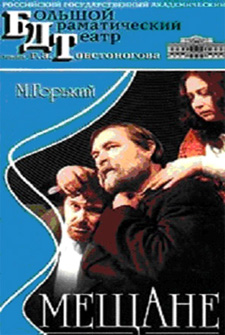
"Petty bourgeois" - a performance of the Leningrad Bolshoi Drama Theater. Gorky , directed by director Georgy Tovstonogov in 1966. The performance was awarded the USSR State Prize ; in 1971 its television version was created.
| Petty bourgeois | |
|---|---|
 | |
| Genre | drama |
| Based on | play of the same name |
| Author | A. M. Gorky |
| Producer | G. A. Tovstonogov |
| Actors | Evgeny Lebedev Emma Popova Pavel Pankov |
| Company | Bolshoi Drama Theater. M. Gorky |
| A country | the USSR |
| Tongue | Russian language |
| Year | 1966 |
| Awards | USSR State Prize |
Content
Creation History
Assigned to the Bolshoi Drama in 1932, the name of Maxim Gorky obliged the theater to have his plays in his repertoire, however, when he joined the Bolshoi Theater in 1956, Georgy Tovstonogov preferred to resume the performances of Enemies and Dostigayev and Others , staged by Natalya Rashevskaya . Only in 1959, when the caricature of “The Gorky Leningrad Theater and Theater does not stage M. Gorky’s plays” appeared in Crocodile [1] , he first turned to the drama of one of the founders of the Belarusian Theater of Theater, staging the play “Barbaras” for the 40th anniversary of the theater " [2] . The play, which caused sharp controversy, nevertheless became one of the best in the repertoire of the Bolshoi Drama; but by 1966 the ensemble broke up: forcibly, due to leg illness, Pavel Luspekaev left the theater, Tatyana Doronina left for Moscow - and the “Barbarians” left the stage. Fortunately for the director, writes E. Gorfunkel, the Gorky line did not become either formal or violent in his work [1] . For a new appeal to Gorky, Tovstonogov chose the play " Petty Bourgeois ", which he had already staged with students in Tbilisi in his youth [3] .
Tovstonogov once admitted that the theater of the absurd gave him the first impetus for staging this play in the Bolshoi Theater : the plays of S. Becket and E. Ionesco helped him see a new thing in the old play - the absurdity and senselessness of her characters' existence, “vicious circles around which they rush about” [4] . In the Petty Bourgeoisie there was a place for the ideas of Bertolt Brecht : wanting to present not individual people in the play, but a “life phenomenon” and make the viewer see him widely, see not directly, but indirectly, Tovstonogov turn to the arsenal of the “ epic theater ”. “In order to maintain this distance,” the director wrote, “one of the components of the play must always return the viewer to its original position, forcing him to look at everything from the side” [5] . In the Petty Bourgeoisie, music became such a component: “A balalaika or mandolin , performing a simple melody of a“ cruel ”romance or a song from the outskirts of the city, burst into the action of our performance every time unexpectedly, giving the audience the opportunity to more accurately evaluate what is happening. The music here is called upon to create the effect of estrangement that Brecht writes about in his theatrical theory ” [5] .
The premiere of "Philistines" was held on December 25, 1966 [6] . The main discoveries of this performance were the tragic one - in his “futile effort to understand what is happening, to find a foothold for himself and his neighbors” [7] - Bessemenov Evgeny Lebedev , whom one of the critics called “philistine king Lear” [8] , and Tatyana Emma Popova , which critics, on the contrary, compared with Chekhov’s characters, with the Prozorov’s sisters from “ Three Sisters ”, and Sorin from “The Seagull ” - “the man who wanted,” but could not carry out his plan [8] .
In 1968, Georgy Tovstonogov, Evgeny Lebedev and Emma Popova were awarded the USSR State Prize . The performance took place on the BDT stage for about twenty years in an almost unchanged composition: after the death of Pavel Pankov (in 1978), the role of Teterev was played by Vladislav Strzhelchik [9] ; the role of Peter was eventually introduced Oleg Borisov .
In 1971, with the participation of Tovstonogov, a television version of the play was created, with a "classical" cast.
Story
The action takes place at the very beginning of the XX century , in a provincial town. The large house of the prosperous tradesman Vasily Vasilyevich Bessemenov is always crowded: except for his wife, Akulina Ivanovna, there are two Bessemenovs children - Tatyana and Peter, a pupil of Neil, a young lady Elena Nikolaevna Krivtsova, renting two rooms on the top floor, and a cook Stepanida. The Bessemyonovs also have two parasites - the songwriter Teterev and the student Shishkin; Stepanide is assisted in the household by the girl Fields, the daughter of a distant relative of the Bessemyonovs, Perchikhin, a merchant of songbirds, and he is also a frequent guest in this house.
Son Peter - a former student who was expelled from the university for his short-term interest in politics, does not find classes for himself and is constantly in a gloomy mood. Daughter Tatyana - a school teacher, is burdened by her work and dreams of a man who will violate her loneliness and fill her life with meaning. She likes Neil - the depot engineer, standing firmly on his feet, the only person in this family who is happy with his life; but Neal barely notices Tatyana: he is constantly looking for Paul. Bessemenov is concerned about the fate of his children; he cannot understand why his son is toiling around, and the 28-year-old daughter is still not married; he is alarmed by the communication of children, especially Petra, with Elena Nikolaevna, a woman of dubious behavior - in children, however, constant irritation causes pettiness and limited parents; quarrels flare up between father and children every day, often turning into scandals.
Another dreary evening, with another quarrel between father and children; offended Bessemyonov leaves the dining room, Tatyana sings a mournful romance at the piano, the philosopher Teterev does not take his eyes off Paul, unsuccessfully trying to attract her attention. Perchikhin in melancholy offers to play cards, but nobody wants to; Fields goes to the theater, but no one wants to keep her company: the local theater is also boring. From a rehearsal of an amateur performance, Neil and Elena Nikolaevna come back, and everything immediately comes to life; the evening ends with songs and dances. And in the morning - another quarrel between father and children; Bessemyonov bitterly regrets that he gave the children an education that he himself does not have, seeing in this the reason for all the evils, and above all, mutual misunderstanding.
Tatyana, reviving every time Neil appears, is unable to understand what he found in an uneducated and limited girl, and does not believe in the seriousness of his hobby. However, at dinner, in the absence of Tatiana and Peter, another scandal is played out: Neil informs his adoptive father of his intention to marry the Field. But Bessemenov was looking for another bride with a good dowry; the tramp's daughter was not part of his plans. Bessemyonov discharges his impotent anger on Perchikhin - drives him out of the house.
At the same time, Neil takes away the last hope from Teterev too: the heavily drinking, lowered singer wanted to rise, it seemed to him that Fields was the man who could change his life. Tatiana is losing her last hope. Accidentally overhearing the explanation of the Nile with Fields at night, she drinks ammonia.
Tatyana is being saved; but the family is crumbling: Neil leaves with the Fields, followed by Peter and the cheerful Elena Nikolaevna. Only Tatiana remains in the house with her parents, who have nowhere and no one to leave with. Tovstonogov somewhat changed the ending of the play: if Gorky Tatyana, left alone, “slowly bent, leaning on the keys”, then in the BDT performance she, on the contrary, rose slowly and began to catch a moth with dull concentration. “She clapped her hands in the air, upturned, strange as a mechanical doll, circling around the room, and something terrible was in the methodical movements of Tatiana's scattered hands, in her wandering gaze” [10]
Ratings
"Petty bourgeois" entered the "golden fund" of the Soviet theater and for decades became a kind of hallmark of the Tovstonogovsky BDT [11] . “We argue about every image of Tovstonogovsky“ Petty Bourgeois ”, as we would argue about the fact of life ... - wrote P. A. Markov ten years after the premiere. - The integrity of the images is brought both actorly and vitally to an extreme, utter pathos: for Bessemyonov - to the tragedy of a life impasse, for Akulina Ivanovna - to helpless worldly concerns, for Tatyana - to hopelessness piercing the soul ... And this aggravation does not require an actor’s emphasis. Such is the stage key to the "Philistines". The psychological fullness and wealth of associations associated with each image are inextricable ” [12] .
In 1990, on the first anniversary of the death of Tovstonogov, the artists of the theater restored the performance for the only performance in Moscow; according to N. Staroselskaya , in the Theater. The Moscow City Council, where the play was played, “it was possible to break through only with battle”: “... The impression was truly overwhelming: on the threshold of a completely different era ... huge changes were brewing in the country, and the pathos of this old performance was still fascinating! .. In a crowded visual dead silence reigned in the hall, people listened to Tovstonogov’s masterpiece as if the performance had been staged not nearly a quarter century ago, but yesterday ... ” [13] .
Actors and Performers
- Production and design by George Tovstonogov
- Director - Rose Orphan
- Artist - Semyon Mandel
- Set Designer - L. Urlina
- Costume Designer - Natalya Vasilyeva
- Musical arrangement of Semyon Rosenzweig
The creators of the television version :
- Directors - Georgy Tovstonogov and Gennady Beglov
- Operators: Lev Kolganov , S. Filanovsky.
- Sound producer: Galina Gorbonosova
- Vasily Vasilievich Bessemenov - Evgeny Lebedev
- Akulina Ivanovna, his wife - Maria Prizvan-Sokolova
- Tatyana, his daughter - Emma Popova
- Peter, his son - Vladimir Receptor (in the TV version), Oleg Borisov
- Neil, a pupil of Bessemenov - Kirill Lavrov
- Teterev, singer - Pavel Pankov (in the TV version), Vladislav Strzhelchik (since 1978)
- Elena Nikolaevna Krivtsova - Lyudmila Makarova
- Perchikhin, a merchant of songbirds - Nikolai Trofimov
- Fields, his daughter - Lyudmila Sapozhnikova (in the TV version), Elena Nemchenko
- Shishkin, student - Vladimir Chetverikov (in the TV version), Anatoly Garichev
- Tsvetaeva, teacher - Elena Nemchenko (in the TV version), G.V. Yakovleva
- Stepanida, cook - Marina Adashevskaya
- Doctor - Izil Zabludovsky (in the TV version), George Shtil
- Carrier - Yuri Solovyov
Notes
- ↑ 1 2 Premieres of Tovstonogov / Comp., Will explain. text E.I. Gorfunkel. - M .: Artist. Producer. Theater; Professional Fund "Russian Theater", 1994. - S. 99. - 367 p.
- ↑ Staroselskaya, 2004 , p. 176-177, 179.
- ↑ Staroselskaya, 2004 , p. 236.
- ↑ Rudnitsky K. L. About the director's art of G. A. Tovstonogov // Tovstonogov G. A. Mirror of the scene: In 2 book. / Comp. Yu. S. Rybakov .. - M .: Art, 1984. - P. 31 .
- ↑ 1 2 Tovstonogov, 1972 , p. 149-150.
- ↑ Performances 1956-1979 Archived December 29, 2010. // Official site of the Bolshoi Drama Theater
- ↑ Rabinyants N. Evgeny Lebedev. - L .: Art, 1969. - S. 116. - 144 p.
- ↑ 1 2 Nikolaeva L.V. Early drama of M. Gorky in the historical and functional study .... - Samara: Publishing House of Samara State University, 2000.
- ↑ Receptor V.E. Life and adventures of BDT artists. - M .: Vagrius, 2005. - S. 28. - ISBN 5-475-00096-4 .
- ↑ Yakhnin A. Three roles of Emma Popova. - L .: Art, 1984. - S. 47.
- ↑ Staroselskaya, 2004 , p. 246.
- ↑ Markov P. A. About Tovstonogov // About the theater . - M .: Art, 1977. - T. 4. Theatrical critic's diary: 1930-1976. - S. 550–551. - 639 p.
- ↑ Staroselskaya, 2004 , p. 243.
Literature
- Altshuller A. Dispute at all times // Premieres of Tovstonogov / Comp., Will explain. text E.I. Gorfunkel. - M .: Artist. Producer. Theater; Professional Fund "Russian Theater", 1994. - S. 193-194.
- Smelyansky A. M. Suggested circumstances. From the life of Russian theater of the second half of the XX century. - M .: Artist. Producer. Theater, 1999 .-- S. 62–66. - 351 p. - ISBN 5-87334-038-2 .
- Solovyova I.N. , Shitova V.V. Universe of a single house // Premieres of Tovstonogov / Comp., Will explain. text E.I. Gorfunkel. - M .: Artist. Producer. Theater; Professional Fund "Russian Theater", 1994. - S. 184-191.
- Staroselskaya N. D. Tovstonogov. - M .: Young Guard, 2004. - ISBN 5-235-02680-2 .
- Tovstonogov G. A. Circle of thoughts: Articles. Director's comments. Recordings of rehearsals .. - L .: Art, 1972. - 287 p.