Phragmipedium ( Latin Phragmipedium ) is a genus of perennial herbaceous plants of the Orchidaceae family.
| Phragmipedium | |||||||||||||||||||||||||
| Scientific classification | |||||||||||||||||||||||||
|---|---|---|---|---|---|---|---|---|---|---|---|---|---|---|---|---|---|---|---|---|---|---|---|---|---|
| |||||||||||||||||||||||||
| International scientific name | |||||||||||||||||||||||||
Phragmipedium Rolfe , 1896 nom. cons. | |||||||||||||||||||||||||
| Area | |||||||||||||||||||||||||
| |||||||||||||||||||||||||
The abbreviation of the generic name is Phrag. [2]
Many representatives of the genus and hybrids with their participation are popular in indoor and greenhouse floriculture , and are also widely represented in botanical gardens .
Synonyms
According to the Royal Botanic Gardens at Kew [3] :
- Uropedium Lindl. , 1846
- Phragmopedilum Rolfe , 1901
Etymology
The name " Phragmipedium " comes from other Greek. φράγμα - separation, septum and πέδιλον - slipper, slipper, and indicates the ovary of a flower divided into three parts.
Description History
In 1896, the English botanist Robert Rolfe divided the tribe Cypripedioideae into 4 genera - Paphiopedilum , Phragmipedium , Selenipedium and Cypripedium .
Over the next century, the name of the genus was modified several times (Phragmopedilum, Uropedium).
In 1975, in the International Code of Botanical Nomenclature adopted at the Twelfth International Botanical Congress in Leningrad , the modern name of the genus was finally fixed. The names Uropedium and Phragmopedilum were recognized synonymously.
The first representative of the genus Phragmipedium - Cypripedium vittatum was described by Brazilian naturalist Franciscan monk Jose Wellosu in 1831 .
Biological Description
Botanical illustration from the book "Xenia orchidacea" vol. 1 tab. 62.1858
From medium to large sizes, adult plants of some species up to 1 meter in height (without peduncle). Escape sympodial , do not form pseudobulbs .
Rhizome is present in all species. Usually very shortened.
The roots are well developed.
The leaves are hard, leathery, belt-shaped, raised, sometimes hanging, often sedge-shaped.
Peduncle long, up to 1 meter in height, straight or arched, sometimes branching, low-flowered, with well-defined bracts .
Flowers are extremely diverse in color. In most species, the petals are narrow and elongated, often twisted. In Phragmipedium caudatum and some related species, petals continue to grow several days after the flower opens. The upper sepaly is often elongated; in Phragmipedium lindenii, it can reach 40 cm in length.
The lip is sessile, helmet-shaped, plays the role of a landing platform for an insect pollinator.
The column is short, thick.
In frapipediums, the ovary has three hollows, while the flowers of Paphiopedilum have only one hollow in the ovary. The edges of the lips at the base of the petals are very close, whereas in Paphiopedilum they do not connect. The sepals in the bud are connected by faces, while in Paphiopedilum they are folded like tiles [4] .
Distribution and environmental features
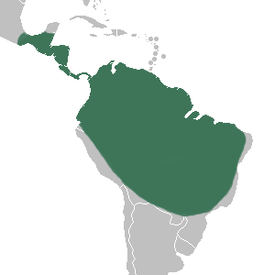
Tropical regions of Central and South America , from southern Mexico and Guatemala to southern Bolivia and Brazil .
Most species grow in mountainous regions at altitudes from 900 to 1500 meters above sea level [5] , some representatives ( Phrag. Longifolium ) are also found at sea level.
Most of the species are terrestrial plants and lithophytes that inhabit humid habitats. A smaller part of the species are epiphytes and half-epiphytes.
In the areas where most species grow, both seasonal and diurnal temperature fluctuations are well pronounced, and the relative humidity does not fall below 50%. Many species easily tolerate short-term temperature drops of up to 5–10 ° C, and for some species, for example, Phragmipedium caudatum, such a decrease is necessary to stimulate flowering [6] .
Endangered Species Protection Problem
Habitats for all species of Fragmipediums are under strong human pressure. In all their habitats, the destruction of tropical forests and their conversion into agricultural land continues. Excessive collection of plants for export in order to meet demand from orchid collectors undermines the purity of species that grow in still-preserved natural habitats.
All species of the Fragmipedium genus are included in Appendix II of the CITES Convention. The purpose of the Convention is to ensure that international trade in wild animals and plants does not endanger their survival.
Systematics
One of the problems of classification of this genus is that many species have large and miniature forms , and often these forms grow in the same places. When they enter the culture, they can be mistaken for different species [4] .
The taxonomy of the genus Phragmipedium is not well-established. The composition and names of the sections are regularly reviewed.
The composition of the sections is given according to the site Phragweb.info [7] :
- Section - Phragmipedium Rolfe .
- Phragmipedium caudatum , Phragmipedium warszewiczianum , Phragmipedium popowii ,
Phragmipedium exstaminodium , Phragmipedium lindenii
- Section - Himantopetalum ( Hallier ) Garay
- Phragmipedium caricinum , Phragmipedium christiansenianum , Phragmipedium pearcei , Phragmipedium klotzscheanum , Phragmipedium richteri , Phragmipedium tetzlaffianum .
- Section - Platypetalum ( Pfitzer ) Garay
- Phragmipedium lindleyanum .
- Section - Lorifolia ( Kraenzl. ) Garay
- Phragmipedium longifolium , Phragmipedium hartwegii , Phragmipedium boissierianum , Phragmipedium hirtzii , Phragmipedium vittatum , Phragmipedium brasiliense .
- Section - Micropetalum ( Hallier ) Garay
- Phragmipedium schlimii , Phragmipedium fischeri , Phragmipedium andreettae ,
Phragmipedium besseae , Phragmipedium dalessandroi .
- Section - Schluckebieria Braem
- Phragmipedium kovachii .
Views
botanical illustration from the book "Xenia Orchidacea" 1874
botanical illustration from the book "Xenia orchidacea" vol. 1 tab. 15, 1858
List of species (including obsolete names) according to the Royal Botanic Gardens at Kew [3] :
- Phragmipedium andreettae PJCribb & Pupulin , 2006
- Phragmipedium besseae Dodson & J. Kuhn , 1981
- Phragmipedium besseae var. besseae .
- Phragmipedium besseae var. dalessandroi ( Dodson & O. Grass ) A.Moon & PJCribb , 1997
- Phragmipedium besseae var. flavum Braem , 1990 = Phragmipedium besseae var. besseae
- Phragmipedium besseae f. flavum ( Braem ) O. Gruss & Roeth , 1999 = Phragmipedium besseae var. besseae
- Phragmipedium boissierianum ( Rchb.f. & Warsz. ) Rolfe , 1896
- Phragmipedium boissierianum var. boissierianum .
- Phragmipedium boissierianum var. czerwiakowianum ( Rchb.f. & Warsz. ) O. Gruss , 1995
- Phragmipedium brasiliense Quené & O.Gruss , 2003
- Phragmipedium cajamarcae Schltr. , 1921 = Phragmipedium boissierianum
- Phragmipedium caricinum ( Lindl. & Paxton ) Rolfe , 1896
- Phragmipedium caudatum ( Lindl. ) Rolfe , 1896 typus
- Phragmipedium caudatum var. lindenii (Lindl.) Pfitzer in Engl. , 1903 = Phragmipedium lindenii
- Phragmipedium caudatum var. roseum Delchev. , 1867 = Phragmipedium warszewiczii
- Phragmipedium caudatum var. wallisii ( Rchb.f. ) Stein , 1892 = Phragmipedium warszewiczianum
- Phragmipedium caudatum var. warszewiczianum ( Rchb.f. ) Pfitzer in Engl. , 1903 = Phragmipedium caudatum
- Phragmipedium chapadense Campacci & R. Takase , 2000
- Phragmipedium christiansenianum O. Gruss & Roeth , 2001 = Phragmipedium longifolium
- Phragmipedium czerwiakowianum ( Rchb.f. & Warsz. ) Rolfe , 1896 = Phragmipedium boissierianum var. czerwiakowianum
- Phragmipedium dalessandroi Dodson & O. Grass , 1996 = Phragmipedium besseae var. dalessandroi
- Phragmipedium dariense ( Rchb.f. ) Garay , 1979 = Phragmipedium longifolium
- Phragmipedium ecuadorense Garay, 1978 = Phragmipedium pearcei
- Phragmipedium exstaminodium Castaño , Hágsater & E. Aguirre , 1984
- Phragmipedium exstaminodium subsp. warszewiczii Dressler , 2005 = Phragmipedium warszewiczii
- Phragmipedium fischeri Braem & H. Mohr , 1996
- Phragmipedium hartwegii ( Rchb.f. ) Pfitzer in Engl. , 1903 = Phragmipedium longifolium
- Phragmipedium hartwegii f. baderi ( Roeth & O.Gruss ) O.Gruss , 2001 = Phragmipedium longifolium
- Phragmipedium hartwegii var. baderi Roeth & O. Grass , 1997 = Phragmipedium longifolium
- Phragmipedium hincksianum ( Rchb.f. ) Garay , 1979 = Phragmipedium longifolium
- Phragmipedium hirtzii Dodson , 1988
- Phragmipedium humboldtii ( Warsz. Ex Rchb.f. ) JTAtwood & Dressler , 1999 = Phragmipedium warszewiczii
- Phragmipedium humboldtii subsp. exstaminodium ( Castaño , Hágsater & E. Aguirre ) JTAtwood & Dressler , 1999 = Phragmipedium exstaminodium
- Phragmipedium kaieteurum ( NEBr. ) Garay , 1979 = Phragmipedium lindleyanum
- Phragmipedium klotzschianum ( Rchb.f. ) Rolfe , 1896
- Phragmipedium kovachii JTAtwood , Dalström & Ric.Fernández , 2002
- Phragmipedium lindenii ( Lindl. ) Dressler & NHWilliams , 1975
- Phragmipedium lindenii subsp. wallisii ( Rchb.f. ) Dressler , 2005 = Phragmipedium warszewiczianum
- Phragmipedium lindleyanum ( MRSchomb. Ex Lindl. ) Rolfe , 1896
- Phragmipedium lindleyanum var. sargentianum (Rolfe) O.Gruss, 2003 = Phragmipedium lindleyanum
- Phragmipedium longifolium ( Warsz. & Rchb.f. ) Rolfe , 1896
- Phragmipedium longifolium var. chapadense ( Campacci & R.Takase ) O.Gruss , 2003 = Phragmipedium chapadense
- Phragmipedium longifolium var. darienense ( Rchb.f. ) Hallier f. , 1897 = Phragmipedium longifolium
- Phragmipedium longifolium var. gracile ( HJVeitch ) Pfitzer in Engl. , 1903 = Phragmipedium longifolium
- Phragmipedium longifolium f. gracile ( HJVeitch ) O. Grass , Caesiana 2001 = Phragmipedium longifolium
- Phragmipedium longifolium var. hincksianum ( Rchb.f. ) Stein , 1892 = Phragmipedium longifolium
- Phragmipedium longifolium f. minutum O.Gruss , 2001 = Phragmipedium longifolium
- Phragmipedium longifolium var. roezlii ( Rchb.f. ) Hallier f. , 1897 = Phragmipedium longifolium
- Phragmipedium pearcei ( Rchb.f. ) Rauh & Senghas , 1975
- Phragmipedium pearcei var. ecuadorense ( Garay ) C. Cash ex O.Gruss , 1994 = Phragmipedium pearcei
- Phragmipedium peruvianum Christenson , 2002 = Phragmipedium kovachii
- Phragmipedium popowii Braem , 2004 = Phragmipedium warszewiczii
- Phragmipedium reticulatum ( Rchb.f. ) Schltr. , 1921
- Phragmipedium richteri Roeth & O.Gruss , 1994
- Phragmipedium roezlii ( Rchb.f. ) Garay , 1979 = Phragmipedium longifolium
- Phragmipedium sargentianum ( Rolfe ) Rolfe , 1896 = Phragmipedium lindleyanum
- Phragmipedium schlimii ( Linden ex Rchb.f. ) Rolfe , 1896
- Phragmipedium schlimii var. albiflorum ( Linden ) Braem , 1996 = Phragmipedium schlimii
- Phragmipedium schlimii f. albiflorum ( Linden ) O. Grass , 1996 = Phragmipedium schlimii
- Phragmipedium tetzlaffianum O.Gruss , 2000
- Phragmipedium vittatum ( Vell. ) Rolfe , 1896
- Phragmipedium wallisii ( Rchb.f. ) Garay , 1978 = Phragmipedium warszewiczianum
- Phragmipedium warszewiczianum ( Rchb.f. ) Schltr. , 1922
- Phragmipedium warszewiczii ( Rchb.f. ) Christenson , 2006
- Phragmipedium warszewiczii subsp. exstaminodium ( Castaño , Hágsater & E. Aguirre ) Christenson , 2006 = Phragmipedium exstaminodium
- Phragmipedium xerophyticum Soto Arenas , Salazar & Hágsater , 1990 = Mexipedium xerophyticum
Natural Hybrids
Interspecific natural hybrids occur randomly in closely related species that grow on the same territory and bloom at the same time.
According to the Royal Botanic Gardens at Kew [3] :
- Phragmipedium × roethianum - Phrag. hirtzii × Phrag. longifolium O. Grass & Kalina , 1998
In Culture
Fragmipediums are simple to grow plants, stably flowering, extremely strong and very resistant to pests. Species with long petals, such as Phragmipedium caudatum , its relatives and hybrids bloom simultaneously in three to five colors on one peduncle. Other species bloom sequentially, revealing many individual flowers for a long time, some flowering lasts up to eight months [8] .
The first Phragmipedium to bloom in Europe was Phragmipedium caudatum . This happened in 1847 in England.
Until 1989, only four species were considered interesting and were well distributed in the culture: Phrag. besseae , Phrag. caudatum , Phrag. lindenii and phrag. schlimii . Until 1989, when it was still possible to legally import plants taken from nature, firms engaged in the mass sale of orchids refused to engage in species plants, due to low demand. After the entire genus was included in Appendix I of the CITES convention, almost all types of frampediums became a subject of active interest among collectors [4] .
Phragmipedia are often divided into 2 conditional groups - the caudatum group, or the dry group, which includes Phrag. caudatum and other representatives of the sections Phragmipedilum and Platypetalum, and the group "besseae", or "wet" group, uniting Phrag. schlimii , Phrag. besseae and related species [6] .
Temperature group : from cold to warm, depending on the ecology of the species.
There is experience in maintaining a large collection of species and hybrids in the same temperature conditions. Daytime summer temperature is 29–32 ° C. In winter, about 16 ° C [8] .
Substrate Fragmipediums are contained in plastic and ceramic pots with several drainage holes at the bottom, providing uniform drying of the substrate, as well as in baskets for epiphytes. Plastic pots should be white to avoid overheating of the roots in the sun.
Pieces of 0.5 to 2 cm pine bark are a common element of substrates of mixtures for frampediums. The proportions of the components of the substrate are selected depending on the relative humidity in the room, the size of the pot and the requirements of a particular type.
Substrate Options:
- 9 parts of pine bark, fine fraction
- 3 parts fine perlite
- 3 parts of charcoal , fine or super fine fraction
- 3 parts of sphagnum
For large plants, medium-sized pine bark is added (1/4 of the total bark volume) [4] .
- 8 parts of medium sized pine bark
- 4 parts medium charcoal fraction
- 2 parts medium-sized wood fern
- 1 part of lava
- 1 part perlite
Such a substrate requires full watering every 2-4 days, depending on the weather. Fragmipediums can remain in this substrate for up to two years. More moisture-resistant substrates are changed annually. For seedlings and young plants, it is recommended to use the same composition with the addition of several parts of sphagnum [8] .
For species of the Phrag group . caudatum recommend the use of substrates with a high content of bark or coconut chips, well-drying and breathable. For the group Phrag. besseae are better suited for water-absorbing substrates with the addition of sphagnum, mineral wool and peat [6] .
The pH of the substrate is about 5-6.
Watering Fragmipedium like wet content. The roots of most species are located in a rather loose surface layer of soil consisting of plant litter, where, in addition to moisture, air easily enters. If the soil is always very moist, this prevents the aeration of the roots and causes fungal and bacterial diseases .
The frequency of watering should be chosen so that the substrate inside the pot has time to dry out almost completely, but does not have time to dry out completely.
The plant is sensitive to the accumulation of salts in the substrate. A sign of problems with salinization of the substrate may be the blackening of the tips of the leaves [9] . Also, the death of the tips of the leaves can occur when the content is too dry. The resumption of more frequent watering should stop the spread of such spots. If this does not help, then a transplant is necessary [8] . For irrigation, it is better to use water that has been purified by the reverse osmosis method with the addition of small doses of specialized fertilizer for orchids.
Relative humidity 50–80%. Low humidity (less than 45%) in the room can lead to wrinkling of growing leaves.
Light For many species, illumination should be 20,000–50000 lx , or 50–70% of the brightness of direct sunlight. According to the requirements for the amount of light, some Fragmipediums are close to the Cattleya . Lack of light slows down growth and flowering problems. In order to avoid leaf burns in the summer, plants should be shaded in the afternoon, and in the room where the plants are kept there must be intense air movement [9] .
Some collectors contain frampediums at 24,000-30000 lx . The only exception is the Phragmipedium besseae , which is more shade-loving. Plants should be located sufficiently loose so that all leaves can get maximum light. Leaves should be light green. Dark green leaves indicate too little light, and yellowish to too much sun [8] .
Transplant Most species and hybrids easily tolerate transplant. They are transplanted annually after flowering. Phrag. besseae does not form roots on young shoots if they do not reach the substrate.
Frequent divisions are undesirable [10] . A plant with three or four mature rosettes usually gives two new shoots from each front rosette, while a plant consisting of one rosette can produce only one growth in two or three years [8] .
Artificial Hybrids
Hybridization experiments of the Fragmipediums were begun in the 19th century; quite a lot of primary and secondary hybrids were created. The first hybrid, Phrag. Dominianum , the result of the Phrag cross . caudatum and phrag. caricinum , registered in 1870.
In contrast to Paphiopedilum , no complex (complex) hybrids were obtained in Fragmipediums [6] .
Hybridization was carried out in two directions, based on Phrag. schlimii , which are characterized by shortened petals and pink color and with the participation of representatives of the Phragmipedium section (hybrids with long petals). James Weich called these groups the Cedeni group and the Dominian group, according to the names of the first hybrids obtained in the corresponding groups [6] : Phragmipedium × Dominianum ( Phrag. Caudatum × Phrag. Caricinum ) and Phragmipedium × Sedenii ( P. schlimii × Phrag. Longifolium ).
In recent years, bright compact hybrids based on Phrag have been created. besseae . A significant contribution to modern hybridization was made by the Eric Young Orchid Foundation, the British Foundation, Donald Wimber and other researchers in his group create beautiful polyploid hybrids - winners of numerous exhibitions. Their first success is Phrag. Eric Young ( Phrag. Besseae × Phrag. Longifolium ), served as the basis for a series of popular modern hybrids. From Phrag. besseae they inherit a bright color and more compact size of the plant, and polyploidy provides large flower sizes [6] .
To date, hundreds of primary [11] and complex [12] hybrids have been created.
Diseases and Pests
Notes
- ↑ For the conventionality of indicating the class of monocotyledons as a superior taxon for the plant group described in this article, see the APG Systems section of the Monocotyledonous article .
- ↑ Alphabetical list of standard abbreviations of all generic names. occurring in current use in orchid hybrid registration as at 31st December 2007 Archived September 10, 2016.
- ↑ 1 2 3 World Checklist of Phragmipedium . The Royal Botanic Gardens, Kew.
- ↑ 1 2 3 4 Harold Koopowitz. Tropical Slipper Orchids: Paphiopedilum & Phragmipedium Species & Hybrids. - Timber Press.
- ↑ Phragmipedium on the site Phragweb.info (inaccessible link) . Date of treatment March 19, 2009. Archived November 20, 2008.
- ↑ 1 2 3 4 5 6 Zhukova M. Fragmipediums
- ↑ PhragWeb - Phragmipedium - Taxonomy (inaccessible link) . Date of treatment March 19, 2009. Archived November 20, 2008.
- ↑ 1 2 3 4 5 6 Gary Zetterstrom (AOS). Growing Fragmipediums.
- ↑ 1 2 http://culturesheet.org/orchidaceae:phragmipedium (inaccessible link) Phragmipedium Rolfe
- ↑ Cherevchenko T. M. Tropical and subtropical orchids. - Kiev: Naukova Dumka, 1993.
- ↑ Phragmipedium Primary Hybrid Listings
- ↑ Phragmipedium Hybrids by Grex Name
Literature
- Hedgehog Zdenek. Orchids Illustrated Encyclopedia. - Labyrinth, 2005. - ISBN 5-9287-1134-4 .
- Harold Koopowitz. Tropical Slipper Orchids: Paphiopedilum & Phragmipedium Species & Hybrids. - Timber Press, 2007 .-- ISBN 978-0881928648 .
- Cash C. The Slipper Orchids. - Portland, 1991.
- Albert, VZ & B. Pettersson. Expansion of Genus Paphiopedilum Pfitzer to Include All Conduplicate-leaved Slipper Orchids (Cypripedioideae: Orchidaceae). Lindleyana 9 (2). - 1994 .-- S. 133-139.
- McCook, L. An Annotated Checklist of the Genus Phragmipedium. - 1998. - 28 p. - (Special Publication of the Orchid Digest).
- Gruss, O. A checklist of the genus Phragmipedium. Orchid Digest 67 :. - 2003. - S. 213-241.
- Braem, GJ, Ohlund, S., and Quene, RJ The real Phragmipedium warszewiczianum: a clarification of the Phragmipedium caudatum complex (Phragmipedium section Phragmipedium) Orquideologia 23 (2) :. - 2004 .-- S. 87-136.
Links
- Fragmipedium. Zhukova M., Moscow Society of Orchid Lovers (Russian)
- Phragmipedium Rolfe (link unavailable )
- Stephen Manza Website - Slipperorchids.info