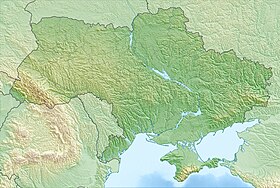
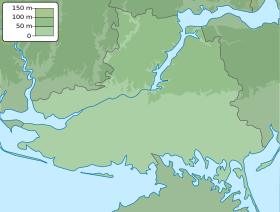
Azov-Sivash National Natural Park ( Ukrainian: Azov-Sivassky National Natural Park ) is a national park located in the north of the western part of the Sivash Bay and on the spit Biryuchy Island , in the Kherson region of Ukraine.
| Azov-Sivashsky | |
|---|---|
| Ukrainian Azov-Sivaskiy | |
 Scythe Privet Island | |
| IUCN Category II ( National Park ) | |
| basic information | |
| Square | 52 154 ha |
| Established | February 25, 1993 |
| Management organization | State Administration of Affairs |
| Location | |
| A country |
|
| Region | Kherson region |
| Nearest town | Genichesk |


Created February 25, 1993 . Area - 52 154 ha.
Content
History
In 1923, the island of Churyuk became part of the Askania-Nova reserve. In 1927, at the Askania-Nova Reserve, the Primorye Spit reserve ("Nadmorski Spit") was created, which included separate sections of the Northern Black Sea, Sivash and the Sea of Azov [1] . In 1933, the Primorye Spit reserve became an independent institution, then in 1937 new reserves were created on its basis: the Black Sea and the Azov-Sivashsky . In 1957, by order of the Council of Ministers of the Ukrainian SSR, the Azov-Sivash Reserve was reorganized into the Azov-Sivash State Reserve and Hunting Farm , which included islands in the Sivash Bay (part of Kuyuk-Tuk, part of Churyuk, Martinyachy, China) and the water area around the islands, the sea strip around spit Biryuchy island.
The National Natural Park was created by Decree of the President of Ukraine No. 62 of February 25, 1993 by reorganizing the Azov-Sivash State Reserve and Hunting Farm within its borders [2] . The national park was created with the aim of preserving, renewing and rationally using valuable natural and unique complexes and objects of the steppe and water area in the northern Azov and Prisivash regions, which have important environmental, recreational and historical-cultural significance.
In 1976, Sivash Bay (an area of 45,700 ha) was declared a wetland of international importance according to the Ramsar Convention. In 1995, the Decree of the Cabinet of Ministers of Ukraine No. 935 approved the Central Sivash wetland (an area of 80,000 hectares).
Geography
All land is the property of the park.
- Zoning : conservation area ( Sivash Bay) - 38 970 hectares , regulated recreation zone - 618 hectares, stationary recreation zone - 93 hectares, economic zone (Spit Biryuchy island ) - 12 473 hectares .
The area of the park is 52,154 ha: 8,469 ha of land (16.24%) and 43,685 ha of the water area (83.76%). It is represented by two sections: the Biryuchanskoe ( Biryuchy island spit with a strip of water) and Genichesky (Sivash water with islands) branches. The land part of the park is divided by administrative regions: Genichesky 7,528 hectares ( Biryuchy island spit, Kuyuk-Tuk islands (without northern tip), Camel , China ) and Novotroitsky (western part of Churyuk island). The water area of the park includes the eastern part of Western Sivash within the boundaries of the Kherson region, a strip around the spit Biryuchiy island of the Sea of Azov (including the Utlyuk estuary ).
On the spit Biryuchy Island there are several holiday homes, observation towers, places for short-term picnics. There are three car routes connecting the infrastructure of the park.
Nature
According to physical and geographical zoning, the park is located within the Prisivash-Priazov lowland region of the Black Sea-Priazov dry steppe province and Prisivash-Crimean lowland region of the Crimean steppe province of the dry steppe subzone of the steppe zone of Ukraine. According to the geobotanical zoning system, the land part of the park is part of the Prisivash district of the subzone of the Azov-Black Sea steppe sub-province of the Black Sea province of the European-Asian steppe region. Spit Biryuchy ostrov and Fedotova spit are of the type of coastal landscapes and are characterized by modern coastal sand-shell limestone-sea plains with underdeveloped sod-telltale solonchak soils and solonchaks . Central Sivash is a sea lagoon type gulf. Within its limits, the so-called “droughts” are distinguished — areas that are periodically flooded under the influence of surge waves, which during the drought have the appearance of heavy loamy salty solonchaks . Its islands are represented by weakly soddy forest-like plains with chestnut medium and high solonetzic soils in combination with solonetzes and meadow solonchaks. The climate of the park is temperate continental, with hot long dry summers and relatively short winters with unstable snow cover 5-10 cm thick. The average July temperature is + 24 ° С, maximum + 40 ° С. The average January temperature is −3 ° C, the minimum −34 ° C. The average annual rainfall is about 260 mm. The region is characterized by long droughts with dry winds.
Flora
The vegetation of the Sivash islands is represented by the desert steppe and salt marshes, the spit Biryuchy island is represented by real steppes, and the coast of the Utlyuk estuary is occupied by reed thickets. Some endemic species were described precisely from the national park and became the subject of research. In total, 308 plant species were registered, including 12 species are listed in the Red Book of Ukraine.
The Sivash Islands were less subject to anthropogenic influence, where the true steppe phytocenoses were preserved. Illyrian buttercup ( Ranúnculus illýricus ), purple mullein ( Verbascum phoeniceum ), and dry-sage ( Salvia tesquicola ) grow here. Such endemic species are widespread such as Churyuk Kermek ( Limonium tschurjukiense ), Mutovskaya (Sivash) ( Scleranthus verticillatus ), Sivash (), Yarrow ( Biryuchinsky ) ( Achillea birjuczensis ), Fomina agaricus, Agrocopus sylivis ( Synovis polynomidae ) Lepidium syvaschicum ), Sivash dandelion ( Taráxacum syvaschicum ), saltwort ( Odontites salinus ). Pleistocene relic plants are found only in the Sivash region , such as the one- stamen oyster ( Ofaistoneta monandri ) and the thin tetradiclis ( Tetradiclis tenella ). Deserted steppes are common on the watersheds. The grass stand is represented by xerophytic shrubs ( Tauridae wormwood Artemisia taurica , Larch hodgepodge Salsola laricina ) and cereals ( Becker fescue Festuca beckeri , Lavrenko agropyron lavrenkoanum grass mat , Lessing feather grass Stipa lessingīica , feather grass ). Communities of the Caspian Kermek species ( Limonium caspium ) and plantain genus are found on the braids; desert halophytic vegetation (the European salt salmon Salicórnia europaéa , pruned Suaeda prostrata , petrosymonium trichophyta Petrosimariconomyrantrumate quinoa quinoa Atriplex tatarica ).
Fauna
Wetlands are a nesting, wintering and migratory site for many birds. In total, 250 species of animals were registered, including 48 species are listed in the Red Book of Ukraine. 30 species of birds are listed in the CCU.
Over 1 million birds of 197 species stay in the Sivash Bay during the year. Common species are the genera of gulls, ducks, marsh terns, penguins, herons, species of mute swan , rare red-listed species of sea-squirrel ( Charadrius alexandrinus ), black- winged stilt ( Himantopus himantopus ), sandpiper ( Haematopus ostralegus ), European mackerel ( Oryx phalaenopsis ) laughter ( Larus ichthyaetus ), white-tailed eagle ( Haliaeetus albicilla ). The Sivash region and the spit Biryuchy island is the habitat of the bustard ( Otis tarda ), strepet ( Tetrax tetrax ), Demoiselle crane ( Anthropoides virgo ), gray crane ( Grus grus ), field harrier ( Circus cyaneus ), steppe harrier ( Circus macrourus ) Golden Eagle ( Aquila chrysaetos ), Great Spotted Eagle ( Aquila clanga ), Saker Falcon ( Falco cherrug ), Peregrine Falcon ( Falco peregrinus ), Steppe Kestrel ( Falco naumanni ).
Notes
- ↑ Vasilyuk O.V., Kolomіychuk V.P. The stink of boolean persimmon (up to the 90th anniversary of the Nadmorskiy Zapovidnikov // Melitopol Local History Journal, 2016, No. 8, pp. 74-81
- ↑ About the establishment of the Azov-Sivassky National Natural Park