The Battle of Lake George is a battle that took place on September 8, 1755 between the Allied Franco-Indian and British forces near Lake George during the French-Indian War . Despite heavy losses, neither side was successful, but the French offensive was halted.
| Battle of Lake George | |||
|---|---|---|---|
| Main Conflict: Seven Years War French indian war | |||
 | |||
| date of | September 8, 1755 | ||
| A place | Lake George, New York | ||
| Total | British strategic victory | ||
| Opponents | |||
| |||
| Commanders | |||
| |||
| Forces of the parties | |||
| |||
| Losses | |||
| |||


Content
Background
On August 28, 1755, as part of the unfolding large-scale armed conflict between the French and English colonies in North America, British troops led by Sir William Johnson arrived on the northern shore of Lake Lac Saint Sacrement . By order of the commander, the lake was renamed George in honor of King George II of Great Britain. The goal of the British offensive was the French Fort St. Frederick, which was the key to the defense of French Canada.
In order to stop the advance of Johnson's troops, the commander of the French forces, Baron de Discau, with the troops camped at Fort Carillon, located between two large lakes. On September 4, Dieskau decided to organize a raid behind the British who had recently built Fort Edward on the Hudson River . The purpose of the raid was the destruction of boats, food and artillery, necessary for the British expedition. Having left part of his forces in Carillon, Discau led 222 grenadiers of the regular regiments La Reine and Languedoc , 600 militias and 700 Indians from the Abenaki tribe, and on September 7, 1755 arrived at Fort Edward. Johnson at that time was located with the main forces 14 kilometers north of the fort along the shore of Lake George and was soon notified by scouts about the approach of the enemy. Johnson sent a courier with a letter to warn the garrison of Fort Edward about the approach of the enemy. The courier, however, was intercepted, and Edward's plans were instantly revealed. Despite the numerical superiority of the British, on the morning of the next day, Dieskau ordered the troops to march to the lake. In this he was supported by the Indians, who did not want to attack the fort protected by artillery.
Battle
At 9:00 a.m., Johnson sent Colonel Williams with 1,000 soldiers and 200 Mohawks to support the fort garrison (at that time the fort was defended by 500 English soldiers). Concerned about the British advance, Dieskau placed his grenadiers on the road to the fort, and ordered militias and Indians to ambush along the sides of the road. The Williams column, thus, fell into the trap, falling under the cross-gun fire of the enemy. In this bloody battle, the commander of the column, Colonel Williams and the leader of the Mohawks, Hendrick, died. The British, having disordered their ranks, began to hastily retreat, covered by Mohawks and soldiers under the command of Colonel Whiting. In this battle, the famous French commander, Legardouer de Saint Pierre, was very popular among the Indians.
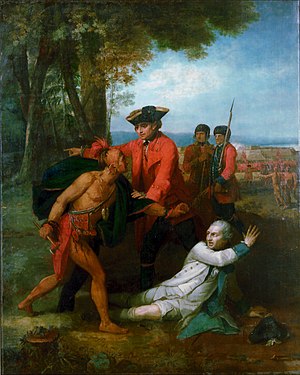
Discau decided to build on his success and ordered an attack on Johnson's camp. But already at that time, Dieskau controlled only regular units: the Indians and partly the militias refused to take part in the offensive. Diskau built the grenadiers in a six-row column and personally led the offensive, wanting to inspire his soldiers and allies. Meanwhile, the British had already managed to strengthen the camp by building barricades around it from carts, upturned boats and dumped trees. As the French approached, the British opened fire with buckshot with the support of three guns and made large gaps in the ranks of the French. Discau himself was wounded in battle and captured. The French offensive choked.
At that time, the commander of the fort garrison, Joseph Blanchard, seeing the smoke of the battle, sent a reconnaissance detachment of 80 soldiers from the New Hampshire Provincial Regiment and 40 soldiers from New York under the command of Captain McGennis. On the way, they came upon a French convoy and, scattering the guards, quickly captured it. At 4 o'clock in the afternoon on the way of the British there was a retreating French detachment of 300 people (mainly Canadian militias and Indians). The British ambushed and launched targeted fire as the enemy approached. In this battle, the British won a landslide victory, losing only 6 people (though the commander of the British detachment, Captain McGennis, died). So many Frenchmen were killed in the battle that their bodies were thrown into the nearest pond after the battle, which after that acquired the characteristic name Bloody Pond (in the English translation, “Bloody Pond”). As a result of the battle, the loss of the British amounted to 331 soldiers, and the French - 339 soldiers [1] . The battle put an end to the military career of Baron de Discau and stopped the advance of French troops in the region.
References and Sources
Notes
- ↑ Steele, Ian K. , Betrayals: Fort William Henry & the “Massacre,” Oxford University Press, Inc., New York, 1990, ISBN 0-19-505893-3 , Page 53