Citroën Traction Avant is one of the world's first mass - produced front-wheel drive vehicles with a bodywork , produced by the French automaker Citroën from 1934 to 1957. (Sometimes it is mistakenly considered the world's first production front-wheel drive car, but in 1929-1932, the Cord L-29 front-wheel drive was already produced in the USA, and in Germany - DKW F1 (since 1931) and Adler).
| Citroën Traction Avant | |
|---|---|
 | |
| general information | |
| Manufacturer | Citroёn |
| Years of production | 1934 - 1957 |
| Assembly |  Paris , France Paris , France Foret , Belgium Foret , Belgium Cologne , Germany Cologne , Germany Copenhagen , Denmark Copenhagen , Denmark Slough , UK Slough , UK |
| Other designations | Citroën 11CV Citroën 15CV Citroën Big Fifteen Citroën Big Six nickname "Reine de la Route" (Queen of the Roads) |
| Design | |
| Body type | 2-dv. coupe 4-dv. sedan |
| Layout | front-wheel drive, front-wheel drive |
| Wheel formula | 4 × 2 |
| Characteristics | |
| Dynamic | |
| Top speed | 100 km / h |
| On the market | |
| Segment | D (11CV) E (15CV) |
| Other | |
| Fuel consumption | 10 l / 100 km |
| Designer | André Lefèbvre , Flaminio Bertoni |
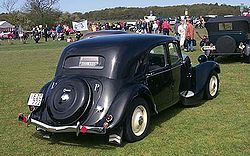

"Traction Avant", which in French means "front-wheel drive", was designed by Andre Lefebrom and Flaminio Bertoni in late 1933 - early 1934. The car was one of the most successful front-wheel drive in the 1940s. In total, about 760 thousand cars were manufactured.
Content
- 1 History of creation
- 1.1 Features
- 1.2 Startup
- 1.2.1 Impact on Citroën
- 1.3 In war time
- 1.4 End of release
- 2 Design
- 3 Modifications
- 3.1 Names and symbols
- 3.2 Mass production sedans
- 3.3 Modifications that did not appear on the conveyor
- 3.4 Coupes and convertibles
- 3.5 Self-leveling hydraulic suspension mod. 1954 year
- 3.6 Production in the United Kingdom
- 4 Impact on motorsport
- 5 In the cinema and on television
- 6 Modern
- 7 Sources
Creation History
Features
Front-wheel drive first appeared on luxury cars " Alvis " ( 1928 Racing FWD) and Cord ( , model L29, 1929-1932).
While most modern cars were based on separate chassis and bodywork , the basis for Traction Avant was an all-welded supporting body. Such monocoque (in the USA called Unit Body and “Unibody”) give an advantage in weight, which in the case of Traction Avant was 70 kg (150 pounds) of steel for each car. in the USA it was not particularly important, but for Citroën it became decisive for the purchase of mass production technologies for such bodies from the American company Budd Company [1] .
A new type of body was carefully studied for strength, and a kind of crash test was even undertaken: dropping a car off a cliff, in practice, showed its rigidity [2] .
Such an innovative body gave the car a recognizable, low-standing among contemporaries, and the long production period led to the fact that in 1934 the model was perceived as stylish, and in 1955 - very outdated.
The pendants were also of a very progressive design. The front one is an independent torsion-lever with an A-shaped lower lever (while competitors continued to produce cars with suspension depending on longitudinal semi-elliptic springs). The rear suspension is dependent, basically its steel beam with a Panhard rod , suspended on the wishbones, the levers are attached to the torsion bars enclosed in 3-inch steel pipes, and the pipes, in turn, are attached to the body.
Due to the significant mass advantage, the Traction Avant had a speed of 100 km / h (62 mph ), consuming only 10 liters per 100 km (28 miles per imperial gallon , 24 mpg US).
Production Launch
The scale of investment in production shows how much Andre Citroen expected from the new model. Site preparation took place in the winter of 1932/33, on March 15, 1933, demolition of the buildings of the former factory with a total area of 30,000 m 2 began . [3] On April 21, construction of new buildings began, and by the end of August, boxes of buildings had risen four times more than the old. The structures used 5,000 tons of iron and steel. At the same time, several hundreds of Rosalie continued to be produced daily. At the opening, Citroen called in 6,000 guests, mainly dealers, sales agents and advertisers, for whom a grand banquet was held on October 8th in still empty buildings. This gesture meant that a race against time was coming in the coming months in order to have time to prepare the car and equipment before investors became disappointed [3] .
The first finished car was shown to the public in the Paris salon of the company on April 18, 1934, and the private show for the main dealers took place even earlier, on March 23. In this case, until April, only rumors were circulating about the car, because it was possible to keep the characteristics of the model a secret. On April 19, 1934, the conveyor started working at its full potential, and although the new supporting body was not satisfactory, due to the rush to launch the model, shortcomings were identified in the transmission and hydraulic brakes (also the first in a mass vehicle) [3] .
The market, however, required old rear-wheel drive models, whose share in the total production of the plant even in 1936 reached another 10% [4] .
Impact on Citroën
The development of the Traction Avant and the refurbishment of the plant were incredibly expensive, and in late 1934 Citroën filed for bankruptcy . The largest lender was Michelin , which owned Citroën from 1934 to 1976. At the same time, Citroën also became a research laboratory where radial tires and other Michelin innovations were tested.
In wartime
In September 1939, France declared war on Germany , and in June 1940 the Wehrmacht occupied the northern part of the country. The war years were marked by a serious shortage of gasoline and raw materials for the civilian industry, but it did not develop immediately. The Paris Motor Show , scheduled for October 1939, did not take place; Citroën associated with it the announcement of the 2CV model, changes to Traction were not planned. For Traction Avant, the last “normal" year was 1939, during which 8,120 7C cars with a wheelbase of 2,910 mm (115 in) and 1,628 cm 3 (99.3 cu in) were produced. In 1940, output fell to 1,133 units due to the fact that on June 3, the plant suffered from German bombing. In June 1941, production was stopped after only 154 cars were assembled in six months. 7C remained on the Citroën price list until March 1944, but after the war the release of this version (with reduced engine capacity) did not resume. The more powerful 1 911 cm 3 modification of 11B-light was released in 1939 in an amount of 27,473 copies, 4,415 in 1940 and 2,032 in 1941 (for 11 months, since this model was discontinued in November) [5] .
In 1945, output increased very slowly. 11 B-light appeared without significant changes compared with 1941, only the rims around the headlights were not chrome , but painted. By the end of December 1945, 1,525 vehicles were launched. Prices are evidence of inflation in the franc : if in January 1940 a car cost 26,800 francs, then in October 1945 it was 110,670. In 1945, 11B-light was the only Citroën model of a passenger car. Another sign of the times: a set of five tires was sold separately from the car for 9,455 francs. By May 1946, the tire deficit was overcome, a separate payment for them disappeared, but the price had already reached 121,180 francs [5] .
The 11B-normal modification, which differs from the 11B-light with a wheelbase of 3,090 mm (122 in), experienced a similar drop in sales in 1939-41, for the seven months of 1941 only 341 were produced. After the war in 1946, the only 11B-normal was assembled for the October auto show, and the model returned to the conveyor only in 1947. For 10 post-war years, sales of the shorter 11B-light model in France exceeded 11B-normal [5] .
At first, the clearance of the Traction Avant was in doubt among the French army, but by September 1939 there were approximately 250 vehicles in service. The loss of equipment during the rapid retreat of the front deep into the country necessitated new supplies, and from February to May 1940 Citroën sent a batch of 570 units. Probably, supplies continued after that, until the defeat of the French army. Subsequently, German troops requisitioned a lot of cars for their needs, which received license plates "WH ..." (Wehrmacht Heer / Wehrmacht Command). Traction proved to be a reliable machine in France, and in Libya, and near Stalingrad . Traction Avant participated in the Resistance , and after liberation, the letters FFI were written on the doors of these machines. Less honorable for the model was the special location that gangsters showed to Traction, such as, for example, the Pierrot le Fou gang.
Release End
After the Citroën ID was introduced, a simplified and cheaper version of the DS, Traction Avant was discontinued in July 1957.
For 23 years (taking into account the stop of the conveyor during the war), 759 111 cars were produced, including:
- 26,400 in Slough, United Kingdom,
- 31,750 in Foret, Belgium,
- 1,823 in Cologne, Germany,
- 550 in Copenhagen, Denmark.
Design
The power unit in the Traction Avant is located longitudinally, with the engine falling inside the wheelbase, due to which the car boasts a good weight distribution along the axles and easy control. The transmission is integrated into a common unit in an aluminum crankcase and is attached to the engine in front, with the gearbox extended forward, and the differential located between it and the engine. The power units of later models Renault 4 and Renault 16 and the first generation of Renault 5 are arranged according to a similar scheme, while many other front-wheel drive cars with a longitudinal engine arrangement are arranged exactly the opposite ( Saab 96 and Renault 12 , Renault 18 and most Audi ) [6 ] .
Manual gearshift drive, the lever is located on the dashboard in an H-neck. Since this arrangement of the lever increases the risk of “loss” of gears engaged by moving the lever up (second and rear), the mechanism locks when the clutch closes and unlocks when it is squeezed [6] .
As a result of the arrangement of the gearshift lever on the dashboard, the use of suspension pedals and manual control of the parking brake, the front seats can be made in the form of a sofa, and the absence of a gearbox cover and tunnel for the driveshaft in the floor, in addition, make the cabin very spacious. Due to the low landing, the car does not have any steps , and all these features make Traction suitable for building limousines and use as a taxi [6] .
Until 1953, the only color available was black [6] .
Modifications
Names and conventions
Traction Avant ("front-wheel drive") - the unofficial name of the model. The official designations were the number of tax horsepower (CV), which determined the amount of the annual tax on the car. However, often changes in the tax class were not reflected in the designations of the models. For example, in 1934, a 7CV modification was introduced (unofficially 7A ). The designation 7CV was maintained even when, on the 7B modification, the increased engine displacement fell into the class 9CV. The designations 11CV , 15CV and 22CV were also used .
Traction is also known by the nickname "Reine de la Route" ("Queen of the Roads") [7] .
Mass Production Sedans
The number indicates the tax group . All modifications have front doors with rear hinges (the so-called “suicide doors”) and rear doors with hinges located in front [3] .
- 7A is the original "small sedan " with a base of 2,910 mm (115 in) and an engine with a displacement of 1,303 cm 3 (79.5 cu in). In production from April to June 1934, for 2 months, 7,000 copies were produced.
- 7B - differs from 7A in a more powerful 1,523 cm 3 (93.3 cu in) engine and two windshield wiper blades instead of one. Also corrected "childhood illnesses" transmission. From June to September 1934, 15,620 cars were produced [3] .
- 7C - with an even more powerful 1,628 cm 3 (99.3 cu in) engine, in production since October 1934.
- 11B - ("Normale", "normal"), 1 911 cm 3 (116.6 cu in) four-cylinder engine, the length, wheelbase and track are increased compared to 7B [8] . Release since November 1934.
- 11BL - ("Légère", "light") the same size as 7B .
- 15B - (from June 1938 [9] ), 2,867 cm 3 (175.0 cu in) six-cylinder engine. Interestingly, 15B actually got into the 16CV tax group .
- Modifications to the rear
Traction 7A: until 1935, two gas tank necks behind, access to the luggage compartment from the inside of the cabin
after 1935 behind one neck, trunk with access from the outside [4]
the trunk is extended and its volume doubled since the fall of 1952 [10]
At the 39th Paris Motor Show in October 1935, various modifications for 1936 were shown [4] :
- painted radiator grilles instead of chrome;
- restyled headlights;
- external trunk lid (before access to the luggage compartment was only inside the cabin and very inconvenient).
The boot lid made it necessary
- move the license plate to the left rear wing (before it was mounted in the middle above the bumper ) [4] ;
- remove the left of the two neck of the gas tank and move the right.
Two months later, a modification of the Pausodyne suspension followed, with conical rubber bushings appearing in the front.
In May 1936, the worm-roller steering gear with significant play was replaced by a more progressive rack and pinion .
To expand the market, an elongated 9-seater Familiale (“family”) model was released with three rows of seats, of which the middle folded, leaving huge free space for rear row passengers [11] . This body type lasted until 1991 on the Citroën DS Familiale and Citroën CX Familiale families .
On the same elongated chassis was built the station wagon 11CV Commerciale ("commercial") [11] for greengrocers, butchers and other merchants. Its back door consists of two halves: the lower one, reclining down, carries a spare wheel, and the upper one, reclining upwards, opens to the very roof. The one-piece back door, which leans up, appeared with the resumption of production after the war.
Familiale 1955: 6 side windows, 9 seats
Citroën 11 Commerciale 1938 5-door station wagon
Traction Avant Pickup
1934 22CV V8 engine - model never entered production
Right-hand drive modifications were also made in Paris and Foret ( Belgium ). 550 two-door trucks were assembled in Copenhagen to pay less import duties.
Modifications that did not appear on the assembly line
Two modifications did not reach mass production, because they could not recoup the costs, they were brought only to the stage of fully functional prototypes: a car with automatic transmission "Sensaud de Lavaud" and 22CV with a 3.8-liter V8 .
Sensaud de Lavaud transmission developed by order of Citroën is a gearless automatic machine with a torque converter that matches engine and drive wheels, much like the later American Dynaflow system. In this model, a less Spartan interior was also assumed than in other versions of Traction Avant, and as an option, the new V-shaped eight-cylinder engine of its own Citroën development. About 20 prototypes were made, but at the beginning of 1935 the development was stopped after the bankruptcy of the company and its transfer to the ownership of the main creditor - Michelin , who introduced much more stringent financial discipline [12] .
Coupes and Convertibles
Before the war, 2-door coupes and 2-door convertibles , both versions with a " mother-in-law seat ", were produced .
- Coupe and convertibles
Citroën 7C 1937 2-door sedan, so-called Faux Cabriolet (False Convertible)
Citroën 7C Cabriolet
Challenger is the brand under which The Challenger Motor Car Co was imported into Los Angeles in the 1930s by Traction Avant
Self-leveling hydraulic suspension arr. 1954
The six-cylinder 2,876 cm 3 model became the test bench for hydropneumatic suspension, which became the basis of the Citroën DS19 , shown at the Paris Auto Show in 1955. A hydropneumatic system was built into the rear suspension; a height adjustment lever was located in the trunk. The switch on the dashboard made it possible to fix the height of the suspension when parking, so that the car does not sag during loading. The suspension automatically unlocked on the go. The compressor and the fluid reservoir were located in the engine compartment, the compressor drive was from the fan belt , and the fluid brand was “LHS”. The model received the designation 15-6 H. Many parts of the hydraulic system were interchangeable with the earlier DS 19, which also had hydraulic disc brakes, a power steering and a semi-automatic gearbox with a hydraulic drive that did not appear on 15-6 H. A year after the launch of the DS, the 15-6 H rolled off the assembly line (in 1956).
UK Manufacturing
- Right-Hand Traction Released in Slough
6-cylinder engine 15CV
The Big Six with a 6-cylinder engine
1938 11B-L with 4-cylinder engine
Right-hand drive modifications were produced at a factory in Slough near London . Version 11L was called “ Light Fifteen” (“light fifteen”) , and 11 with a long base was called “ Big Fifteen” (“big fifteen.”). The confusion arises because engines in France classified as 11CV corresponded to 15HP in British tax horsepower [8] .
The 15CV was called the “Big Six” because of the six-cylinder engine.
| Model | Year | Engine volume, cm 3 (cu in) | Naib. speed, mph ( km / h ) | Acceleration 0-60 mph (0-100 km / h ), s | Fuel Consumption, miles / imp. gal ( l / 100 km ; miles / gal USA ) | Price with taxes GB £ |
|---|---|---|---|---|---|---|
| " Light Fifteen" | 1951 | 1 911 (116.6) | 72.6 (116.8) | 29.7 | 25.2 (11.2; 21.0) | 812 |
| "Big Six" | 1954 | 2 866 (174.9) | 81.1 (130.5) | 21,2 | 18.6 (15.2; 15.5) | 1,349 |
When assembling in Slough, it was necessary to use 51% of British parts in order not to pay import duties that protected the British auto industry from foreign competitors. Thus, on Traction appeared:
- 12-volt headlights , alternator and starter "Lucas electrics",
- in the interior - a walnut panel with a combination of Jaeger appliances, seats, door pockets and wool upholstery from Connolly Leather,
- outside - British bumpers with fangs, chrome grille .
Some cars had a sunroof.
Although most British Traction were right-hand drive, a small number of left-hand drive cars were released in Slough.
Impact on motorsport
The cast aluminum transmission housing , combining the gearbox and the center differential in one unit, was one of the most radical innovations in the Traction Avant. Its significance is not only in reducing the mass of the power unit, and not only in the fact that the launch of this fundamentally new technology was one of the reasons that ruined the Citroen , but also in the fact that John Cooper in search of the lightest transmission for rear-wheel drive Formula cars 1 could not find anything suitable except the Traction Avant crankcase, because the Volkswagen magnesium crankcase was too small for the gears needed in the F-1.
The Traction Avant transmission was used in the Cooper T43, which in 1958 was the first mid-engined car to win the F-1 race. His followers Cooper T45, T51 and T53 had a similar transmission. Cooper T51 won the Grand Prix in 1959.
Unlike the Volkswagen crankcase used by Hewland , the Traction Avant could not be put upside down. The input shaft of the gearbox is so high relative to the output shafts that in the upside down position, an oil level sufficient to lubricate the bearings of the output shafts would be too high for the input shaft to seal unreliably. For this reason, the engine had to be placed high, as if the bottom needed space for a pallet with engine oil, but at that time in racing engines pallets for storing oil were not used. Nevertheless, the French transmission was used by various designers with varying success in the late 1950s - early 1960s.
Jack Brabham , who specially visited the ERSA foundry in Paris to agree on the release of a reinforced crankcase [15] , made known the modification "ERSA Knight" with additional gears mounted in a "bell" connecting the engine to the transmission. The idea was proposed by Ron Tauranac, and it is named after Jack Knight, who developed the project and manufactured gears. Thus, the axis shift allowed the engine to land lower, and the Cooper T53, nicknamed “Lowline”, not only brought Brabham the 1960 title, but also became a stepping stone to his design career.
In the cinema and on television
According to the Internet Movie Cars Database , Traction Avant has appeared in film and television more than 1,300 times, including important roles in The Sound of Music, USA , Diva (1981, France), The Army of Shadows (1969) .
In modern times
Even by modern standards, Traction Avant is not so bad, but a common weakness is water leakage into the cabin.
As of 2006, the oldest known 7A (chassis number AZ 00-18), in a disassembled form, is on display at the Citroen Corporation Museum in Paris (engine and front wheels removed). The oldest running instance 7A number AZ-00-23 until September 1, 2006 was owned by one Dutchman, after which it was sold to Slovenia.
Every 4 years, car owners get to some exotic destination and arrange an ICCCR (International Citroën Car Clubs Rally) mileage. For example, in 2002, more than 30 Traction Avant drove without incident from Los Angeles to New York [16] .
Sources
- ↑ Nieuwenhuis, Paul. The automotive industry and the environment: a technical, business and social future . - Boca Raton, Fla .: CRC Press, 2003 .-- 1 online resource (xv, 255 pages) p. - ISBN 1855738600 , 9781855738607, 020349184X, 9780203491843.
- ↑ "The legacy of Andre Citroen". Retrieved 2008-11-05. (inaccessible link) . Date of treatment July 9, 2019. Archived October 10, 2008.
- ↑ 1 2 3 4 5 "Automobilia". Toutes les voitures françaises 1934 (salon [Oct] 1933) // Paris: Histoire & collections. - 2002. - No. 22 . - S. 25-27 .
- ↑ 1 2 3 4 "Automobilia". Toutes les voitures françaises 1936 (salon [Paris Oct 1935) // Paris: Histoire & collections. - 1996. - No. 1 . - S. 24 .
- ↑ 1 2 3 "Automobilia". Toutes les voitures françaises 1940 - 46 (les années sans salon) // Paris: Histoire & collections. - 2003. - No. 26 . - S. 21 .
- ↑ 1 2 3 4 Willson, Quentin. The ultimate classic car book . - 1st American ed. - New York: DK Pub, 1995 .-- 224 pages p. - ISBN 0789401592 , 9780789401595, 0756618851, 9780756618858.
- ↑ Citroen Traction 15 Six G surnommee la Reine de la Route - in French. .
- ↑ 1 2 Odin, LC World in Motion 1939, The whole of the year's automobile production. - Belvedere Publishing, 2015.
- ↑ "Automobilia". Toutes les voitures françaises 1938 (salon Paris Oct 1937) // Paris: Histoire & collections. - 2000. - No. 6 . - S. 30 .
- ↑ "Automobilia". Toutes les voitures françaises 1953 (salon Paris oct 1952) // Paris: Histoire & collections. - 2000. - No. 14 . - S. 13 .
- ↑ 1 2 Citroën Traction Avant 11CV Commerciale - The World's First Hatchback? (English) (unopened) ? . The Truth About Cars (February 9, 2017). Date of treatment February 19, 2019.
- ↑ Ronan Glon. A look at the enigmatic Citroën 22cv . Ran When Parked (August 15, 2013). Date of treatment February 19, 2019.
- ↑ The Citroen Light Fifteen // The Motor. - 1951. - March 7.
- ↑ The Citroen Six // The Motor. - 1954. - March 24.
- ↑ The Hweland Story . www.vhrr.com. Date of treatment February 22, 2019.
- ↑ TRACBAR YANKEE 2002: Crossing USA by the Road 66 . www.lincoln-highway-museum.org. Date of treatment February 22, 2019.