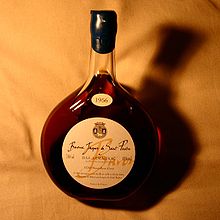
Armagnac ( French Armagnac ) - a strong alcoholic beverage (a subspecies of brandy ), produced through the distillation of white grape wine in the province of Gascony .
| Armagnac | |
|---|---|
| Country of origin | |
Content
History
The geographical location of Armagnac , located between the Mediterranean Sea and the Atlantic Ocean , made it difficult to access the sea coast. That is why, despite its excellent quality, Armagnac is less known today than cognac . Residents of the region, for convenience in transportation, as well as due to demand from Dutch merchants, began to distill their wines. Armagnac's oak forests provided wood producers for heating distillation apparatuses and making barrels.
The history of grape growing in this area goes back thousands of years. To this day, preserved images of mosaics depicting grapes of the Gallo-Roman era .
- Some mosaics of the Gallo-Roman villa Séviac, depicting clusters and leaves of vine
It is believed that Armagnac received the name on behalf of the knight Herreman, who in the X century owned the estate in Gascony. Medieval monks pronounced his name in the Latin manner - Arminius, and in the local dialect it sounded like Armagnac. However, the drink of the same name began to be produced, drunk and sold only in the XIV century, which makes the hypothesis about the origin of the name doubtful. The very first mention of Armagnac dates back to 1348 - one hundred years before the appearance of whiskey and one hundred and fifty before the appearance of cognac . However, for several centuries, Armagnac was simply called alcohol obtained from grapes grown in the south-west of Gascony. About multi-stage technology, brought to perfection in our days, then there was no question.
In 1461, Armagnac is already freely and widely sold, a fixed price is set on it, like any other product. In the middle of the 16th century, Armagnac was shipped to Germany and Holland.
A turning point in the fate of the drink happened in the 17th century, when due to fierce competition in the gas market in Gascony, it began to be processed into alcohol in large volumes, which allowed it to enter the less competitive market for spirits.
By the 30s of the 18th century, alcohols were actively sold, however, their quality was not stable and depended on the grape harvest harvested in more or less favorable weather conditions. In order to solve this problem, winemakers began to create stocks of spirits, which were stored in oak barrels, made since Gallic times. The new drink combined wonderful color, roundness of taste, rich aromas - all that could enrich itself in the aging process. That is how modern Armagnac was born.
Armagnac production was improved over the years, until by 1890 it, like all French viticulture, had not suffered a terrible blow - the phylloxera epidemic. Most of the vineyards in Armagnac were destroyed, the production of the drink fell sharply, many plants were closed. The production of the drink was reviving slowly, Armagnac was not of high quality and sold poorly.
At the beginning of the 20th century, the production of Armagnac, like cognac, was taken under state control.
A decree of the Government of France of May 25, 1909 restricted the territory of Armagnac production to the region of the same name, distinguishing three zones in it: Lower Armagnac (Bas-Armagnac), Tenareze (Tenareze) and Upper Armagnac (Haut-Armagnac). By the beginning of the First World War, the production of Armagnac was experiencing a certain rise, although the consequences of phylloxera were still making themselves felt.
The decree of August 6, 1936 already stipulates the features of technology for the production of Armagnac. After this decree, in order to be called Armagnac, a drink must be made in the locality of the same name from white grapes of traditional varieties grown on these lands in one of two ways permitted by law.
In 1941, the Armagnac State Bureau of Control over Wines and Distillates was created.
Production Zones
The Armagnac region includes the department of Gers, a portion of the Landes, and several cantons of Lot-et-Garonne.
In 1909, three zones were allocated for the production of Armagnac: Bas-Armagnac ( Eng. Bas-Armagnac ) - 57% of the total Armagnac; Armagnac-Tenarez ( English Armagnac-Ténarèze ); O-Armagnac ( English Haut-Armagnac )
Grape Varieties
Armagnac is made from grape varieties: Uni Blanc , Fol Blanche ( Pickpool ), Colombard , Bako Blanc (22A-Bako)
Uni Blanc
Uni Blanc (fr. Ugni Blanc ), or Trebiano (it. Trebiano ) - Italian grape variety from Tuscany . The grape variety became famous as far back as 1302, after its description by the botanist Pierre Crechentsi . In France, this grape appeared at about the same time - during the Avignon capture of popes (1309–1377), after which it began to be cultivated everywhere on its territory. This variety is used not only for the production of Armagnacs, but also for the production of table wines, brandy, cognac and balsamic vinegar. The variety is very resistant to fungus, which leads to its widest distribution. 75% of the produced Armagnac uses the spirits of this grape variety.
Fole Blanche
Folle Blanche (French Folle Blanche ), or Pickpool - the main grape variety for brandy production in the French provinces before the widespread variety of Bako Noir. It is to this grape variety that cognac owes its origin. Today, this grape variety in cognac production is replaced by Uni Blanc. Folle Blanche is believed to produce more aromatic and milder alcohols than Uni Blanc. For example, the well-known cognac houses Tesseron and Leopold Gourmel use the alcohol Blanche as the basis. Nevertheless, the share of this grape in cognac production is small. A little more is used for the production of Armagnac, but here its share does not exceed 1%. Until about 1890, this grape variety was the leader in the creation of Armagnac spirits, but the phylloxera epidemic made it preferable to varieties of Bako Blanc.
In addition to the production of alcohols for Armagnac and cognac, the Folle Blanche grape variety is widely used in the Loire Valley to produce the very dry Gros Plant du Pays Nantais wine.
A big disadvantage of this variety is its high susceptibility to gray and black rot.
Today, this variety, although supplanted by easier-to-grow grape varieties, has not ceased to be valued by winegrowers and is considered by them the treasure of France.
Colombar
Colombard (French Colombard ) is a white variety of late-ripening grapes. Homeland grape France. This grape variety is resistant to mildew and rotting berries, sensitive to autumn frosts. Colombard is also cultivated in Bordeaux. In addition to using Armagnac in the production, this grape variety is often used in the manufacture of Borderian cognacs, which gives them a magnificent bouquet.
Bako Blanc
Bako Blanc (French: Baco blanc ) or 22A-Bako is a white grape variety bred by Maurice Bako in 1898 and named after him. Bako Blanc is a medium-ripening grape. Its clusters are medium-sized, rounded, loose. The berries are medium, round, white, with full ripening amber. Mucous flesh with labrus scent. The buds bloom quite early, the grapes are high-yielding. Bako Blanc is grown mainly in the western part of France.
When producing grapes of this variety, Maurice crossed European varieties of Folle Blanche grapes and the only American hybrid Noah allowed for growing in France. His goal was to preserve the best of the Folle Blanche and at the same time to get rid of such a strong susceptibility to mold diseases that it was very important for France in the 19th century, when the massive disease of the phylloxera grapes destroyed more than half of the follies of the Blanche. Unlike cognac producers from the province of the same name, who at that time preferred to use the Uni Blanc grape variety ( Trebbiano in Italy), the Gasconi winemakers used a new hybrid of white grapes, Bako Blanc, to produce Armagnac. Similar preferences also persisted throughout the 20th century, and by the middle of the 20th century, this grape variety was already growing in 85% of all vineyards in the region.
Uni Blanc bunch.
Uni blanc leaves
Colombard is a bunch.
Colombar leaves.
Folle Blanche bunch.
Folle Blanche leaves.
Production
At present, wine distillation can be carried out in two types of apparatus: in the Charente alambike , which is also used in the production of cognac , and the Armagnac alambike , specially created for the production of Armagnac. In the Armagnac Alambique, the wine heats up, flowing through a system of round disks stacked on top of a heater. For heating only firewood from natural oak is used. At the same time, wine is also a condenser. The result is alcohol with a strength of 52 to 72%, rich in aromas, with a refined taste. Immediately after distillation, Armagnac is placed in oak barrels with a capacity of 400 liters. Aging takes place sequentially in several oak barrels from new to old so that Armagnac does not contain too many tannins . Aging in new barrels is from 6 months to a year. In old barrels, alcohols slowly develop, evaporating through a tree and losing strength and part of the volume, but at the same time acquiring a beautiful mahogany color. The taste is made round, velvety, acquires the subtlety characteristic of Armagnac. Old barrels are barrels that have served for more than ten years. Upon reaching the required exposure, the winemaker assembles Armagnac spirits of various ages and origins. This kind of mixing allows you to get a higher quality product. The final strength of Armagnac (at least 40 °) is achieved by adding to the Armagnac alcoholized water - small portions of the mixture, consisting of Armagnac and distilled water.
Armagnac Alambic 1804
Armagnac Alambic "Sier" of 1936
Cognac Alambik
Armagnac classification and flavor characteristics
The classification of Armagnacs is reduced to a geographical sign and a symbol for the aging period. Unlike other strong drinks, the aging time is indicated only if the drink is obtained by mixing various alcohols. You can find out everything about the origin of the drink from the label on the bottle. When the word “Armagnac” is indicated on it, it is correct to conclude that the drink is created from alcohols obtained in all three appellations . Such Armagnacs are very high quality and predictable, since the master blender hides the flaws of the source material. But with this procedure, the unique taste of each individual eau-de-vie may also be lost.
If Armagnac consists of the alcohols of one appellason, then its name is indicated on the label. The difference between appellation in taste:
- Le Bas-Armagnac - has a light fruity bouquet and a very delicate taste. This Armagnac is good on average and in adulthood.
- L'Armagnac-Tenareze - has a rich bouquet and full-bodied taste. However, the drink acquires these properties most often with very long exposure times.
- Le Haute-Armagnac - has a lively character and can be drunk young, but, unfortunately, the production volume of these Armagnacs is small, and therefore they are of some rarity on the market.
In 1999, the Armagnac National Interprofessional Bureau (BNIA) changed Armagnac's classification by age. Until 1999, the system largely coincided with other systems accepted for grape brandy, where the label indicates:
- Three stars - when creating this Armagnac, eau-de-vie was used, the youngest of which is at least 2 years old.
- VSOP - when creating this drink, the age of the youngest eau-de-vie is at least 5 years.
- Napoleon or XO - at least 5 years - in the blend of the drink there are no alcohols younger than 6 years old.
- Hors d'Age - the age of the youngest spirits in the blend is at least 10 years old.
Since 1999, Armagnac's classification has been changed and now the following labels can be found on the bottle label:
- Vieil armagnac - or old Armagnac, is indicated for drinks where "eau-de-vie" is aged in oak barrels for more than 6 years.
- Vintage combined with vintage - refers to drinks where the blend was not used, that is, created from one single eau-de-vie. Moreover, for vintage Armagnac, the alcohol content is not standardized and can fluctuate over a wide range from 40% to 48%.
- Blanche d'armagnac (white Armagnac) - refers to grape spirits that have not been aged.
Tasting
Armagnac is poured either into a cognac glass or into a special glass for Armagnac. The recommended shape of the glass is tulip-shaped. Young Armagnac can be drunk from spherical cognac glasses. For old and vintage Armagnacs, it is better to use special glasses. For the best perception of taste before drinking, the drink should “breathe” a little. It is optimal to drink Armagnac 15-30 minutes after it is poured into a glass. This time is necessary for the formation of vapors containing the most complete range of aromas of the drink.
Before tasting, Armagnac should be slightly warmed up in your hands and after, having brought it to your nose, inhale its aroma. A similar approach allows you to distinguish notes in the aroma of the drink: fruit, wood, flower, vanilla, spices, the smell of smoke. The more saturated the aroma of Armagnac, the more high-quality drink. According to the rules, after the aroma of the drink, you can go on to taste tasting. Armagnac is drunk in small sips, holding it in the mouth in order to better feel the rich taste.
The rules for using Armagnac are less stringent compared to cognac. On an aperitif, it can be drunk with ice, water, soda and juice. Armagnac is an excellent digestif , that is, a drink that completes the meal. Armagnac is very well combined with chocolate and good coffee, which allows you to soften the alcoholic taste of the drink. Armagnac is combined with various fruit and chocolate desserts, which also soften the hard taste of the drink.
Almost without exception, Armagnacs are perfectly combined with cigars , unlike cognac, which is far from always suitable for a cigar. It is for this reason that specialized cigar publications most often publish the results of a cigar tasting with Armagnacs rather than cognacs.
There are a number of dishes that go well with Armagnac. First of all, these are traditional Gascon cuisine: foie gras , sauces , Gascon meat, flambe , as well as the famous Gascon Armagnac desserts. The white Armagnac served with ice goes well with smoked salmon and is also a great drink to drink between dishes.
- Wine glasses
Snifter cognac glass
Armagnac glass
Manufacturers
- Domain d'Esperance (French Domaine d'Espérance ) - written sources confirm the ownership of this estate of the genus of the Counts of Montesquieu from the X century. In Russia, the genus of Montesquieu is well known to most thanks to the works of Alexander Dumas about the musketeers - “ Three Musketeers ” (1844), “ Twenty Years Later ”, “ Viscount de Brazhelon ” - which describe the fate and adventures of their captain d'Artagnan (Duke of Montesquieu d'Artagnan), who came from this branch of a noble family. The Esperance estate is now owned by Count Jean-Louis De Montesquieu, a descendant of d'Artagnan. The Esperance estate produces the finest and most noble varieties of Armagnac, the most appreciated by true gourmets, connoisseurs of this drink. Armagnac and wine labels are decorated by the famous couturier Jean-Charles de Castelbajac , also a nee Gascon.
- Laberdolive (French Laberdolive ) - experts consider it one of the most exquisite Armagnacs. The Laberdoliv family has been producing Armagnac since 1866, it owns the entire production cycle of this product - from vines to bottles. The family owns two distillation apparatuses that distill the entire wine stock of the estate. One of the devices was designed in 1893. The distillation is carried out in a traditional device with obligatory heating only by burning firewood to obtain cognac alcohol with a content of 53%. Alcohol is poured into oak barrels of local wood, after which it is aged in new barrels for about 3 years. Further, the aging process continues for many more years under the influence of tanning substances of wood barrels. The family collection consists of vintage Armagnacs from 1900 to 1989.
- Chateau Ravignan (fr. Chateau Ravignan ) - one of the best Armagnacs in France, has an excellent reputation. Armagnac of this estate received many awards at various competitions. One of his admirers is the ex-president of France - Jacques Chirac . Distillation in the Chateau Ravignan is done not by classic double heating, but continuous, in which only copper alambiks are used, ensuring uniform heating of their entire surface. The resulting alcohols are aged initially only in new barrels. Armagnac in this chateau is sold only after 10 years of aging.
- Armagnac
Ba Armagnac Laberdoliv 1904
Ba Armagnac Domain of Joand 1934
Ba Armagnac Chateau d'Esperance 10 years