Cheshire ( English Cheshire , archaic name - County Chester) - a county in northwestern England. The capital is Chester , although the largest city is Warrington . It borders in the east with the ceremonial counties of Derbyshire and Staffordshire , in the south with the ceremonial counties of Shropshire in the west with Wales , in the north with the ceremonial counties of Merseyside and Greater Manchester .
| Ceremonial county | |||||
| Cheshire | |||||
|---|---|---|---|---|---|
| |||||
| A country |  Great Britain Great Britain | ||||
| Includes | 4 unitary units | ||||
| Adm. Centre | Chester | ||||
| History and Geography | |||||
| Square | 2343 km² | ||||
| The largest city | Warrington | ||||
| Population | |||||
| Population | 1,027,709 people ( 2011 ) | ||||
| Density | 439 people / km² | ||||
| Digital identifiers | |||||
| ISO 3166-2 Code | GB-CHS | ||||
| Official site | |||||
 | |||||
 | |||||
![Flag [d]](http://upload.wikimedia.org/wikipedia/commons/thumb/9/93/Cheshire_Flag.svg/160px-Cheshire_Flag.svg.png)
The ceremonial area of Cheshire is 2344 square kilometers, the population is 1028.6 thousand. For the most part, the county is “rural” - many small towns and villages support the agricultural industry. It produces the famous Cheshire cheese , salt, chemicals, and silk fabrics.
Content
History
The Kornovia , who from the Iron Age inhabited the area, which later became the county of Cheshire, was one of several Celtic tribes who succumbed to the Roman conquest of Britain and joined the conquerors. In the 60th year. e. in order to protect silver and lead deposits in the Welsh county of Flintshire , adjacent to Cheshire, the Roman fort Deva (now Chester ) was founded. Virgo was the largest Roman fortified settlement in Britain.
In the year 71 e., after several battles against the brigant tribe, the Romans began a full-scale occupation of the future of Cheshire. Then Chester became the most important defensive fortification, opposing the invasions of local tribes, and turned into a large military and commercial center. Due to the proximity of salt deposits to them, the importance of the cities of Condate ( Northwich ) and Saling ( Middlewich ), which were the largest settlements in Cheshire after Chester, also increased.
Then a road network was built - the so-called “salt roads”, along which salt was transported. By 80 AD e. Cheshire was very romanized, and it was quite calm. Lead was smelted in Runcorn , and pottery was made in Wilderspool , but the indigenous inhabitants of these places were not very interested in industry - the British preferred to engage in agriculture, and therefore the county retained its "rural" appearance.
In the 5th century AD e. the Romans left Britain, and Cheshire was invaded by the Anglo-Saxons. “Northern people” settled in the territory of the future county and began to cultivate local fields and clear forests, although until the 7th century Cheshire was controlled by the Britons from Gwynedd and Powys, before their defeat at Chester. By the middle of the 7th century, Christianity spread throughout the future county, and then the first churches were erected - one of the oldest was built in the city of Eccleston near Chester.
In the VI century AD e. the English tribes founded the kingdom of Mercia , which included the territory of Cheshire. In a certain way, Cheshire served as the border between the Vikings in the north and east and the Welsh in the west - at least two ramparts were poured to protect against them - the famous Offa rampart , dug by Offa of Mercia in the 760-770s, and earlier, as well as less the famous, Huat rampart , built before 655.
In addition to raids from Wales, in the VIII century the region suffered from constant attacks by the Vikings . They invaded from already conquered Ireland. It was only during the reign of Alfred the Great , King of Wessex and Mercia, that the Vikings managed to sign a peace treaty in exchange for giving them the city of Virral .
After the conclusion of peace with the Vikings in western Cheshire, there was still a threat from the east - from the Danish kingdom of York ( Jorvik ). Many new fortifications were built and old ones repaired - along the Mersey River and all the way to Manchester . By 930, peace reigned in Mercia, and, apart from minor infrequent raids and attacks in 980, the Viking threat came to naught.
Towards the end of the 10th century, Chester became the permanent residence of Eadric Streon , the royal governor of Cheshire, Staffordshire and Shropshire, and was in fact governed as autonomy. In 1030, the grandson of Leofrick of Mercia , a representative of one of the most powerful families in England, became the governor of the county. he ruled Cheshire until 1066, that is, before the Norman Conquest .
In 1066, William the Conqueror conquered most of England, but the distant northern lands - including Cheshire - continued to fight stubbornly against the invaders. Wilhelm responded to their struggle with his “ruin of the north”, in comparison with which all the early Viking raids faded: by his order the army razed entire villages, burnt crops, killed livestock and destroyed tools. As a result, people were left homeless and without supplies before the impending winter, in some places even cases of cannibalism were recorded. In 1069, William's troops thwarted their last attempt at resistance, and draconian measures were taken against the rebels to impress the Saxons and convince them of the futility of further confrontation. After that, the land was taken from Count Edwin of Mercius and several other large landowners and distributed among several Norman barons.
As a result, the once prosperous territories turned into one of the poorest regions of England, and in the Doomsday Book (census conducted by William in 1086) the territory of Cheshire was recorded as a wasteland. The cities of Mucklesfield and Chester were especially hard hit - the latter was besieged and captured in 1070, after which William's troops almost demolished the city and ruined it. For many years the county was plunged into a state of extreme poverty and hunger.
William the Conqueror built a castle in Chester overlooking the River Dee , and fortified his defense with ten new watchtowers, and also repaired the city wall, so that Chester became one of Britain's most protected settlements of that time. The king also gave the title of Count of Chester to one of his closest barons - Hugh d'Avranche , who received the nickname "Wolf". After that, Cheshire received the status of a palatinate (valid today), and it was completely ruled by the Norman counts - in fact, the county was autonomous. However, in 1273, the last count of Cheshire died without leaving a male heir. King Henry III declared that female inheritance was illegal, and gave this title to his son, Prince Edward. Since then, this title was received by all the eldest sons of the English monarchs, and in the XIII century an extension to the castle was built in Chester, in which the apartments of the king and queen were placed, emphasizing the importance of the city. At the same time, castles were actively built along the western border to protect against Welsh raids, and they were also erected in the central lands of the county, as the locals hated the Norman invaders and these strongholds helped maintain calm in the region.
It took two centuries to overcome the ethnic and cultural differences between the Saxons and the Normans, which led to the emergence of English culture proper. Two or three centuries after the Norman conquest, the changes in trade and commerce caused by the adoption of the Magna Carta (1215) became especially apparent. The growth of trading cities took place, fairs began to be held more often, and the wounds inflicted by the "ruin of the north" began to heal.
By the beginning of the XVII century, the traditional differences between the Saxons and the Normans were forgotten, at the same time the Cheshire nobility was formed, which mainly had Norman roots and owned almost all the land in the county. To know dominated in trade and had more weight in legal and public matters. But the English revolution of 1642 changed the order of things - society was divided into royalists and supporters of Parliament, regardless of social status. Terrible battles were fought in the county. About two-thirds of the Cheshire nobility remained loyal to the monarch, and Chester was a stronghold of the royalists, while the merchants of Stockport , Knutsford , Nantwich , Middlewich and Northwich supported Parliament.
In 1645, the military ruled England, the governor of Cheshire, Lancashire and North Staffordshire was Charles Worsley . He ruthlessly cracked down on the royalists, and his name instilled fear in the northeast of England. Even supporters of the Parliament planned to raise a revolt against the governor’s regime, but suppressed the uprisings, and the ringleaders were executed.
At the end of the 18th century, the reorganization of districts and the change in the boundaries of many land holdings took place on the territory of Cheshire. Industrialization in Lancashire and Manchester attracted peasants, they left their farms in search of a better life, and larger estates consumed the abandoned land, so that in the end, 98% of the Czech land was owned by 26% of its inhabitants. The beginning of the heyday of suburban residences dates back to this time - in Cheshire there are more such estates built in the 18th and 19th centuries than in any other English county. At the same time, Cheshire cheese became popular, 10,000 tons of which were sent annually via the channel between the Trent and Mercy rivers to London alone. In the XIX century, Cheshire was a very rich county.
In 1974, the borders of Cheshire underwent significant changes, both external and internal. Stockport, Hyde, Dewkinfield and Stalibridge became part of Greater Manchester, the Virral Peninsula went to Merseyside, and Disley to Derbyshire. Many small districts within the county were merged, and in 1998 the Halton and Warrington districts received the status of unitary units and since then are part of Cheshire only for ceremonial purposes.
Today's Cheshire has two completely different sides - industrial and rural. In cities such as Northwich, Middlewich, Runcorn, industry is well developed - salt production, chemicals, but most of the county is of the "rural" type, it produces milk, Cheshire cheese and potatoes. Rural Cheshire is a very popular place to live. It is estimated that there are far more millionaires in Cheshire than in any other English county.
Cheshire's economy is highly diverse, including automobile manufacturing, biotechnology, financial services and tourism.
The chemical industry of Cheshire was founded by the Romans, who developed salt production in Middlewich and Northwich. Salt is also mined today, this has led to the emergence of the chemical industry in the Northwich area, although there are more such plants in Runcorn . Shell is an oil refinery located in Ellesmere Port , operating since 1942; Jaguar and Vauxhall Motors are also located in this city. The city of Crew was once the center of the British railway industry, and remains an important railway junction, also in the city is the headquarters of Bentley Motors . In addition, the county is home to the production of BAE Systems , a British military and aerospace company that designed and assembled Avro Lancaster and Avro Vulcan bombers, as well as Hawker Siddeley Nimrod marine electronic reconnaissance aircraft , and the Broughton Aviation Plant, located on the border with Welsh County Flintshire . Airbus owned.
The tourism industry in Cheshire also continues to gain weight, and the county is popular among both the British and foreigners.
Cheshire schools - as in the unitary districts Halton and Warrington - are general education, among them - 15 private and 43 state. In addition, there are several elite grammar schools in the county - including some ancient ones like King's School in Chester and Stockport Grammar School. There are two universities in the county - Chester University and the campus of the University of Manchester Metropolitan (Manchester Metropolitan University).
The two main railway lines of Cheshire run from north to south and from south-west to north-east, and the largest station is the city of Crewe. On the border between Greater Manchester and Cheshire, Manchester Airport is located - the largest in England, excluding London. The length of Cheshire's roads is about 5,500 kilometers, 344 of which are on major highways - M6, M62, M53 and M56. The industrial heritage is quite actively used in the county - a network of canals, the so-called “ Cheshire Ring ”, which used to transport chemicals, and now it mainly serves tourists, fishermen and hikers.
In Cheshire, like in any other English county, there are many football clubs, for example - Chester City (Chester City), Crewe Alexandra (Crewe Alexandra), Macclesfield Town (Macclesfield Town). Despite the fact that not one of them plays in the Premier League, “Mcclesfield Town” managed to go down in history - his player Chris Priest scored the last goal of the last millennium. The county also has sports such as England’s traditional cricket, golf, rugby and hockey, but these teams are only known within the county.
The famous English writer Lewis Carroll was born and raised in the Cheshire village of Darsbury, who named one of his most curious characters - Cheshire Cat - in honor of his native county. However, in reality such a breed does not exist; the writer probably came up with the name Kota when he saw the British Shorthair cat on the cheshire cheese label.
Administrative Division
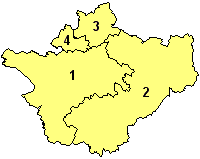
Since April 1, 2009, the ceremonial county of Cheshire has been divided into 4 unitary units :
|
See also
- List of Cheshire Sites of Special Scientific Importance
- Cheshire eyepiece
- Cheshire Cat
- Cheshire English
Literature
- Cheshire // Brockhaus and Efron Encyclopedic Dictionary : in 86 volumes (82 volumes and 4 additional). - SPb. , 1890-1907.
- Cheshire - article from the Great Soviet Encyclopedia . .
Links
- Cheshire Council
- Cheshire Wildlife Trust
- Lion Salt Works Museum
- Cheshire Canals
- Cheshire on Adelanta-info website
- 2011 England and Wales Census
- Cheshire in the Open Directory Project (dmoz) link directory