Type King George V ( eng. King George V ) - a series of British battleships , the further development of battleships of the Orion type . The King George V type was designed as part of the 1910 shipbuilding program. The average cost of one battleship of this type was 1,945,200 pounds . In total, four ships were built in the framework of the program in 1911 - 1913 . All ships of this type were actively used during the First World War . One battleship - the Odeshies - died at the beginning of the war, on October 27, 1914, being blown up by a mine near the island of Tori . The post-war service of the three remaining ships of the type turned out to be relatively short-lived: in accordance with the Washington Sea Treaty of 1922, the battleships were withdrawn from service in 1923-1926.
| Type "King George V" | |
|---|---|
| King george v-class battleship | |
 HMS Audacious 1912 - 1914 | |
| Project | |
| A country |
|
| Preceding type | Orion |
| Subsequent type | Iron Duke |
| Scheduled | four |
| Built | four |
| In the ranks | withdrawn from service |
| Scrapped | 2 |
| Losses | one |
| Main characteristics | |
| Displacement | 23,000 English tons normal [1] 27 120 t full |
| Length | 179.7 m (on design waterline ) 182.2 m (largest) |
| Width | 27.1 m |
| Draft | 8.15 m (bow) 8.48 m (aft) [2] |
| Reservation | main belt: 229-305 mm top belt: 203 mm traverses: 51—254 mm deck: 25-102 mm turret GK: 76-279 mm GK tower barbets: 76—254 mm conning tower: 76 - 279 mm |
| Engines | Parsons turbines, 18 water - tube boilers of the Babcock and Wilcox type (on King George and Ajax), the same number of Yarrow boilers on other ships |
| Power | 31 000 liters from. |
| Mover | 4 screws |
| Speed | 21.7 knots (full) [3] 22.134 knots maximum (for the lead ship) |
| Sailing range | 3805 miles on 21 knots 6310 miles at 10 knots [4] |
| Crew | 862 people (in time of war up to 1050) |
| Armament | |
| Artillery | 5 × 2 343 mm / 45 Mk.V 16 × 102 mm / 50 BL Mk.VII |
| Flak | 4 × 47 mm salute guns 5 7.71 mm Vickers machine guns , 10 machine guns "Lewis" 7.71 mm |
| Mine torpedo armament | 3 (2 airborne and 1 aft) underwater 533 mm TA (14 torpedoes) |

Content
- 1 Design
- 1.1 Case
- 1.1.1 seaworthiness
- 1.2 Booking
- 1.3 Armament
- 1.4 Powerplant
- 1.4.1 Main power plant
- 1.4.2 Cruising range
- 1.4.3 Power Supply
- 1.1 Case
- 2 Representatives
- 2.1 Construction
- 2.2 King George V
- 2.3 Ajax
- 2.4 Odessa
- 2.5 Centurion
- 3 Project Evaluation
- 4 Comments
- 5 notes
- 6 Literature
Design
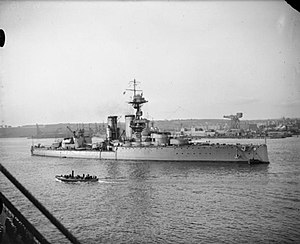
Ships of this type were a further development of battleships of the "Orion" type. In the new project, they tried to eliminate the shortcomings that were inherent in Orion-type ships: weak mine protection and insufficient stability [5] ; however, the improvements were minor.
The main differences between the ships of the type "King George V":
- Normal displacement increased by 500 long tons. Length and width increased by 4.1 m and 0.15 m, respectively.
- Mine artillery was deployed taking into account intensification of fire on the nose [6] , 12 of 16 guns could fire in the bow directional angles , the bow guns were in single casemates reserved by 76-mm plates.
- The protection of the vital parts of the ship (control posts, ammunition cellars and machine-boiler plant) is somewhat enhanced.
- The maximum design speed was increased by 0.7 knots [3] [5] (almost by a knot) [6] .
- The bridge design has been changed and improved.
- Changes in the mast were limited to replacing the heavy tripod mast, behind the nasal chimney, with a light hollow, mounted in front of the nasal pipe. Placing the focus mast in front of the chimney reduced the effect of smoke on the firing control post [5] .
The crew placement returned to the traditional in the British Navy - the officer’s cabins were in the stern, the cockpits of sailors and foremen were in the bow [7] .
Corps
The normal displacement was 25,420 tons, the total displacement was 27,120 tons. The length between the perpendiculars was 169.3 m, the largest was 182.2 m. The width of the hull was 27.15 m, the draft with normal displacement by the nose was 7.8 m [4] .
The actual metacentric height at normal displacement was 1.39 m, in full load 1.57 m [8] .
King George V was equipped with three rodless Admiralty anchors (two main, one spare) weighing 7.11 tons, and one aft anchor weighing 2.13 tons. The choice of a chain of bow anchors was made by two bow spiers driven by a steam engine [4 ] [9] .
The rescue equipment consisted of two steam half-barges 15 m long, one steam boat 12.8 m long, one sail-rowing 11-meter semi- longboat , three sail-rowing 9.8-meter boats , three 8.2-meter whaleboats , one A 9-meter boom , one 5-meter skiffing ( tusik ) and one standard folding balsa raft [4] [7] .
Seaworthiness
Ships had good seaworthiness and driving performance. In the middle part of the ship's hull was straightened - such contours softened side rolling. Along the sides were zygomatic keels , having a triangle shape in cross section . Zygomatic keels not only reduced the amplitude of the side rolling , but also damped the vibrations caused by flows from the screws [10] . The disadvantage was the low freeboard in the aft, because of which the feed was flooded with water during excitement [11] .
Booking
The main armor belt consisted of two parts - 305 mm lower, protecting the waterline to the level of the middle deck, and 229 mm upper, located in height from the middle deck to the level of the main deck. The upper 203 mm armor belt had the same length as the main armor belt and ranged from the main to the upper deck. The total height of the vertical side booking was 6.26 m [4] .
The main armor belt continued into the bow at the same height (at the level of the main deck) as in the middle of the ship - first from the traverse of the center of the bow barbet of tower “A” 152 mm thick and 15.2 m long, then extended further 102 mm thick and a length of 14.8 m, not reaching 13.7 m in the stern. The main armor belt continued to stern at the level of the main deck from the traverse of the center of the feed barbet with a thickness of 64 mm and a length of 17.8 m, not reaching the stern of 15.2 m The total length of the main armor belt with bow and stern ends was 153.1 m (8 4.1% of the length of the ship along the waterline) [12] .
The main bow and stern armor traverses were located as follows: in the bow of the 254 mm transverse bulkhead covered the tip of the upper (203 mm) armor belt from the main to the upper deck and the tip of the upper (229 mm) part of the main armor belt from the middle to the main deck and was located obliquely inward from the extremities of the 203 mm and 229 mm armor belts to the tower barbet “A”; The 152-mm bow traverse covered the extremities of the main 305-mm armor belt from the lower to the middle deck and was located obliquely inward from the extremities of the main armor belt to the outer surface of the tower barbet “A” [12] .
The frontal and side walls of all the towers of the main caliber had a thickness of 279 mm. The back plate was 203 mm thick. The front of the roof was 102 mm thick and the rear was 76 mm. Armored flooring had a thickness of 76 mm [12] .
The deck of the forecastle is 25.4 mm, the upper deck is 45-38 mm, the middle deck is 25.4, the lower deck is 64-25.4 mm in the bow, 102-76 mm in the aft, chimney casings: 38-25.4 mm , screens of powder cellars 45-38-25.4 mm, screens of the engine room 25.4 mm [13] .
The main serious drawback in the underwater protection of the ship was the lack of an internal longitudinal armored bulkhead, as it was on Neptune , where the longitudinal anti-torpedo bulkheads were continuous between the final barbets. Instead, the shell and powder cellars of the main-caliber towers and the engine room were covered with armored protective shields 25.4-45 mm thick [12] .
Total booking weight: 6960 Eng. tons [com. 1] [14] .
Armament
King George V-class battleships were equipped with ten 13.5-inch main-caliber BL Mark V cannons in five hydraulically powered two-gun turrets. Orion ships of the Orion type carried the same guns. The location of the towers was the same as on the Orion, but the nasal superstructure was cut off at a sharper angle to provide a larger firing sector for the guns of the Q tower [15] . The gun barrels were fastened with a high-strength calibrated steel wire , which was wound in several layers on the inner tube. The guns had a descent angle of 3 ° and an elevation angle of 20 °, however, the initial design of the range finders controlling the towers limited the rise to 15.35 °. The piston lock, Velin system, loading - shotgun [16] . They fired 1400-pound (635 kg) shells with a muzzle velocity of 762.5 m / s, with a lifting angle of 14.75 ° the maximum firing range was 20,000 yards (18 288 m) when firing armor-piercing shells. At an elevation angle of 20 °, the maximum range increased to 23,820 yards (21,781 m). At a range of 10,000 yards (9144 m), armor penetration was 310 mm on a vertical plate of cemented Krupp steel . The rate of fire of these guns was 1.5-2 rounds per minute [16] . The ammunition consisted of 1000 shells (armor-piercing, half-armor-piercing, high-explosive) for 343-mm guns (100 shells per barrel [4] ). In wartime, the number of shells increased: in the cellars of Odesjesha (October 27, 1914) there were 1120 343 mm shells [17] .
The weight of the rotating part of the towers (without the weight of the guns) "A": 565 dl. tons, "B": 600 dl. tons, "Q": 592 dl. tons, "X": 596 dl. tons, "U": 592 dl. tons The total weight of the towers of the main caliber with 343 mm guns: 3770 dl. tons [14] .
Mine artillery consisted of 16 102 mm Mk guns. VII with a barrel length of 50 calibers (5100 mm). They fired shells weighing 14.1 kg with an initial speed of 873 m / s at a range of up to 58 cable with a rate of fire up to 8 rounds per minute. The total ammunition of 102 mm guns was 2400 rounds or 150 rounds per barrel [18] .
Compared to Orion, on King George V, the placement of the 102-mm guns was somewhat different - most of the guns, 12 of 16 (each side 6 of 8) were grouped in the nose, which was explained by the desire to provide the most dense barrage with nasal course angles , from where the most likely were the attack of the destroyers . For the four guns moved from the stern, they arranged a short tank battery (just under the gun turrets “A” and “B”), two guns each outboard. The guns were covered from fragments with 76 mm armor shields [18] .
All ships had four 47-mm Hotchkiss salute guns with an ammunition load of 64 rounds [19] .
At the end of 1914, two 76-mm anti-aircraft guns of Hotchkiss with ammunition of 350 shots per barrel were installed on the King George V (and on Ajax) in the rear. During the war, the ships were rearmed, replacing the Hotchkiss guns with the 76-mm anti-aircraft guns Mk.1 with ammunition of 150 rounds per barrel [19] .
On the battleship Centurion in the aft part, two 102-mm Mk quick-firing guns were originally installed. VII with an elevation angle of the barrel + 60 °, converted to anti-mine from anti-mine with giving the barrel a large elevation angle (ammunition was 150 rounds per barrel) [18] .
| Gun | 13.5 "/ 45 Mark V (H) [20] | 4 "/ 50 BL Mark VII [21] | 3 "/ 45 20cwt QF HA Mark I [22] | 47 mm Hotchkiss [23] [com. 2] | ||
|---|---|---|---|---|---|---|
| Year of development | 1909 | 1904 | 1910 | 1885 | ||
| Caliber mm | 343 | 102 | 76 | 47 | ||
| Barrel length, calibres | 45 | fifty | 45 | 40 | ||
| Gun mass, kg | 76 102 | 2126 | 1020 | 240 | ||
| Rate of fire, in / min | 1,5-2 | 6-8 | 12-14 | twenty | ||
| Installation | B mark ii | PIV | HA Mark II | ? | ? | |
| Declination angles | −3 ° / + 20 ° | −10 ° / + 15 ° | −10 ° / + 60 ° | −10 ° / + 90 ° | / + 60 °? | |
| Shot loading method | cap-shaped | unitary | ||||
| Projectile type | Light armor-piercing Mark iia | Heavy armor-piercing Mark IIIa (Greenboy) | high explosive | shrapnel? | shrapnel | high explosive |
| Projectile weight kg | 574.5 | 639.6 | 14.06 | 14.06 | 5.67 | 1,5 |
| Weight and type of propelling charge | 133 kg MD45 | 4.3 kg MD16 | 2.7 kg MD8 | 0.96 kg MD | 0.24 kg MD | |
| Initial speed, m / s | 787 | 759 | 873 | 732 | 762 | 574 |
| Maximum range, m | 21,780 | 21,710 | 10 610 | |||
| Reach maximum height, m | - | - | - | ? | 11 340 | 3000 |
| Effective, m | - | - | - | ? | 7160 | 1100 |
The torpedo armament consisted of three 533-mm torpedo tubes - two airborne, located in front of the A tower barbet, and one stern (subsequently removed) with a total ammunition of 15 torpedoes. Torpedoes - MK.II and MK.II [24] .
By 1917, it became necessary to have an airplane on each battleship to adjust the shooting. For this, takeoff platforms were installed on the roofs of the towers. Wheel biplanes of the Camel "Camel" [25] were adopted as aviation weapons.
Powerplant
Main power plant
The main power plant included two sets of Parsons turbines with direct transmission to four propeller shafts that rotated four three -blade propellers . Each turbine set consisted of forward and reverse high pressure turbines and forward and reverse low pressure turbines. The turbines for Ajax and Odesais were built by the manufacturers of these ships, the turbines for the Centurion were ordered by Hawthorn Leslie & Company, and the turbines for King George V by Parsons [26] . The turbines were located in three compartments of the engine room, separated by two longitudinal bulkheads. High pressure turbines rotated the outer propeller shafts, low pressure turbines rotated the internal. The length of the engine room was 20.74 m.
The rated power of the power plant was 31,000 liters. from. , which was supposed to provide a speed of 21.7 knots (with a power of 27,000 liters. from. the stroke should be 21 knots) [3] . The screws standing on the outer shafts were 6.67 m away from the screws installed on the inner shafts [27] .
Three boiler rooms had 18 water-tube boilers (six in each section), King George V and Ajax boilers were of the Babcock and Wilcox type, and Centurion and Odesais were of the Yarrow type. There were no boilers operating only on oil on King George V type battleships, so the boilers were heated by coal, and oil was sprayed by nozzles (each boiler was equipped with three nozzles for oil burning) directly to burning coal [27] .
At the time of sea trials, four-bladed propellers were installed on the Ajax (the designers expected to get a gain in speed). In a 30-hour factory test, Ajax showed a maximum speed of 22.47 knots (versus 22.866 Centurion with three-bladed) on a mile in Polperro, with an average speed of 290 rpm of propellers [28] . That is, the course of Ajax with experimental propellers was even lower than the course of other ships of this class equipped with three-bladed propellers. The tests were not satisfied by the Admiralty. After the tests, Ajax installed the design three-blade propellers. External screws had a diameter of 2.7 m, internal screws - 2.9 m [27] .
Cruising Range
Fuel: the normal supply of coal is 900 long tons , the total reserve is 3,100 dl. tons, oil - 840 tons [4] .
The cruising range at full speed is 3805 miles , at a 10-knot course 5910 miles (Ajax and Centurion have 6310 miles) [29] .
Power
Four turbogenerators with a capacity of 200 kW each and two diesel generators with a capacity of 100 kW each supplied the ship with electricity with a constant voltage of 200 V. Generators were placed on the hold deck and through the central switchboard supplied electricity to the ship's devices. The ships also had an emergency diesel generator with a capacity of 100 kW, which was connected in parallel to the emergency electrical panel [7] .
Representatives
Construction
The construction of linear ships of this type was included in the draft state budget of Britain for expenditures for 1910. The average cost of each battleship was £ 1,945,200, that is, about 85 pounds per ton. The project envisaged an increase in displacement by 500 tons compared to its predecessors, Orion ships, but the excess displacement amounted to 800 tons, while the draft increased by 0.09 m. In general, the constructed ships turned out to be well balanced [30] . In June 1914, all King George V type battleships took part in festivities dedicated to completing the expansion of the Kiel Canal [31] .
King George V
" King George V " ( Eng. HMS King George V ) was laid down at a state-owned shipyard in Portsmouth on January 16, 1911. Launched on October 9, 1911. The main power plant was built by Charles Parsons at the Wallsand plant. At the beginning of the 20th century, a tradition developed in Britain, according to which the first large ship, which was laid after the new king was ascended to the presto, is called in his honor [32] . The ship is named after the British monarch (since 1910) George V (1865-1936) from the Windsor dynasty [33] . The godfather is the English king George V himself [33] .
In early October 1912, factory tests began. Along with them, tests were carried out on rolling stock dampers, which ended in failure (tanks later adapted to store oil) [34] . Plymouth Race Mile Race took place on November 4, 1912. На третьем пробеге корабль развил максимальную скорость 22,373 узла при мощности на гребных валах в 33 022 л. from. , средняя частота вращения гребных валов составила 339 об/мин [33] .
14 ноября 1912 года корабль вошёл в состав флота. Его строительство длилось 23 месяца: стапельный период постройки составил 10 месяцев, достройка на плаву — 13 месяцев. Стоимость постройки составила 1 961 096 фунтов стерлингов. Экипаж корабля, согласно штатному расписанию, насчитывал 869 человек в 1913 году, 1114 человек в 1914 году [33] .
С июня 1914 года «Кинг Джордж V» — флагманский корабль. Первый зарубежный визит состоялся на торжества, посвящённые завершению работ по расширению Кильского канала . Единственный английский линкор, на борт которого поднялся кайзер Германии Вильгельм II [34] . Как и все линкоры типов «Орион» и «Кинг Джордж V», корабль входил во 2-ю эскадру линкоров Гранд Флита , будучи флагманским кораблём вице-адмирала Т. Джерома [35] . Продан на металлолом в 1926 году [28] .
Аякс
« Аякс » ( англ. HMS Ajax ) заложен на частной верфи « Скоттс » 27 февраля 1911 года. Главная энергетическая установка была изготовлена фирмой-строителем корабля. Назван в честь Аякса Теламонида , греческого героя Троянской войны , отличавшегося безумной храбростью и считавшегося самым могущественным героем греков после Ахилла [28] .
Спущен на воду 21 марта 1912 года. Заводские испытания — с апреля 1913 года. Пробеги на мерной миле в Полперро проходили 12-13 мая 1913 года. Совершил серию из четырёх пробегов (с трёхлопастными винтами). На третьем пробеге развил общую мощность турбин на гребных валах 29 250 л. с., при средней частоте вращения гребных винтов 337,5 об/мин добился максимальной скорости 21,225 узла [28] .
Вошёл в состав флота в августе 1913 года. Стапельный период постройки корабля составил 13 месяцев, достройка на плаву заняла 17 месяцев. Всего строительство «Аякса» продолжалось 30 месяцев, стоимость постройки составила 1 889 387 £. Экипаж корабля, согласно штатному расписанию, в 1914 году насчитывал 869 человек [28] .
Одейшес
« Одейшес » ( англ. HMS Audacious ) заложен на частной верфи « Кэммел Лэрд » 3 марта 1911 года. Главная энергетическая установка изготовлена фирмой-строителем корабля. Спущен на воду 14 сентября 1912 года. На момент спуска имел водоизмещение 9095 тонн, осадку в носу — 2,74 м, в корме — 4,99 м, длину между перпендикулярами — 169,18 м, ширина без обшивки 27,08 м. Государственные испытания прошли в июле 1913 года [36] .
Вошёл в состав флота в августе 1913 года [31] . Стапельный период постройки составил 18 месяцев, достройка на плаву заняла 11 месяцев. Экипаж, согласно штатному расписанию, в 1914 году насчитывал 860 человек. С октября 1913 года по август 1914 года входил в состав 2-й эскадры линейных кораблей Флота Метрополии. В августе 1914 года вошёл в состав объединённого Гранд Флита [37] .
27 октября 1914 года «Одейшес», следовавший на учебные стрельбы, в 08:05 наскочил на мину , установленную германским вспомогательным минным заградителем «Берлин». В 21:00 «Одейшес» перевернулся, взорвался и затонул. Осколком был убит petty officer (старшина) на крейсере «Ливерпуль», находившемся на расстоянии более 700 метров от места взрыва. Погибший моряк — единственная жертва гибели «Одейшеса» [38] .
Центурион
" Centurion " ( Eng. HMS Centurion ) was laid down at a state-owned shipyard in Devonport on January 16, 1911. Launched on November 18, 1911. During factory tests on December 9, 1912 he collided with the Italian steamer Derna and sunk it. It was repaired until March 1913. It entered service as part of the 2nd Squadron of battleships of the Navy of the Metropolis, where it served from May 12, 1913 until August 1914. Was in the 2nd squadron of battleships Grand Fleet from 1914 to 1919. Participated in the Battle of Jutland [39] .
From 1919 to 1924 he was part of the 4th squadron of battleships of the Mediterranean fleet, participated in the Black Sea operations. From 1924 to April 1926 he was in reserve at Portsmouth . Appointed in April 1926 for re-equipment instead of the battleship Agamemnon as a radio-controlled target. He was at the state shipyard in Chatham from April 14, 1926 to July 1927 for repair and conversion into a radio-controlled target [38] .
At the beginning of World War II it was used as a repair base and blockchain [38] . Then it was converted into an imitation of the new battleship Anson ( English Anson ) and as such made the 20,000-mile transition to Bombay . He remained in Bombay (under his own name) until 1942, then moved to Alexandria, arriving there in June 1942. Four 76 mm anti-aircraft guns and seventeen 20 mm Oerlikon automatic cannons were installed on the ship there [36] .
As an escort ship, on June 12–16, 1942 he took part in the failed operation Vigeres (out of 11 convoy transports, 2 were sunk, none arrived in Malta). At the beginning of the route, the British fighters managed to repel several air raids and weaken the others, but soon the convoy left the range of the Hurricanes and Kittyhocks . The attempt to break into Malta was canceled after it became known that escort ships had practically consumed anti-aircraft ammunition. Admiral Wayne ordered his ships to return to Alexandria. [40]
Until March 1944, it served as a floating anti-aircraft battery south of the Suez Canal . In April 1944 he left Alexandria and returned to Portsmouth (England) . June 6, 1944 flooded off the Norman coast as a breakwater in the Mulberry Bay [36] .
Project Evaluation
The battleships of the King George V type repeated the previous Orion type almost without changes. On the whole, the ships were well balanced, had a beautiful appearance [41] , but the battleships of other fleets were already armed with anti-mine artillery of at least 120 mm caliber, which required an increase in the displacement of destroyers , as well as an increase in the range of their torpedoes. The King George V 102-mm guns were considered too weak to deal with new, larger destroyers, the size of which grew with the increase in the size of the dreadnought [3] . Disadvantages inherent to Orion type ships (weak anti-mine defense, weak anti-mine artillery) [5] were not completely eliminated in the new project. These shortcomings were eliminated in the next project - battleships of the Iron Duke type , which received 152 mm mine artillery [42] .
| Wyoming [43] | The Courbet [44] | King George V [45] | Orion [46] | Dante Alighieri [47] | The Kaiser [48] | |
|---|---|---|---|---|---|---|
| Bookmark year | 1909 | 1910 | 1911 | 1909 | 1909 | 1909 |
| Year of commissioning | 1912 | 1913 | 1912 | 1912 | 1913 | 1912 |
| Normal displacement, t | 26,416 | 23,475 | 23,368 | 22 555 | 19,865 | 24,724 |
| Full, t [com. 3] | 27,680 | 25,579 | 26 112 | 26,284 | 21 956 | 27,000 |
| Type ofSU | PT | PT | PT | PT | PT | PT |
| Power, l from. | 28,000 | 28,000 | 31,000 | 27,000 | 35,000 | 28,000 |
| Full speed, knots | 20.5 | 21 | 21.7 | 21 | 23 | 21 |
| Maximum, knots | 21.22 | 20.74-22.6 | 22.1-22.8 | 21.4-22.1 | 22.83 [com. four] | 21.7-23.1 |
| Range, miles (on the go, knots.) | 6680 (10) | 4200 (10) | 4060 (18.15) 6730 (10) [1] | 6730 (10) | 4800 (10) | 3800 (18) 7900 (12) |
| Booking mm | ||||||
| Belt | 279 | 270 | 305 | 305 | 254 | 350 |
| Decks | 35–63 | 85 | 45-102 | 45-102 | 38 | 60-100 |
| Towers | 305 | 290 | 279 | 279 | 254 | 300 |
| Barbets | 254 | 270 | 254 | 254 | 300 | |
| Cutting | 292 | 300 | 279 | 279 | 305 | 350 |
| Armament layout | ||||||
| Armament | 6 × 2 - 305/50 21 × 1 - 127/51 2 TA | 6 × 2 - 305/45 22 × 1 - 138/55 4 TA | 5 × 2 - 343/45 16 × 1 - 102/50 4 × 1 - 47 mm 3 TA | 4 × 3 - 305/46 20 × 1 - 120/50 13 × 1 - 76 3 TA | 5 × 2 - 305/50 14 × 1 - 150/45 8 × 1 - 88 5 TA | |
Comments
- ↑ Tower armor is included in the armament article.
- ↑ Salute Cannon
- ↑ For British and American ships in the sources, displacement is given in long tons , so it is converted to metric tons
- ↑ Power: 32 190 l. from.
Notes
- ↑ 1 2 Conway's, 1906-1921 . - P.30
- ↑ Kozlov, Orion battleships, 2006 , p. 49.
- ↑ 1 2 3 4 Parks . Battleships of the British Empire. Volume 7. - P. 21.
- ↑ 1 2 3 4 5 6 7 Burt . British Battleships WW1. - P. 176
- ↑ 1 2 3 4 Kozlov, Battleships of the Orion type, 2006 , p. 39.
- ↑ 1 2 Burt . British Battleships WW1. - P. 169
- ↑ 1 2 3 Kozlov, Battleships of the Orion type, 2006 , p. 52.
- ↑ Burt . British Battleships WW1. - P. 177
- ↑ Kozlov, Orion battleships, 2006 , p. 48.50.
- ↑ Kozlov, Orion battleships, 2006 , p. fifty.
- ↑ Parks . Battleships of the British Empire. Volume 7. - S. 24.
- ↑ 1 2 3 4 Kozlov, Battleships of the Orion type, 2006 , p. 46.
- ↑ Burt . British Battleships WW1. - P. 178
- ↑ 1 2 Burt . British Battleships WW1. - P. 173
- ↑ Parks . Battleships of the British Empire. Volume 7. - P. 23.
- ↑ 1 2 British 13.5 "/ 45 (34.3 cm) Mark V (L) 13.5" / 45 (34.3 cm) Mark V (H) . NavWeaps.com (May 1, 2009). Date of treatment October 4, 2011. Archived April 19, 2012.
- ↑ Kozlov, Orion battleships, 2006 , p. 43.
- ↑ 1 2 3 Kozlov B.V. Battleships of the Orion type. - S. 44.
- ↑ 1 2 Kozlov, Battleships of the Orion type, 2006 , p. 44.
- ↑ DiGiulian, Tony. British 13.5 "/ 45 (34.3 cm) Mark V (L) 13.5" / 45 (34.3 cm) Mark V (H ) . website navweaps.com . NavWeaps.com (May 1, 2009). - Description of the gun 13.5 "/ 45 BL Mark V (L). Date of treatment October 4, 2011. Archived on April 19, 2012.
- ↑ DiGiulian, Tony. British 4 "/ 50 (10.2 cm) BL Mark VII. (English) . Site navweaps.com . - Description of the gun 4" / 50 BL Mark VII. Date of treatment September 24, 2011. Archived on April 19, 2012.
- ↑ DiGiulian, Tony. British 12-pdr {3 "/ 45 (76.2 cm)} 20cwt QF HA Marks I, II, III and IV . The site navweaps.com . - Description of the gun 3" / 45 20cwt QF HA Mark I. Date of treatment September 24, 2011. Archived on April 19, 2012.
- ↑ DiGiulian, Tony. British Hotchkiss 3-pdr (1.4 kg) {1.85 "/ 40 (47 mm)} QF Marks I and II . Website navweaps.com . - Description of the 3-pdr Hotchkiss implement. Access date September 24, 2011. Archived 19 April 2012
- ↑ Kozlov, Orion battleships, 2006 , p. 45.
- ↑ Parks . Battleships of the British Empire. Volume 7. - S. 9.
- ↑ Burt . British Battleships WW1. - P. 179
- ↑ 1 2 3 Kozlov, Battleships of the Orion type, 2006 , p. 48.
- ↑ 1 2 3 4 5 Kozlov, Battleships of the Orion type, 2006 , p. 57.
- ↑ Kozlov, Orion battleships, 2006 , p. 51.
- ↑ Kozlov, Orion battleships, 2006 , p. 27.
- ↑ 1 2 Burt . British Battleships WW1. - P. 187
- ↑ Coffman, Flagships of the British Navy, 2015 , p. 13.
- ↑ 1 2 3 4 Kozlov, Battleships of the Orion type, 2006 , p. 56.
- ↑ 1 2 Burt . British Battleships WW1. - P. 186
- ↑ Parks . Battleships of the British Empire. Volume 7. - S. 26.
- ↑ 1 2 3 Kozlov, Battleships of the Orion type, 2006 , p. 60.
- ↑ Kozlov, Orion battleships, 2006 , p. 62.
- ↑ 1 2 3 Burt . British Battleships WW1. - P. 188
- ↑ Kozlov, Orion battleships, 2006 , p. 59.
- ↑ Pedestal, 2005 , p. 37.
- ↑ Burt . British Battleships WW1. - P. 170
- ↑ Burt . British Battleships WW1. - P. 189
- ↑ Conway's, 1906-1921 . - P.114
- ↑ Conway's, 1906-1921 . - P.197
- ↑ Parks . Battleships of the British Empire. Volume 7. - P. 20.
- ↑ Conway's, 1906-1921 . - P.28
- ↑ Conway's, 1906-1921 . - P.259
- ↑ Gröner . Band 1. - P.49
Literature
- in Russian
- Kozlov B.V. Linear ships of the Orion type. - Edition 2006. - St. Petersburg. : Eastflot, 2006 .-- 116 p. - ISBN 5-98830-017-0 .
- Parks, Oscar. Battleships of the British Empire. Volume 7. The Age of the Dreadnoughts. - SPb. : Galeia Print, 2008 .-- 116 p. - ISBN 9785817201321 .
- A.A. Mikhailov. Line ships of the Queen Elizabeth type. - SPb. , 2001 .-- 96 s. - (Warships of the world).
- P. C. Smith. Pedestal (Collection "Decisive convoy battles"). - ACT, 2005 .-- 223 p. - ISBN 5-17-038536-6 .
- Kofman V.L. Flagships of the British Navy. King George V battleships. - M .: Yauza, EKSMO, 2015 .-- 160 p. - ISBN 978-5-699-79828-5 .
- in German
- Gröner, Erich. Die deutschen Kriegsschiffe 1815-1945. Band 1: Panzerschiffe, Linienschiffe, Schlachschiffe, Flugzeugträger, Kreuzer, Kanonenboote. - Bernard & Graefe Verlag, 1982. - 180 p. - ISBN 978-3763748006 .
- in English
- Staff, Gary. German Battlecruisers: 1914–1918 . - Oxford: Osprey Books, 2006 .-- 48 p. - ISBN 1846030099 .
- Burt RA British Battleships of World War One. - London: Arms and armor press, 1986.- 344 p. - ISBN 0-85368-771-4 .
- All the World's Battleships: 1906 to the present / I. Sturton. - 1996 edition. - London: Conway Maritime Press, 1987. - 190 p. - ISBN 0-85177-691-4 .
- Conway's All The Worlds Fighting Ships, 1906-1921 / Gray, Randal (ed.). - London: Conway Maritime Press, 1985 .-- 439 p. - ISBN 0-85177-245-5 .