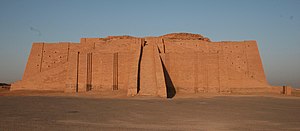
The Great Ziggurat in Ur (ziggurat Etemenniguru [1] ) is the most preserved temple complex of the Ancient Mesopotamia . Built in the XXI century BC. e. (circa 2047 BC) in the city of Ur by the local kings Ur-Nammu and Shulga , like the Ekishnugal sanctuary, in honor of the lunar deity Nunn . Subsequently, it was rebuilt more than once, it was significantly expanded by the New Babylonian king Nabonid .
Content
- 1 History
- 2 Current status
- 3 Notes
- 4 Literature
History
The construction of the ziggurat was carried out by the third dynasty of Ur , which restored local statehood after the invasions of Akkadians and Gutians . Ziggurat was called to serve not only as a temple, but also as a public institution, archive and royal palace. From its top, at a glance, one could contemplate the whole city.
Ziggurat was a 20-meter-tall brick building, which was located on platforms of various widths, with a base of 64 by 46 meters, with three floors. The foundation was made of mud brick, the external walls were lined with stone slabs [1] .
The entire surface of the building was lined with bricks that had previously been treated with bitumen .
Three ascents like ladders (steep-central and two side connected above) led to the first platform, from where the steps led to a brick superstructure, where the main sanctuary-temple of the moon goddess Nunna was placed. The upper platform also served as priests for observing the stars. Inside the walls supporting the platforms, there were many rooms where priests and temple workers lived [1] .
The add-in was not preserved [2] . The first researcher of the structure, Leonard Woolley , believed that in ancient times these stairs were planted with trees, so that the entire structure reminded the inhabitants of the alluvial plain of the sacred mountain [3] .
Ziggurat in Ur served as an honored model for architects of the Ancient Mesopotamia. It is possible that either the ziggurat Etemenniguru himself or the ziggurat built on his model in Babylon served as a prototype of the Tower of Babel described in the Bible [4] .
Current status
In the XX century, the expedition of Leonard Woolley from the British Museum cleared the ziggurat of centuries-old deposits, after which it was partially reconstructed. In the ziggurat’s courtyard, Woolley discovered the remains of the temple’s archive — clay tablets with information about trade deals in which the priests acted as representatives of the lunar deity.
In 1979-1980, during the reign of Saddam Hussein , with the approval of the Iraqi Directorate of Antiquities, the facades of the building were recreated to the first level and a monumental staircase. According to archaeologists: “It was the right decision, otherwise, after excavation, it would have crumbled!” [5] At present, 2 km south-west of the ziggurat lies the American Ali air base. Near the ziggurat are the ruins of the temple of Nebuchadnezzar II . The city nearest to the monument is Nasiria .
Notes
- ↑ 1 2 3 Bayer B., Birstein U. et al. The history of mankind. 2002. ISBN 5-17-012785-5 .
- ↑ Gardner's Art Through the Ages . P. 41-42. ISBN 0-495-41058-6 .
- ↑ International Dictionary of Historic Places . Taylor & Francis, 1996. P. 718-719.
- ↑ William W. Hallo. Origins: The Ancient Near Eastern Background of Some Modern Western Institutions . Brill Academic Publishers, 1996. P. 279.
- ↑ Zamarovsky V. Concerning the buv Schumer. - Kyiv, 1983 .-- 207 p.
Literature
- Woolley L. Ur Chaldeans. - M .: Publishing house of oriental literature, 1961. - 254 p. - (In the wake of the disappeared cultures of the East). - 25,000 copies.
- Mitchell TC Biblical Archeology: Documents from the British Museum. Cambridge University Press, 1988. P. 25.
- Leick G. A Dictionary of Ancient Near Eastern Architecture. ISBN 0-415-00240-0 . P. 230.